



Relevant for Exams
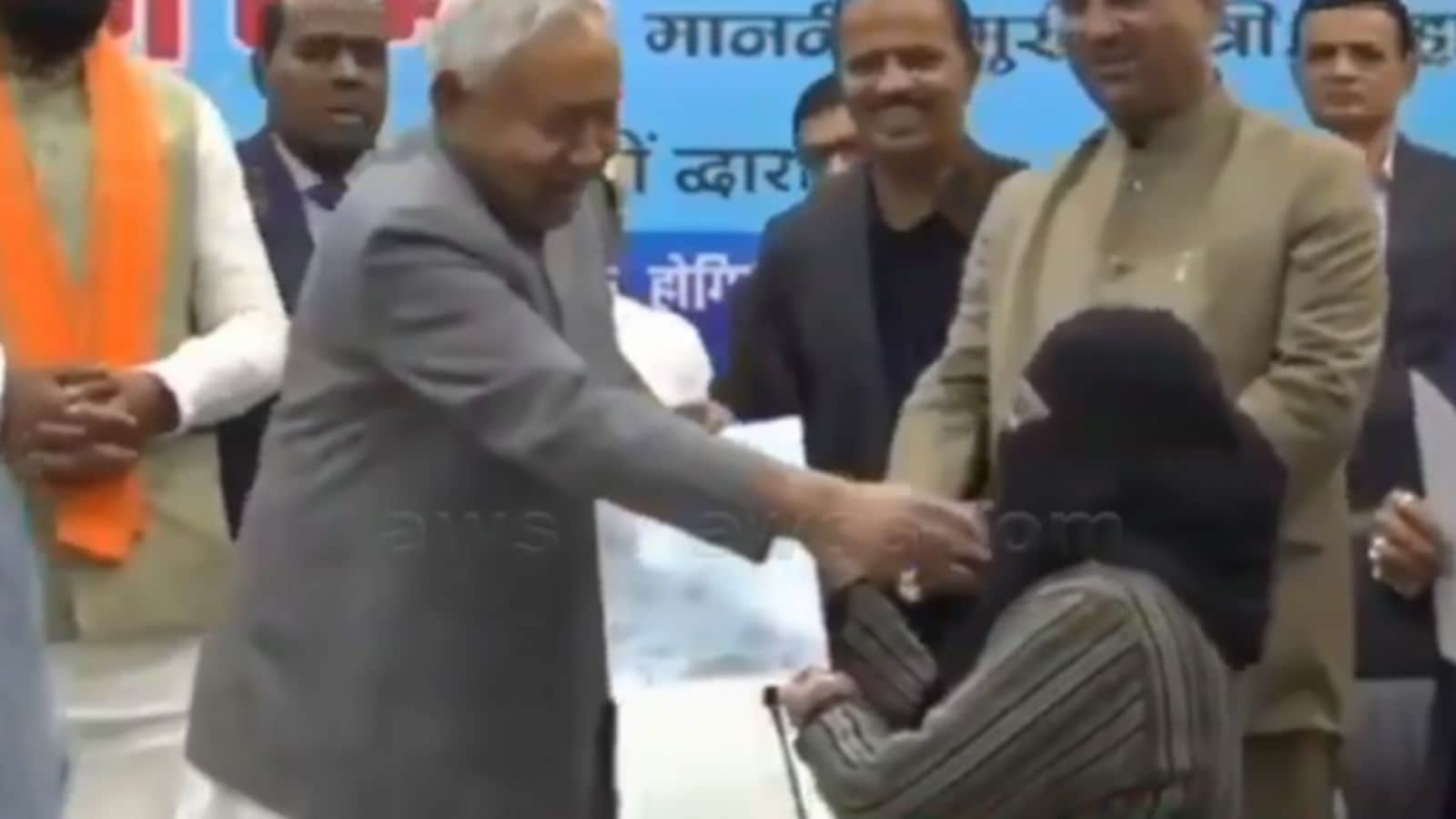
Bihar CM Nitish Kumar removes recruit's hijab at govt event, draws opposition criticism.
Summary
Bihar CM Nitish Kumar reportedly removed a recruit's hijab at a state government event, sparking significant political controversy. This incident highlights issues of religious freedom, state conduct, and political accountability, making it relevant for understanding governance and social dynamics in India for competitive exams.
Key Points
- 1Bihar Chief Minister Nitish Kumar was involved in an incident concerning a recruit's hijab.
- 2The event where the incident occurred was an official Bihar government function.
- 3The action by CM Nitish Kumar drew strong criticism from opposition parties.
- 4Opposition leaders alleged that the Chief Minister was "not in control" of the administration.
- 5The incident raises questions regarding religious attire and state secularism in India.
In-Depth Analysis
The incident involving Bihar Chief Minister Nitish Kumar reportedly removing a recruit's hijab at a state government event has ignited a significant political and social controversy, offering a critical lens through which to examine India's secular fabric, fundamental rights, and governance challenges. This event, while seemingly localized, resonates with broader debates on religious freedom, state conduct, and the role of religious attire in public life, making it highly relevant for competitive exam aspirants.
**Background Context and The Incident:**
Bihar, a state with a rich cultural tapestry, often finds itself at the crossroads of identity politics and developmental aspirations. Nitish Kumar, a veteran politician, has long projected himself as a leader committed to social harmony and good governance. The specific incident reportedly occurred during an official government function, where new recruits were being inducted. The alleged action by the Chief Minister — removing a recruit's hijab — immediately drew sharp criticism from opposition parties, who accused him of being "not in control" and undermining constitutional principles. This immediately placed the focus on the delicate balance between individual religious freedom and the state's role in public functions.
**Key Stakeholders Involved:**
Several key stakeholders are central to understanding this controversy. Firstly, **Chief Minister Nitish Kumar** and his administration are at the core. As the head of the state government, his actions carry immense symbolic and political weight, affecting perceptions of state neutrality and respect for religious diversity. His political party, Janata Dal (United), and its alliance partners also bear the brunt of the criticism. Secondly, **the recruit** whose hijab was reportedly removed is a direct stakeholder, representing individuals whose religious identity and personal dignity might have been impacted. Their experience underscores the human element of such controversies. Thirdly, **opposition parties**, primarily the Rashtriya Janata Dal (RJD) and Congress, seized upon the incident to criticize the CM, questioning his secular credentials and administrative competence. This highlights the competitive nature of Indian politics, where such events often become fodder for electoral narratives. Finally, **religious communities**, particularly the Muslim community, and civil society groups become crucial voices, advocating for religious freedom and constitutional rights.
**Significance for India and Constitutional Implications:**
This incident is deeply significant for India's constitutional and social discourse. It directly challenges the principle of **secularism**, enshrined in the Preamble of the Constitution (added by the 42nd Amendment in 1976). India's secularism is often described as 'positive secularism,' implying that the state respects all religions and can intervene to ensure religious equality, rather than strict separation. However, an action by a state head that seemingly interferes with an individual's religious attire raises questions about the boundaries of state intervention and individual autonomy.
Crucially, the incident implicates **Fundamental Rights**, particularly **Article 25**, which guarantees freedom of conscience and the right to freely profess, practice, and propagate religion, subject to public order, morality, and health. The wearing of a hijab is considered by many Muslim women as an essential part of their religious practice. The Supreme Court's 'essential religious practice' test, though complex, often comes into play in such matters. Additionally, **Article 14** (equality before law) and **Article 15** (prohibition of discrimination on grounds of religion, race, caste, sex) are relevant, as any action by the state that disproportionately affects a particular religious group's freedom could be seen as discriminatory. The incident also touches upon **Article 29**, which protects the cultural and educational rights of minorities.
**Historical Context and Future Implications:**
The debate around religious attire in public spaces is not new in India. Past instances, such as the Karnataka hijab ban in educational institutions in 2022, which led to a split verdict in the Supreme Court, illustrate the complexities and sensitivities involved. Similar debates have occurred globally, from France's ban on religious symbols in schools to discussions on turbans for Sikhs in various contexts. These historical precedents highlight the ongoing tension between individual religious freedom, state neutrality, and societal expectations. For Bihar, the incident could have immediate political ramifications, potentially affecting CM Nitish Kumar's image and the upcoming electoral landscape. It might deepen existing communal divides or reinforce narratives of religious discrimination. On a broader scale, it could prompt further legal challenges or lead to calls for clearer guidelines regarding religious attire in government offices and public events, ensuring that individual rights are respected while maintaining the secular character of state institutions. The incident serves as a stark reminder of the continuous need to uphold constitutional values and foster an inclusive society.
Exam Tips
This topic falls under GS Paper II (Indian Polity, Governance, Social Justice) for UPSC, and General Studies for SSC and State PSC exams. Focus on the constitutional provisions related to Fundamental Rights (Articles 14, 15, 25, 29) and the concept of Secularism in the Preamble.
Study related topics like the 'essential religious practice' doctrine, the difference between 'positive' and 'negative' secularism, the role of the Chief Minister, and the challenges of maintaining communal harmony and minority rights in India. Connect it to previous judicial pronouncements on religious attire.
Expect questions in the form of case studies or analytical essays. For instance, 'Critically analyze the challenges in balancing religious freedom with the state's secular principles, referencing recent incidents.' Or 'Discuss the role of the judiciary in interpreting Article 25 of the Indian Constitution, with suitable examples.'
Prepare for objective questions on the 42nd Amendment (adding 'Secular' to the Preamble), specific articles related to fundamental rights, and the composition/powers of the state executive (CM and Council of Ministers).