



Relevant for Exams
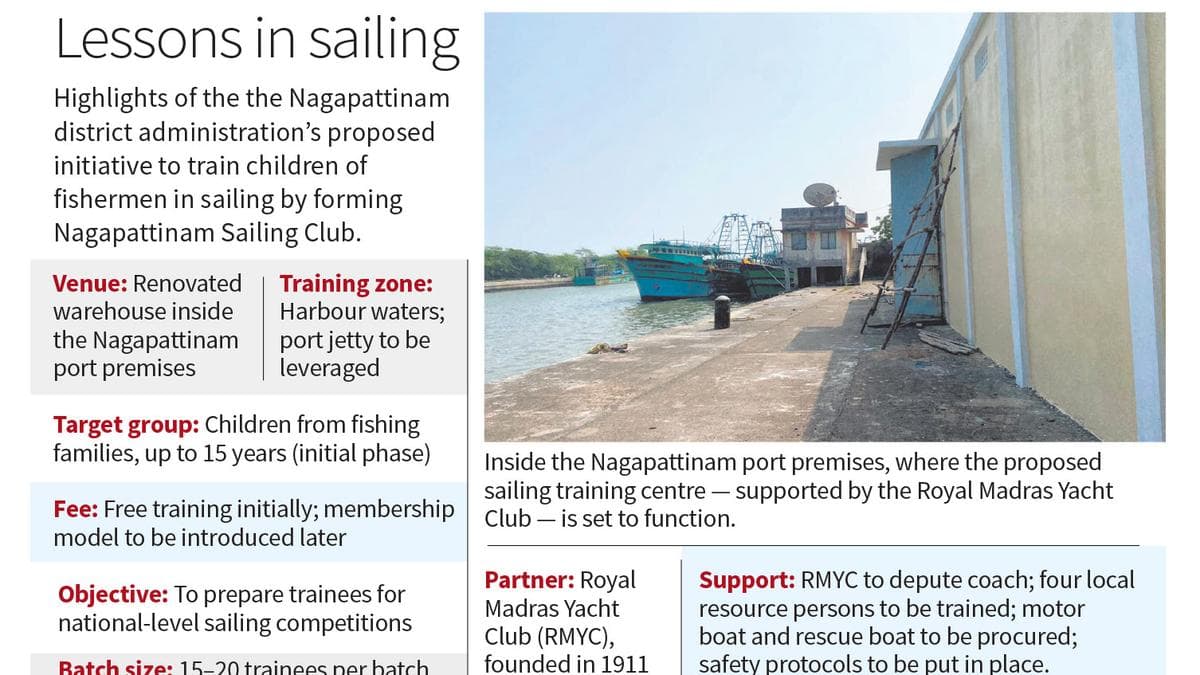
Nagapattinam to launch sailing training for fishermen's children; water sports planned in Velankanni.
Summary
This news highlights a regional initiative in Nagapattinam to offer sailing training to children of fishermen, aiming at skill development and potentially enhancing their livelihoods. Additionally, water sports are planned for Velankanni, which could boost local tourism and economic activity. For competitive exams, this is relevant as a state-level development project focusing on community welfare and tourism promotion, often asked in state-specific general awareness sections.
Key Points
- 1Sailing training will be rolled out specifically for children of fishermen.
- 2The primary location for the sailing training program is Nagapattinam district.
- 3The initiative also includes plans for introducing water sports activities.
- 4Velankanni has been identified as the location for the planned water sports.
- 5The program aims to foster skill development and promote tourism in the region.
In-Depth Analysis
The announcement from Nagapattinam, detailing plans for sailing training for children of fishermen and the introduction of water sports in Velankanni, represents a significant regional development initiative with broader implications for India's coastal communities and tourism sector. This move isn't merely about recreational activities; it's a strategic intervention aimed at socio-economic upliftment, skill development, and sustainable tourism.
**Background Context and What Happened:**
Nagapattinam, a coastal district in Tamil Nadu, has historically been reliant on fishing for its livelihood. The devastating 2004 Indian Ocean Tsunami severely impacted the district, highlighting the vulnerability of its coastal communities and the need for diversified economic opportunities. Children from these fishing families often inherit the traditional profession, which, while vital, can be precarious due to environmental challenges, dwindling fish stocks, and lack of alternative skills. The initiative to roll out sailing training specifically for these children addresses this vulnerability head-on. It aims to equip them with new skills, foster a deeper understanding of maritime activities beyond traditional fishing, and potentially open doors to careers in maritime sports, coastal tourism, or even naval services.
Simultaneously, the plan to introduce water sports in Velankanni, a renowned pilgrimage town within Nagapattinam district, seeks to tap into its existing visitor footfall. Velankanni attracts millions of pilgrims annually to the Basilica of Our Lady of Good Health. By adding water sports, the local administration aims to transform Velankanni into a dual-purpose destination – religious tourism combined with adventure tourism – thereby extending visitor stays, increasing local spending, and creating diverse employment opportunities for the local populace.
**Key Stakeholders Involved:**
Several key stakeholders are central to this initiative. The **Tamil Nadu State Government**, through its Departments of Fisheries, Tourism, and Youth Welfare, is undoubtedly the primary driver, providing policy direction, funding, and administrative support. The **Nagapattinam District Administration**, led by the District Collector, is crucial for on-ground implementation, coordination with local communities, and ensuring the smooth rollout of training programs and infrastructure development for water sports. The **Fishermen Community** itself, particularly the children and their families, are direct beneficiaries and active participants. Their willingness to embrace new skills is vital for the program's success. The **Tourism Sector**, including local businesses, hoteliers, and tour operators in Velankanni, stands to gain significantly from increased tourist activity. Furthermore, specialized **sailing academies or sports associations** might be roped in to provide professional training, ensuring high standards of skill development and safety.
**Significance for India and Historical Context:**
This initiative holds immense significance for India. Firstly, it aligns perfectly with the national vision of **'Skill India'**, aiming to empower the youth with employable skills. For coastal communities, it contributes to the broader **'Blue Economy'** framework, which emphasizes the sustainable use of ocean resources for economic growth, improved livelihoods, and ocean ecosystem health. By promoting skill diversification, it enhances the resilience of vulnerable communities, a lesson painfully learned from past disasters like the 2004 Tsunami. Historically, Indian coastal communities have been at the forefront of maritime trade and exploration; this initiative rekindles a modern connection to the sea, moving beyond traditional fishing to encompass sports and tourism. It also contributes to **regional balanced development**, ensuring that benefits of economic growth reach remote and often marginalized coastal areas.
**Related Constitutional Articles, Acts, or Policies:**
This state-level initiative resonates strongly with the **Directive Principles of State Policy (DPSP)** enshrined in Part IV of the Indian Constitution. Specifically:
* **Article 38** mandates the State to secure a social order for the promotion of welfare of the people, striving to minimize inequalities in income, status, facilities, and opportunities. This program directly addresses economic inequalities in coastal communities.
* **Article 39** directs the State to secure, among other things, that the citizens, men and women equally, have the right to an adequate means of livelihood. Skill training provides new avenues for livelihood.
* **Article 41** recognizes the right to work and to education, and public assistance in cases of unemployment. The sailing training is a form of vocational education and skill development.
* **Article 43** calls for the State to endeavor to secure for all workers a living wage and conditions of work ensuring a decent standard of life. By enhancing skills, the potential for better wages and living standards increases.
Furthermore, this initiative complements national schemes like the **Pradhan Mantri Matsya Sampada Yojana (PMMSY)**, launched in 2020, which aims for holistic development of the fisheries sector and welfare of fishers. It also aligns with the objectives of the **Sagarmala Project**, which focuses on port-led development and coastal community development, including skill development for coastal populations.
**Future Implications:**
The success of this pilot project in Nagapattinam and Velankanni could serve as a model for replication in other coastal districts across Tamil Nadu and even other maritime states of India. It could lead to the establishment of more specialized maritime training centers, fostering a new generation of skilled professionals for the growing blue economy. The rise of water sports could boost local entrepreneurship, create a vibrant tourism ecosystem, and attract domestic and international visitors. Over time, it could transform the perception of coastal communities from merely fishing hubs to dynamic centers of maritime sports, tourism, and skilled labor, contributing significantly to India's overall economic growth and social progress while enhancing the resilience and adaptability of its coastal populations.
Exam Tips
**General Studies - Economy & Social Development (State PSC, SSC, Railway):** This topic falls under government schemes for welfare, skill development, and tourism promotion. Understand the socio-economic challenges of coastal communities and how such initiatives address them.
**Geography (State PSC, SSC):** Be prepared for questions on the geographical location of Nagapattinam and Velankanni, their economic significance (fishing, tourism), and vulnerability to natural disasters. Study the coastal geography of Tamil Nadu.
**Polity (State PSC):** Focus on the Directive Principles of State Policy (DPSP), especially Articles 38, 39, 41, and 43. Understand how state-level welfare initiatives reflect the constitutional mandate for social justice and economic upliftment.
**Current Affairs & Government Schemes (All Exams):** Link this local initiative to broader national policies like the Skill India Mission, Pradhan Mantri Matsya Sampada Yojana (PMMSY), and the Blue Economy concept. Questions often ask about the objectives and beneficiaries of such schemes.
**Common Question Patterns:** Expect questions like 'Which constitutional article supports state initiatives for skill development?', 'What is the primary objective of introducing water sports in Velankanni?', or 'Nagapattinam is primarily known for...?'