



Relevant for Exams
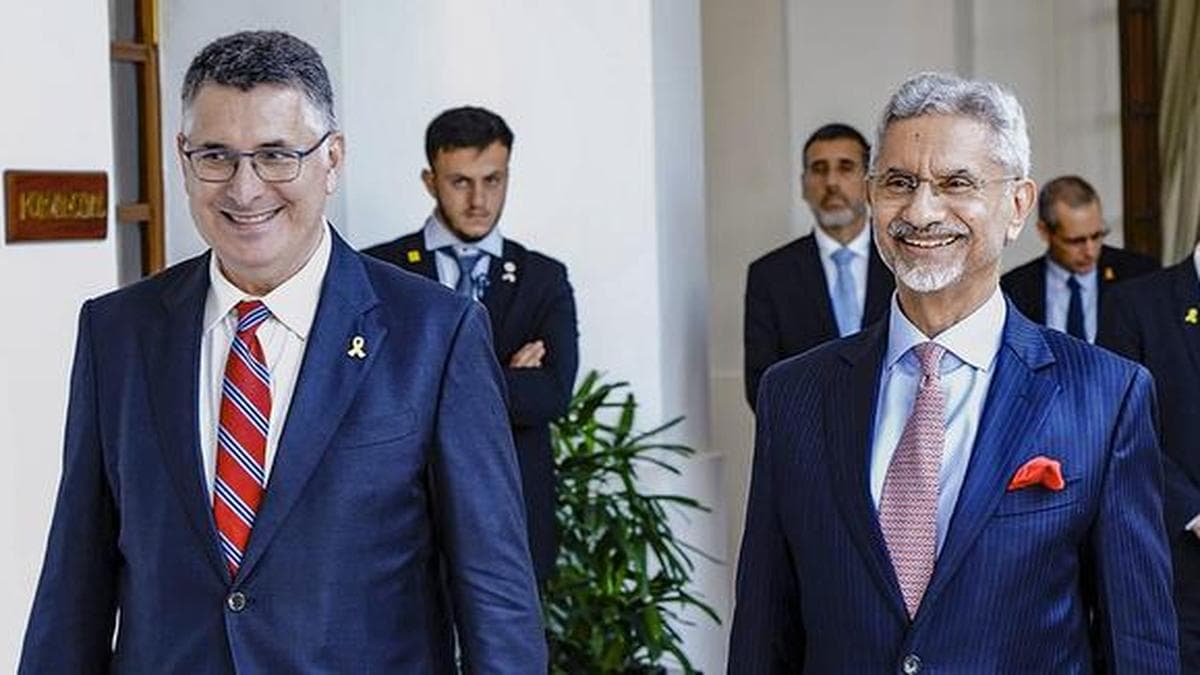
Jaishankar to visit Israel on December 16 for bilateral and regional talks, following PMs' recent call.
Summary
External Affairs Minister S. Jaishankar is scheduled to visit Israel on December 16 to engage in discussions concerning bilateral and regional issues. This high-level diplomatic engagement follows a recent conversation between Indian Prime Minister Narendra Modi and Israeli Prime Minister Benjamin Netanyahu, where both leaders agreed to meet soon. The visit underscores the ongoing strategic partnership between India and Israel and is crucial for understanding India's foreign policy and regional diplomacy in the Middle East.
Key Points
- 1External Affairs Minister S. Jaishankar is scheduled to visit Israel.
- 2The visit by EAM Jaishankar to Israel will take place on December 16.
- 3The primary agenda for the visit includes discussions on bilateral and regional issues.
- 4The visit follows a recent phone conversation between Indian PM Narendra Modi and Israeli PM Benjamin Netanyahu.
- 5During their call, PM Modi and PM Netanyahu 'agreed to meet very soon'.
In-Depth Analysis
External Affairs Minister S. Jaishankar's visit to Israel on December 16, 2023, following a high-level conversation between Prime Ministers Modi and Netanyahu, underscores the deepening strategic convergence between India and Israel. This visit is not an isolated event but rather a continuation of a rapidly evolving relationship that has gained significant momentum in recent decades, particularly under the current Indian government. To truly grasp its significance, one must delve into the historical context, the immediate geopolitical backdrop, and the multifaceted interests driving this engagement.
Historically, India's relationship with Israel was characterized by a period of cautious engagement. While India recognized Israel in 1950, full diplomatic relations were only established in 1992, largely influenced by the end of the Cold War and the changing geopolitical landscape, including the Madrid Peace Conference. For decades, India maintained a strong pro-Palestinian stance, aligning with the Non-Aligned Movement's principles and broader Arab solidarity. However, the economic liberalization of the 1990s and India's growing strategic needs, particularly in defence and technology, gradually paved the way for a more pragmatic foreign policy. The Vajpayee government saw an uptick in cooperation, but it was under the Narendra Modi government, starting in 2014, that the relationship truly flourished, shedding past hesitations. PM Modi's visit to Israel in 2017 was a landmark, marking the first by an Indian Prime Minister.
The immediate background to Jaishankar's visit is crucial. The region is reeling from the Israel-Hamas conflict that erupted on October 7, 2023. India's response to this conflict has been carefully balanced, condemning terrorism while also advocating for humanitarian aid to Palestinians and a two-state solution. In this volatile environment, direct high-level communication becomes even more critical for India to articulate its position, understand regional dynamics firsthand, and protect its strategic interests. The phone call between PM Modi and PM Netanyahu, where they agreed to meet soon, signifies a mutual desire to maintain open channels and coordinate on pressing regional and bilateral matters.
Key stakeholders in this engagement include the governments of India and Israel, their respective foreign ministries, defence establishments, and business communities. For India, the primary interests span defence cooperation, where Israel has been a critical supplier of sophisticated military technology and equipment, including missile systems and UAVs (Unmanned Aerial Vehicles). Economic ties are also robust, with growing trade in diamonds, chemicals, and agricultural products. Israeli expertise in water management, drip irrigation, and agricultural technology is highly valued in India. Furthermore, cooperation in counter-terrorism, cybersecurity, and space technology forms a significant pillar of the partnership. For Israel, India represents a vast market for its technology and defence exports, a reliable strategic partner in Asia, and a diplomatic ally in an often-hostile neighborhood. Strengthening ties with India helps Israel diversify its international partnerships and project its influence beyond its immediate region.
This visit holds profound significance for India. Firstly, it reaffirms India's commitment to a multi-aligned foreign policy, demonstrating its ability to engage robustly with diverse partners, including Israel and Arab nations, without being constrained by past ideological baggage. This aligns with the spirit of **Article 51 of the Indian Constitution**, a Directive Principle of State Policy, which mandates the state to endeavor to promote international peace and security, maintain just and honorable relations between nations, and foster respect for international law. India's engagement with Israel, even amidst regional conflict, is a testament to its pursuit of national interests within a framework of international stability.
Secondly, the visit is vital for India's 'Look West' policy, which aims to strengthen ties with countries in West Asia for energy security, trade, and diaspora welfare. While Israel is not a major energy supplier, its strategic location and technological prowess make it a key player in this broader regional strategy. The visit also feeds into multilateral initiatives like the I2U2 Grouping (India, Israel, UAE, USA), an economic forum focused on joint investments in water, energy, transportation, space, health, and food security. Such platforms underscore the convergence of interests and the potential for India to play a constructive role in regional development.
Future implications include the potential for enhanced cooperation in emerging technologies, joint R&D, and greater strategic coordination on regional security issues. India might also leverage its relationship with Israel to further its interests within the I2U2 framework, potentially attracting more investment into India. However, India will continue to navigate the complexities of the Israel-Palestine conflict, balancing its historical support for the Palestinian cause with its growing strategic partnership with Israel. The visit serves as a diplomatic signal that despite regional turmoil, India values its relationship with Israel and is committed to fostering stability and cooperation in the Middle East, which is critical for India's energy security, trade routes, and the well-being of its large diaspora in the Gulf region.
Exam Tips
This topic falls under GS Paper 2 (International Relations) for UPSC Civil Services Exam. Be prepared for analytical questions on India's foreign policy challenges in West Asia, its balancing act between Israel and Palestine, and the strategic rationale behind India-Israel ties.
Study related topics such as India's 'Look West' Policy, the I2U2 Grouping (India, Israel, UAE, USA), the Abraham Accords, and the broader Israel-Palestine conflict. Understand the economic, strategic, and security dimensions of these relationships.
Common question patterns include asking about the evolution of India-Israel relations, the significance of defence and technology cooperation, India's stance on regional conflicts, and the role of multilateral forums like I2U2 in India's foreign policy objectives.
Pay attention to specific dates of key diplomatic visits (e.g., PM Modi's 2017 visit to Israel, EAM Jaishankar's recent visit) and their outcomes. Understand the impact of global events (like the Israel-Hamas conflict) on India's bilateral relations.
Related Topics to Study
Full Article
His visit comes days after Israeli Prime Minister Netanyahu spoke to his Indian counterpart Narendra Modi and the two leaders "agreed to meet very soon”.