

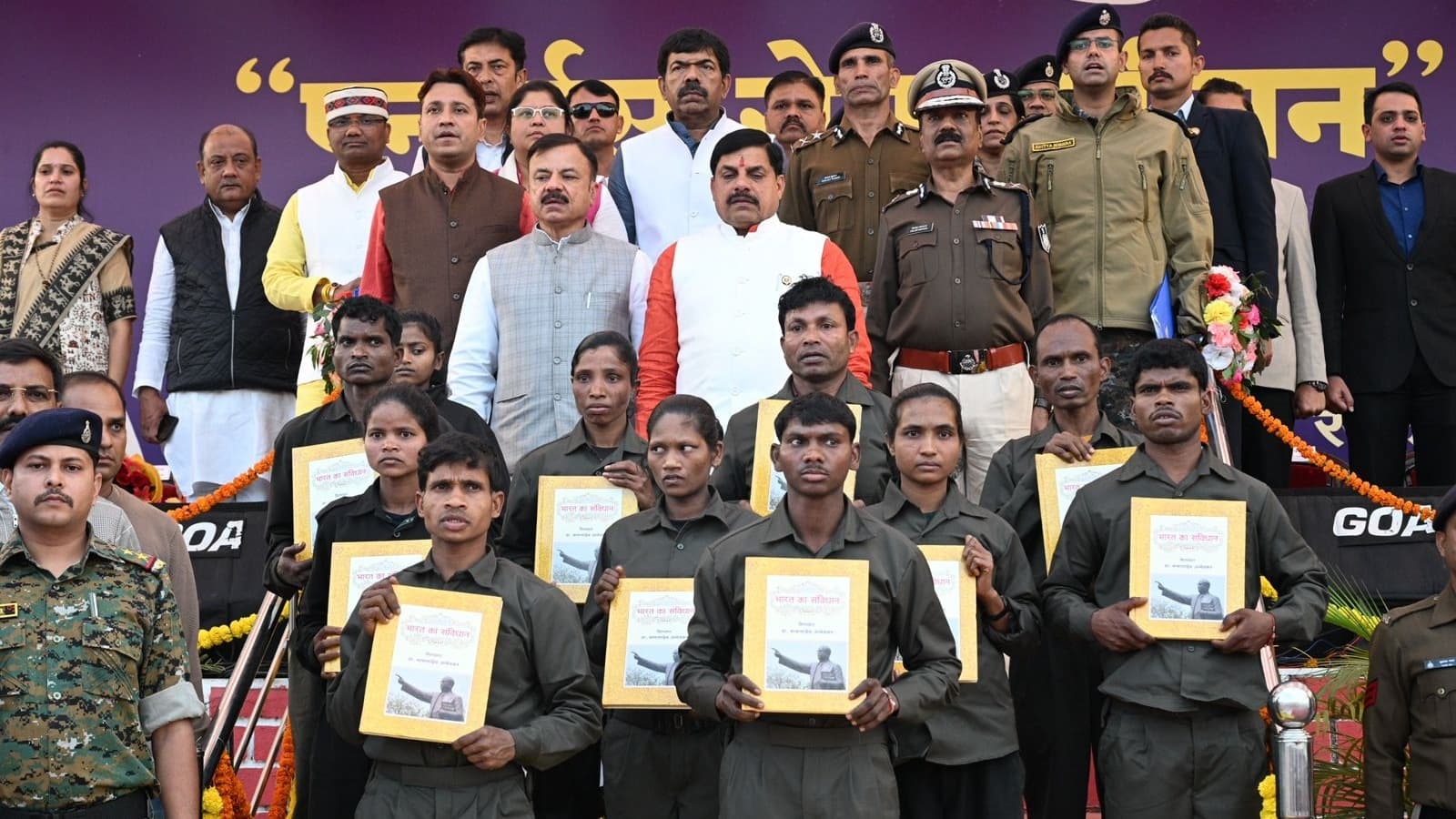


Content unavailable for analysis; no exam-relevant facts extracted from the Madhya Pradesh Maoist news.
Summary
Analysis of the news article titled 'How Madhya Pradesh got ‘the last of its Maoists’: Tracking the one-year push' could not be performed as the article content was explicitly stated as 'No content available'. Consequently, no exam-relevant facts, dates, names, or numbers could be extracted, making it impossible to determine its specific significance for competitive exam preparation.
Key Points
- 1No article content was provided for analysis, making the extraction of specific exam-relevant facts impossible.
- 2The news title suggests a topic related to internal security and state administration in Madhya Pradesh.
- 3Without content, specific details such as dates, names, numbers, or constitutional provisions cannot be identified.
- 4The general topic of Maoist activity is typically relevant for UPSC and State PSC internal security sections.
- 5However, due to the complete absence of content, no concrete exam-focused points can be generated.
In-Depth Analysis
The news title 'How Madhya Pradesh got ‘the last of its Maoists’: Tracking the one-year push' points to a significant development in India's internal security landscape, specifically concerning Left Wing Extremism (LWE). While the article content itself is unavailable, the title provides enough context to discuss the broader implications of combating Maoist insurgency, particularly in a state like Madhya Pradesh, which has historically been part of the 'Red Corridor' but with varying intensity compared to states like Chhattisgarh or Jharkhand.
**Background Context and Historical Roots:**
Left Wing Extremism, often referred to as Naxalism or Maoism, traces its origins to an agrarian revolt in Naxalbari village, West Bengal, in 1967. Fueled by severe socio-economic disparities, land alienation, exploitation of tribal populations, and a perceived lack of governance, the movement quickly spread. Its ideology, inspired by Mao Zedong's 'protracted people's war,' aims to overthrow the existing state through armed struggle. Over the decades, it has evolved into a major internal security challenge, affecting several states across central and eastern India, collectively known as the 'Red Corridor.' Madhya Pradesh, particularly its southeastern districts bordering Chhattisgarh and Maharashtra, has experienced sporadic Maoist activity, primarily through the 'Trikonia' (triangle) region formed by the borders of these three states.
**What Happened (General Strategy):**
The title suggests a focused 'one-year push' that led to the eradication or significant reduction of Maoist presence in Madhya Pradesh. Such a success story typically involves a multi-pronged strategy. Firstly, robust and intelligence-led security operations are paramount. This includes increased deployment of state police and central paramilitary forces (like CRPF), enhanced intelligence gathering, area domination, and targeted operations against Maoist cadres and leadership. Secondly, developmental initiatives play a crucial role in addressing the root causes of extremism. This involves improving infrastructure (roads, bridges), providing access to education and healthcare, implementing land reforms, ensuring fair prices for forest produce, and generating employment opportunities for local populations, especially tribal communities. Thirdly, effective surrender and rehabilitation policies are critical to encourage Maoist cadres to lay down arms and rejoin the mainstream. Finally, strengthening local governance and ensuring the effective implementation of welfare schemes helps build trust between the state and its citizens, thereby denying Naxalites new recruits and safe havens.
**Key Stakeholders Involved:**
Several entities are crucial in the fight against LWE. The **Government of India**, through the Ministry of Home Affairs (MHA), formulates national policy, provides financial assistance, deploys central armed police forces, and coordinates efforts across states. The **Madhya Pradesh State Government** is the primary stakeholder, responsible for law and order, implementing security operations through the state police, and delivering development and welfare schemes through its various departments. **Maoist/Naxalite groups** themselves are a key stakeholder, comprising their armed cadres, leadership, and overground sympathizers. **Local tribal and rural populations** are perhaps the most affected stakeholders, often caught between the state forces and the Naxalites. Their support, or lack thereof, can significantly influence the success of anti-LWE operations. **Civil society organizations and NGOs** also play a role, sometimes advocating for the rights of affected populations, facilitating development, or working on rehabilitation.
**Significance for India:**
Successfully eliminating Maoist presence in a state like Madhya Pradesh carries immense significance for India. It directly enhances **internal security** by reducing a major threat to the state's sovereignty and law and order. It paves the way for accelerated **development** in previously inaccessible or conflict-ridden areas, attracting investment, improving infrastructure, and uplifting marginalized communities. This has significant **economic implications**, as resource-rich regions can be better exploited for national growth, and human capital can be integrated into the mainstream economy. Socially, it fosters **peace and stability**, reducing human rights violations and allowing for the restoration of normal life. Politically, it strengthens the faith of citizens in democratic governance and the state's ability to protect its people.
**Constitutional and Policy References:**
The fight against LWE is deeply intertwined with several constitutional provisions and government policies. **Law and Order** falls primarily under the **State List** (Entry 1 and 2 of the Seventh Schedule), making state governments primarily responsible. However, the Centre plays a crucial supporting role. The **Panchayats (Extension to Scheduled Areas) Act (PESA), 1996**, is vital for empowering tribal communities with self-governance and control over local resources, directly addressing a key grievance exploited by Naxalites. The **Forest Rights Act (FRA), 2006**, recognizes the rights of forest-dwelling tribal communities and other traditional forest dwellers, aiming to correct historical injustices. The **Unlawful Activities (Prevention) Act (UAPA), 1967**, is a key legislative tool used to proscribe Maoist organizations and prosecute their members. The **National Policy and Action Plan to Address Left Wing Extremism** adopted by the MHA outlines a comprehensive strategy focusing on security response, development initiatives, ensuring rights and entitlements, and public perception management. Schemes like the **Security Related Expenditure (SRE) Scheme**, **Special Infrastructure Scheme (SIS)**, and the **Road Requirement Plan (RRP)** specifically target LWE-affected areas to enhance security infrastructure and connectivity. The **Aspirational Districts Program** also indirectly contributes by focusing on holistic development in backward districts, many of which are LWE-affected.
**Future Implications:**
The success in Madhya Pradesh, if sustained, provides a blueprint for other LWE-affected states. However, the challenge is to prevent resurgence. This requires continued vigilance, sustained developmental efforts, effective grievance redressal mechanisms, and ensuring that the benefits of development reach the most vulnerable. Addressing the ideological vacuum and integrating former cadres into society will also be crucial. The focus must shift from merely containing extremism to fostering inclusive growth and robust governance, ensuring that the 'last of its Maoists' truly signifies the end of the insurgency, not just a temporary lull.
Exam Tips
This topic primarily falls under **GS Paper III - Internal Security** for UPSC Civil Services Exam and relevant sections for State PSCs. Focus on the causes, consequences, and government strategies to combat Left Wing Extremism (LWE).
Study related topics such as the evolution of Naxalism, the 'Red Corridor,' the multi-pronged strategy (security, development, rights), and the role of various forces (CAPFs, State Police). Also, link it to socio-economic development challenges in tribal areas.
Common question patterns include: 'Critically analyze the government's approach to tackling Left Wing Extremism. What are the challenges and way forward?' or 'Discuss the role of development and good governance in mitigating the threat of LWE, with reference to specific policies like PESA and FRA.' Be prepared to discuss both security and developmental aspects.
Memorize key constitutional articles (e.g., Seventh Schedule, PESA, FRA) and significant government policies/schemes (e.g., SRE, RRP, Aspirational Districts Program) related to LWE and tribal development. Understand their purpose and impact.