



Relevant for Exams
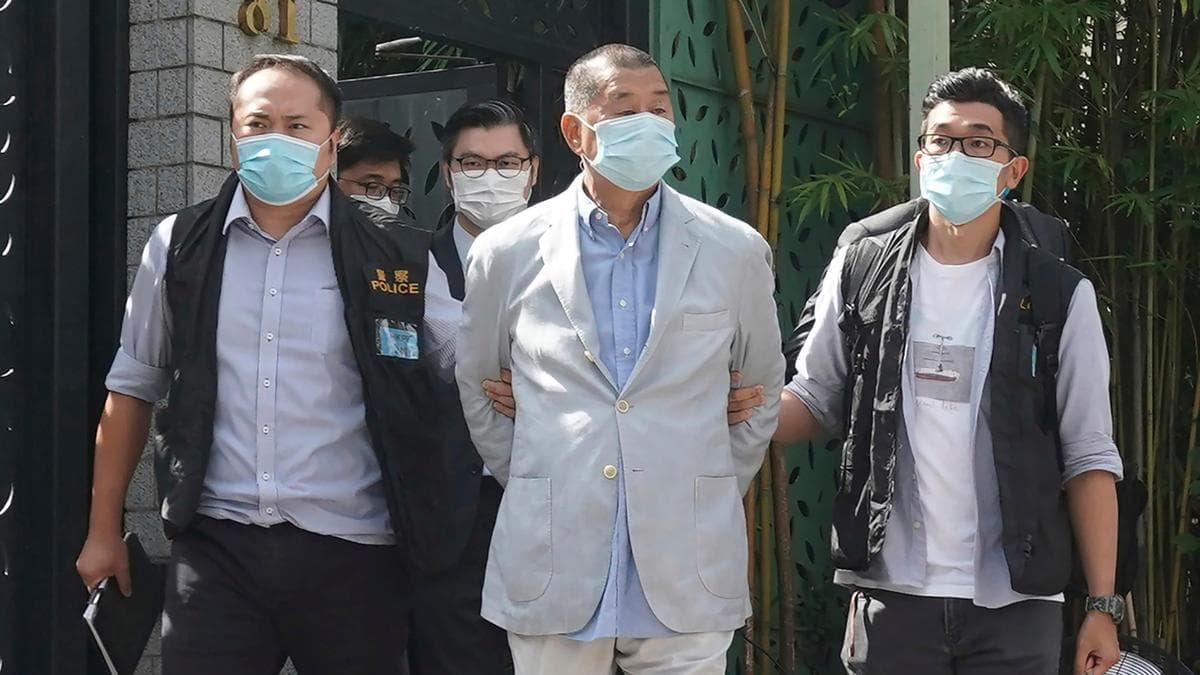
HK pro-democracy media mogul Jimmy Lai convicted under national security law, faces life imprisonment.
Summary
Former Hong Kong pro-democracy media mogul Jimmy Lai has been convicted in a landmark national security trial. This conviction, under Hong Kong's sweeping national security law, highlights the erosion of press freedom and rule of law in the region. Lai faces potential life imprisonment, making this a significant development for international relations and human rights, relevant for competitive exams focusing on global affairs and legal frameworks.
Key Points
- 1Former Hong Kong pro-democracy media mogul Jimmy Lai was convicted.
- 2The conviction occurred in a landmark national security trial.
- 3Lai was convicted under Hong Kong's sweeping national security law.
- 4Sentencing for Jimmy Lai is expected on a later day.
- 5Under Hong Kong's national security law, Lai could face up to life imprisonment.
In-Depth Analysis
The conviction of Jimmy Lai, a prominent pro-democracy media mogul in Hong Kong, under the city's sweeping National Security Law (NSL) marks a critical juncture in the erosion of autonomy and fundamental freedoms in the former British colony. This landmark trial and its outcome carry significant implications not only for Hong Kong but also for international relations, human rights, and the delicate balance of power in East Asia.
**Background Context and Historical Trajectory:**
To understand the gravity of Jimmy Lai's conviction, it's essential to recall Hong Kong's unique status. After its handover from British to Chinese rule in 1997, Hong Kong was governed under the 'One Country, Two Systems' framework, enshrined in its mini-constitution, the Basic Law. This framework promised Hong Kong a 'high degree of autonomy' for 50 years, preserving its independent judiciary, free press, capitalist economy, and rights and freedoms not enjoyed in mainland China. However, over the years, there has been a growing perception that Beijing has been progressively encroaching upon these promised autonomies. This tension escalated dramatically with the 2019 anti-extradition bill protests, which saw millions take to the streets, demonstrating widespread discontent against perceived Chinese authoritarianism. In response to these massive and often violent protests, Beijing imposed the National Security Law on Hong Kong in June 2020, bypassing Hong Kong's legislature. The NSL criminalises secession, subversion, terrorism, and collusion with foreign forces, with penalties as severe as life imprisonment.
**What Happened: The Case of Jimmy Lai:**
Jimmy Lai, the founder of the now-defunct Apple Daily newspaper, was a vocal critic of the Chinese Communist Party (CCP) and a staunch advocate for democracy in Hong Kong. Apple Daily was known for its pro-democracy stance and often critical reporting on both Hong Kong and mainland Chinese authorities. Lai was arrested multiple times under the NSL, with charges including 'collusion with foreign forces' and 'sedition'. His trial, conducted without a jury and presided over by judges selected by the Hong Kong Chief Executive (a mechanism introduced by the NSL), concluded with his conviction. The specific details of the conviction, expected to be followed by sentencing, underscore the NSL's broad reach and its effective stifling of dissent. Lai's potential life imprisonment sends a chilling message to other pro-democracy activists and media outlets.
**Key Stakeholders Involved:**
1. **Chinese Communist Party (CCP) and Central Government of China:** The primary driver behind the NSL and the crackdown on dissent. Their objective is to ensure 'national security' and consolidate control over Hong Kong, integrating it more fully into mainland governance. This is seen as part of President Xi Jinping's broader vision for a unified and strong China.
2. **Hong Kong Government:** Increasingly operating under Beijing's directives, the local government is responsible for implementing the NSL and enforcing its provisions, thereby diminishing its own autonomy and public trust.
3. **Jimmy Lai and Pro-Democracy Advocates:** Representing the segment of Hong Kong's population fighting for the preservation of their promised freedoms and democratic values, now facing severe legal and political repression.
4. **International Community (e.g., US, UK, EU, UN):** Many Western governments and international human rights organisations have condemned the NSL and its application, viewing it as a violation of the Sino-British Joint Declaration (an international treaty) and a grave assault on human rights, press freedom, and the rule of law. They have imposed sanctions on Hong Kong and Chinese officials.
**Why This Matters for India:**
1. **Geopolitical Implications:** India maintains a complex relationship with China, marked by both economic ties and strategic rivalry, particularly concerning border disputes (e.g., Ladakh). The situation in Hong Kong highlights China's growing authoritarianism and its willingness to assert control, which has implications for regional stability and India's security calculations. India typically upholds the principle of non-interference in the internal affairs of other nations but also champions democratic values and press freedom globally.
2. **Trade and Investment:** Hong Kong is a major global financial hub and a gateway for international business. The erosion of its rule of law and political stability could impact investor confidence, including for Indian businesses that have a presence or interests there. A less free Hong Kong could become less attractive as a business destination.
3. **Human Rights and Freedom of Press:** India, as the world's largest democracy, has a constitutional commitment to fundamental rights, including freedom of speech and expression (Article 19(1)(a)). While India has its own national security laws, the draconian application of the NSL in Hong Kong raises universal concerns about the balance between national security and individual liberties. This case serves as a global example of the suppression of press freedom, a value India generally upholds.
4. **International Law and Sovereignty:** The Sino-British Joint Declaration is an international treaty. China's actions are viewed by many as a violation of this treaty. India's stance on international treaties and the sanctity of agreements is crucial for its own foreign policy.
**Future Implications:**
The conviction of Jimmy Lai signals a further tightening of Beijing's grip on Hong Kong. It is expected to lead to continued self-censorship among media outlets, a chilling effect on political dissent, and potentially an exodus of talent and capital from the city. The 'One Country, Two Systems' framework appears increasingly hollow, moving towards 'One Country, One System' in practice. This will likely exacerbate tensions between China and Western democracies, leading to continued diplomatic friction and potentially further sanctions. For India, it reinforces the need to carefully navigate its relationship with an increasingly assertive China, while maintaining its commitment to democratic principles and human rights on the international stage.
**Related Constitutional Articles, Acts, or Policies (Indian Context):**
While the NSL is a Chinese law, its implications touch upon principles enshrined in India's Constitution:
* **Article 19(1)(a):** Guarantees freedom of speech and expression, which includes freedom of the press. This is the bedrock of India's democratic discourse and stands in stark contrast to the restrictions seen in Hong Kong. However, Article 19(2) allows for 'reasonable restrictions' on this freedom in the interests of national security, public order, etc. The debate often revolves around what constitutes 'reasonable'.
* **Unlawful Activities (Prevention) Act (UAPA), 1967:** India's primary anti-terrorism law, which has also faced criticism for its broad definitions and potential for misuse, similar to how the NSL is criticised for its sweeping powers. Understanding the debates around UAPA in India can provide context for analysing laws like the NSL.
* **International Human Rights Covenants:** India is a signatory to various international human rights instruments, such as the Universal Declaration of Human Rights (UDHR) and the International Covenant on Civil and Political Rights (ICCPR), which protect freedom of expression and fair trial rights. These international commitments inform India's broader foreign policy stance on human rights issues globally.
Exam Tips
This topic falls under 'International Relations' (UPSC Mains GS-II, SSC CGL General Awareness) and 'Current Events of National and International Importance' (State PSCs, Defence exams). Focus on the geopolitical context, the 'One Country, Two Systems' framework, and the implications for global human rights and press freedom.
Study related topics like the history of Hong Kong's handover, the Sino-British Joint Declaration, the nature of China's foreign policy, and the concept of 'national security' vs. individual liberties. Understand how different countries balance these two aspects.
Common question patterns include: (a) Direct questions on the National Security Law and its impact on Hong Kong's autonomy; (b) Analytical questions on the geopolitical implications of China's actions for regional stability and international law; (c) Questions comparing press freedom and national security laws in different democratic and authoritarian contexts, possibly referencing India's Article 19.
Related Topics to Study
Full Article
Sentencing is expected to come on a later day. Under Hong Kong’s sweeping national security law, Lai could face up to life imprisonment