



Relevant for Exams
J&K LG links terror victims' 'new courage' to Article 370 abrogation, highlighting regional impact.
Summary
This article's title indicates that the J&K LG stated that families of terror victims found new courage post Article 370 abrogation. While the specific details of the LG's statement are unavailable due to missing content, the topic highlights the political and social impact of the abrogation in Jammu & Kashmir. This subject is highly significant for competitive exams focusing on Indian polity, constitutional law, and current affairs related to internal security and governance.
Key Points
- 1Abrogation of Article 370 of the Indian Constitution occurred on August 5, 2019.
- 2The Jammu & Kashmir Reorganisation Act, 2019, bifurcated the erstwhile state into two Union Territories.
- 3The two new Union Territories formed are Jammu & Kashmir (with a legislature) and Ladakh (without a legislature).
- 4Article 370 granted special autonomous status to the state of Jammu & Kashmir.
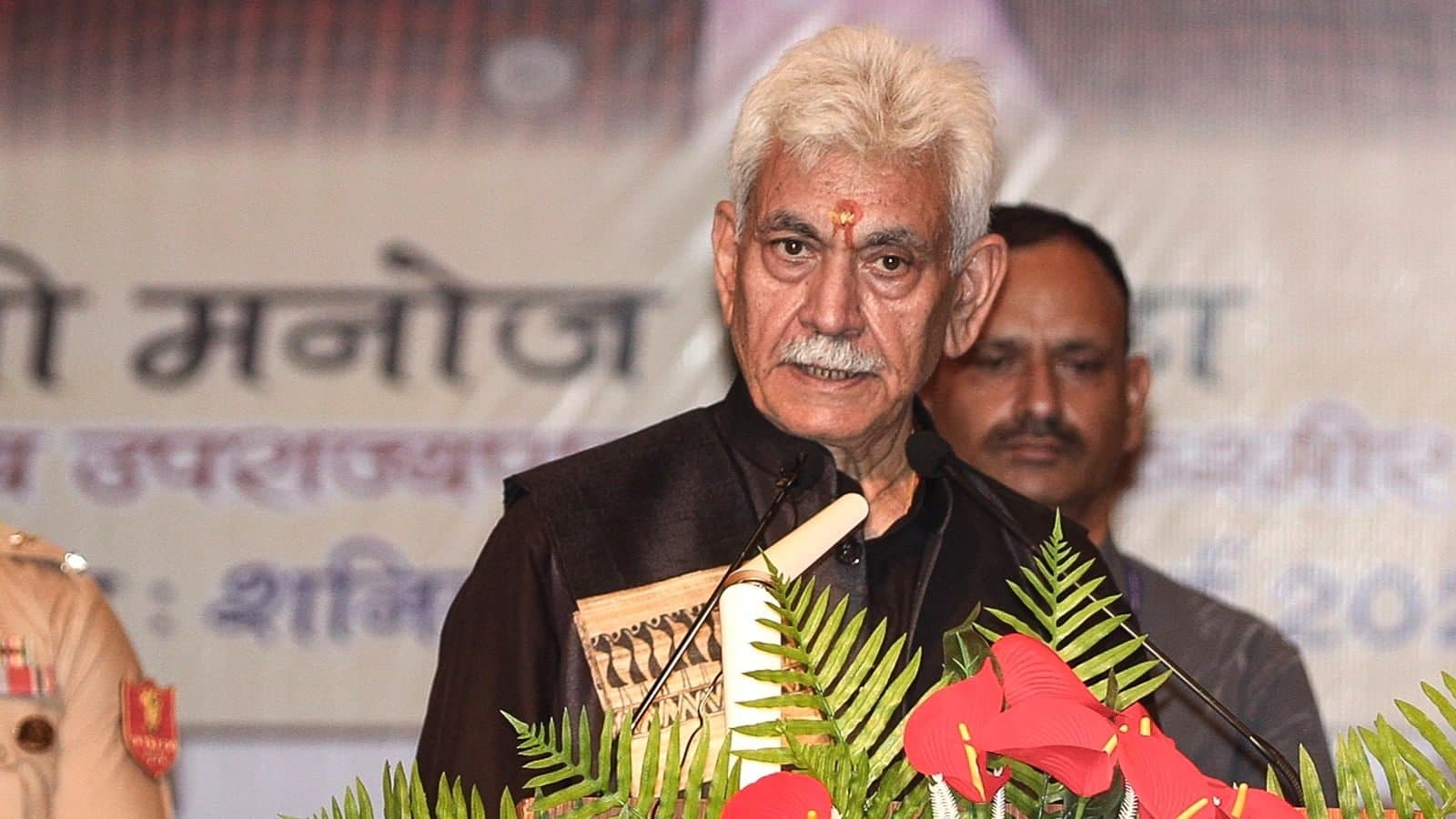
- 5Manoj Sinha is the current Lieutenant Governor (LG) of Jammu & Kashmir.
In-Depth Analysis
The abrogation of Article 370 of the Indian Constitution on August 5, 2019, marked a watershed moment in India's political landscape, particularly concerning Jammu & Kashmir (J&K). This move, often described as a bold constitutional step, fundamentally altered the constitutional relationship between the erstwhile state of J&K and the Union of India, leading to its reorganisation into Union Territories.
To truly grasp the significance, we must delve into its background. Article 370 was incorporated into the Indian Constitution as a 'temporary, transitional and special provision' for Jammu & Kashmir. Its genesis lies in the unique circumstances of J&K's accession to India in 1947, when Maharaja Hari Singh signed the Instrument of Accession. This instrument granted India control over defence, external affairs, and communications, while J&K retained autonomy over other matters. Article 370 essentially enshrined this special status, allowing J&K to have its own constitution, flag, and a greater degree of legislative autonomy compared to other Indian states. Crucially, it limited the Indian Parliament's power to legislate for J&K to only those matters specified in the Instrument of Accession, unless the state government concurred. Article 35A, added through a Presidential Order in 1954 under Article 370, further empowered the J&K legislature to define 'permanent residents' and grant them special rights and privileges, particularly concerning land ownership, employment, and scholarships. This provision was often seen as a protective measure for the region's demography and culture, but also as a barrier to outside investment and full integration.
On August 5, 2019, the Government of India, led by Prime Minister Narendra Modi, issued Presidential Order C.O. 272, superseding the 1954 order and declaring that all provisions of the Indian Constitution would apply to J&K. This was followed by a resolution in both houses of Parliament recommending that the President declare Article 370 inoperative, using the very mechanism provided within Article 370(3). President Ram Nath Kovind subsequently issued Presidential Order C.O. 273, making Article 370 inoperative. Simultaneously, the Jammu & Kashmir Reorganisation Act, 2019, was passed, bifurcating the erstwhile state into two new Union Territories: Jammu & Kashmir (with a legislature) and Ladakh (without a legislature). This effectively removed J&K's special status and brought it fully under the purview of the Indian Constitution, applying all central laws that were previously not applicable.
Key stakeholders in this monumental decision include the **Government of India**, which spearheaded the abrogation, asserting it was necessary for national integration, security, and development. The **people of Jammu & Kashmir** are central, experiencing both the immediate and long-term consequences. While some sections, particularly Kashmiri Pandits and families of terror victims, expressed relief and hope for justice and development, others, especially regional political parties like the National Conference (NC) and People's Democratic Party (PDP), viewed it as an assault on their identity and constitutional rights. **Pakistan** strongly condemned the move, internationalizing the issue and downgrading diplomatic ties. The **international community** largely viewed it as an internal matter of India, while urging de-escalation between India and Pakistan. The **Supreme Court of India** also played a crucial role, upholding the abrogation in December 2023, affirming the President's power and the temporary nature of Article 370.
The significance for India is multi-faceted. **Politically**, it signifies the complete integration of J&K into the Indian Union, removing the perception of a 'state within a state' and reinforcing the principle of 'one nation, one constitution'. It also extends the full application of the Indian Constitution, including fundamental rights and central laws, to the region. **Economically**, the government hopes for increased investment, tourism, and job creation by removing barriers to land ownership and business, fostering development in a region historically hampered by conflict. **Socially**, the abrogation extends progressive laws like the Right to Education Act, the National Commission for Safai Karamcharis Act, and reservation benefits for Scheduled Castes and Tribes, which were previously not fully applicable. It also addresses gender discrimination issues prevalent under Article 35A, where women marrying non-residents lost property rights.
Looking ahead, the **future implications** are profound. The delimitation process in J&K is underway, aiming to redraw electoral constituencies before assembly elections can be held, a crucial step towards restoring elected governance. The eventual restoration of statehood for J&K, as promised by the Home Minister, remains a key political objective. The success of development initiatives, attraction of investment, and improvement in the security situation will be critical indicators of the policy's long-term impact. The role of the Lieutenant Governor, currently Manoj Sinha, is pivotal in administering the Union Territory and facilitating this transition. The government's focus remains on fostering peace, development, and ensuring the full participation of all citizens in the democratic process, while countering any remaining threats to internal security. This constitutional change has firmly anchored J&K within the national mainstream, paving the way for a new chapter in its history.
Exam Tips
This topic primarily falls under 'Indian Polity & Governance' (UPSC GS-II, State PSCs) and 'Current Affairs' (all exams). For SSC and Defence exams, focus on key facts like dates, names of acts, and constitutional articles.
Study the constitutional provisions related to federalism (Articles 1, 3), special provisions for states (Article 371 A-J), and the powers of the President and Parliament in relation to state reorganisation. Understand the concept of Union Territories and their administration.
Common question patterns include: Direct questions on Article 370 and 35A, their historical context, and reasons for abrogation; the constitutional process followed; the provisions of the J&K Reorganisation Act, 2019; the impact on J&K's economy, society, and security; and the Supreme Court's verdict on the abrogation. Be prepared for both factual and analytical questions.