



Relevant for Exams
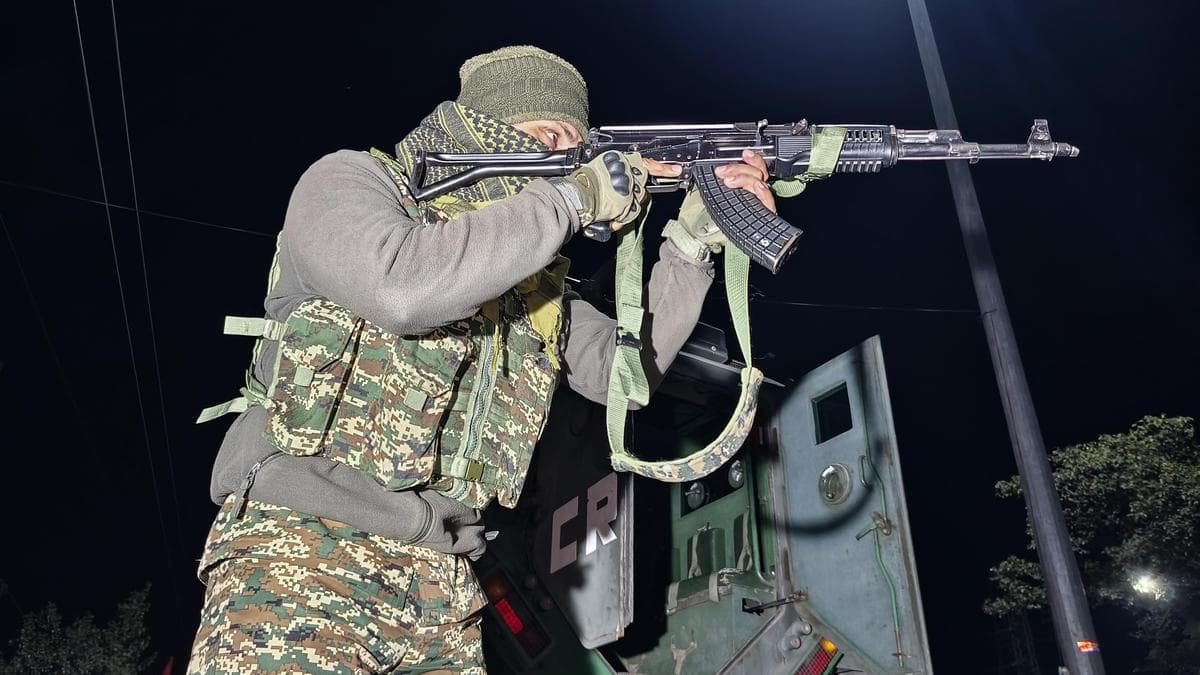
Udhampur, Jammu: Joint security forces engaged terrorists in an ongoing encounter.
Summary
An encounter unfolded in Udhampur, Jammu, where a joint team of the Special Operation Group, Army, and CRPF engaged a group of terrorists. This incident highlights the continuous counter-terrorism efforts by Indian security forces in the Jammu and Kashmir region. For competitive exams, it underscores the importance of internal security, the roles of various security agencies, and geographical knowledge of conflict zones.
Key Points
- 1The encounter took place in Udhampur district of Jammu.
- 2Security forces were engaged with a group of terrorists.
- 3A joint team comprising the Special Operation Group (SOG), Indian Army, and CRPF was involved in the operation.
- 4The incident signifies ongoing counter-terrorism operations in the Jammu and Kashmir region.
- 5The encounter was reported as 'on' (ongoing) by a police spokesman.
In-Depth Analysis
The recent encounter in Udhampur, Jammu, where a joint team of the Special Operation Group (SOG), Indian Army, and CRPF engaged a group of terrorists, is a stark reminder of the persistent security challenges faced by India in the Jammu and Kashmir region. This incident, while localized, reflects a broader, ongoing struggle against cross-border terrorism and internal insurgency that has plagued the region for decades.
**Background Context and Historical Roots:**
Jammu and Kashmir (J&K) has been a hotbed of insurgency and terrorism since the late 1980s, largely fueled by cross-border infiltration and support from hostile state actors. The region's strategic location, sharing a long and porous border with Pakistan, has made it a prime target for proxy warfare. Udhampur, specifically, is a critical location due to its significant military installations, including the Northern Command headquarters of the Indian Army, making it a sensitive area for security forces. The abrogation of Article 370 in August 2019, which revoked J&K's special status and reorganized it into two Union Territories (J&K and Ladakh), was intended to integrate the region more fully with India and curb separatist sentiments. While this move initially led to a period of heightened security and communication restrictions, it also brought about a new phase in counter-terrorism operations, with security forces maintaining high vigilance against attempts to destabilize the region.
**What Happened and Key Stakeholders:**
The encounter involved a coordinated effort by multiple security agencies. The **Indian Army** plays a crucial role in border management along the Line of Control (LoC) and in counter-insurgency operations within the hinterland. The **Central Reserve Police Force (CRPF)**, a premier Central Armed Police Force (CAPF), is extensively deployed in J&K for internal security duties, maintaining law and order, and assisting the Army in counter-terrorism operations. The **Special Operation Group (SOG)** is an elite unit of the Jammu and Kashmir Police, specialized in intelligence-led operations and direct combat with terrorists. The engagement of these forces highlights a multi-agency approach, crucial for effective counter-terrorism. The 'terrorists' involved are typically foreign infiltrators or local militants, often trained and supported by handlers from across the border, aiming to disrupt peace and cause casualties. The **local population** also plays a critical, albeit often unacknowledged, role, sometimes providing intelligence, but at other times facing intimidation or radicalization attempts.
**Significance for India:**
Such encounters carry profound significance for India. Firstly, they underscore the continuous threat to **internal security** and territorial integrity. Every such incident tests the resolve and capabilities of India's security apparatus. Secondly, the persistent threat of terrorism has significant **economic implications**. It deters investment, hampers tourism—a crucial sector for J&K's economy—and diverts substantial resources towards defense and security instead of development. Socially, it perpetuates a cycle of fear, impacts education, and can lead to the displacement of populations. Politically, these incidents challenge the state's authority and require robust governance and strategic responses. On the international front, India consistently uses such incidents to highlight the issue of **cross-border terrorism** and garner support for global counter-terrorism efforts, often pointing fingers at Pakistan for state-sponsored terrorism. This directly impacts India's foreign policy and its standing in global forums.
**Constitutional and Legal Framework:**
India's response to terrorism is underpinned by several constitutional provisions and legislative acts. **Article 355** of the Constitution places a duty on the Union to protect every State against external aggression and internal disturbance, providing the constitutional basis for deploying central forces like the Army and CRPF. The **Armed Forces (Special Powers) Act (AFSPA), 1958**, grants special powers to the armed forces in 'disturbed areas,' enabling them to maintain public order. While controversial for its provisions, security forces argue it is indispensable for operating in hostile environments. The **Unlawful Activities (Prevention) Act (UAPA), 1967**, is India's primary anti-terrorism law, allowing for detention and prosecution of individuals involved in terrorist activities and organizations. The **National Security Act (NSA), 1980**, also allows for preventive detention to prevent individuals from acting in a manner prejudicial to the security of India.
**Future Implications:**
The Udhampur encounter signals that despite efforts to normalize the situation post-Article 370 abrogation, the threat of terrorism remains potent. Future implications include continued high-alert postures by security forces, enhanced intelligence gathering, and proactive counter-insurgency operations. There will be an increased focus on strengthening the local police and intelligence apparatus. Furthermore, the Indian government's strategy will likely involve a two-pronged approach: robust security operations coupled with accelerated economic development and outreach programs to integrate the youth and address grievances, thereby countering radicalization. The situation also holds implications for regional stability and India-Pakistan relations, which remain strained due to the issue of cross-border terrorism. India's commitment to securing its borders and maintaining peace in J&K will continue to be a cornerstone of its national security policy.
Exam Tips
**GS Paper III - Internal Security (UPSC Civil Services Exam):** This topic directly falls under 'Security challenges and their management in border areas – linkages of organized crime with terrorism' and 'Role of various security forces and agencies and their mandate.' Questions can be analytical, asking about the effectiveness of multi-agency operations or the challenges faced by security forces in J&K.
**Related Topics to Study:** Alongside this, students should delve into the history of insurgency in J&K, the evolution of India's counter-terrorism strategy, the role and mandate of CAPFs (CRPF, BSF, ITBP), the provisions of AFSPA and UAPA, and border management challenges.
**Common Question Patterns:** Expect questions on the constitutional and legal framework governing internal security (e.g., AFSPA, UAPA, NIA Act), the challenges of cross-border terrorism, the role of intelligence agencies, and the socio-economic impact of conflict on regions like J&K. Factual questions on specific security forces or operations are common in SSC and State PSC exams.
**Map-Based Questions:** For all exams, be prepared for map-based questions related to J&K, identifying sensitive areas, important passes, or locations of military significance. Understanding the geography of the region is crucial for internal security topics.
Related Topics to Study
Full Article
A joint team of Special Operation Group along with the Army and the CRPF is on job, says a police spokesman