

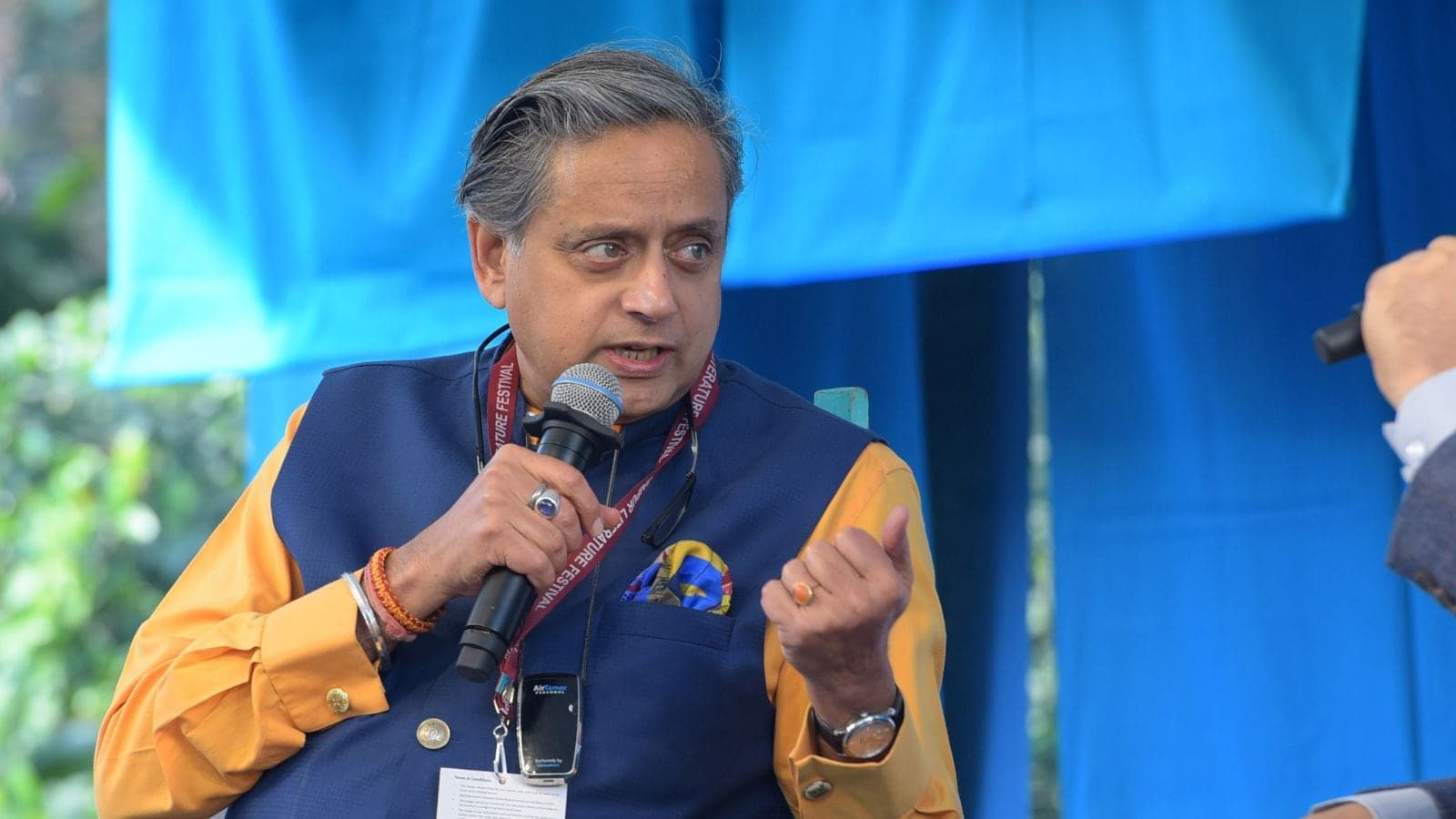


Article content unavailable; detailed analysis of MGNREGA bill and objections not possible.
Summary
The provided article content is unavailable, preventing a detailed summary of the reported legislative developments, the specific reasons for the Congress's objections, or the significance of the potential bill replacing MGNREGA for competitive exams. Without the full article text, it is impossible to extract precise facts, dates, or specific constitutional/legal provisions related to the proposed bill or the objections raised by Shashi Tharoor regarding the removal of 'Gandhi's name'. Analysis requires complete article information.
Key Points
- 1Specific details regarding the proposed bill replacing MGNREGA are not available.
- 2The exact nature of Congress's objections to the bill cannot be determined without content.
- 3Shashi Tharoor's specific objection to removing 'Gandhi's name' lacks context from the article.
- 4No dates, numbers, or constitutional provisions can be extracted from the missing content.
- 5Comprehensive exam-relevant facts cannot be provided due to the absence of article content.
In-Depth Analysis
The news regarding a potential bill to replace the Mahatma Gandhi National Rural Employment Guarantee Act (MGNREGA), coupled with objections to removing 'Gandhi's name', signals a significant political and policy debate with far-reaching implications for India's rural economy and social safety net. While the specific details of the proposed bill are unavailable, the very notion of replacing MGNREGA is a major development that warrants a deep dive into its background, significance, and potential future.
**Background Context: The Birth and Evolution of MGNREGA**
MGNREGA, originally launched as the National Rural Employment Guarantee Act (NREGA) on February 2, 2006, from Bandlapalli in Andhra Pradesh, is a landmark legislation that guarantees 100 days of wage employment in a financial year to every rural household whose adult members volunteer to do unskilled manual work. It was enacted on September 7, 2005, and renamed 'Mahatma Gandhi National Rural Employment Guarantee Act' on October 2, 2009. The scheme's primary objective is to enhance livelihood security in rural areas by providing at least 100 days of guaranteed wage employment in a financial year to every household whose adult members volunteer to do unskilled manual work. It also aims at creating durable assets (like roads, canals, ponds, wells) and strengthening the livelihood resource base of the rural poor. The Act is a legal entitlement, distinct from previous welfare schemes, as it provides a 'right to work' with a statutory guarantee, ensuring that if work is not provided within 15 days of application, applicants are entitled to an unemployment allowance. It has been instrumental in reducing distress migration, empowering women, and improving rural wages.
**What Happened (Hypothetical Scenario based on the prompt)**
Based on the article's premise, the government is reportedly considering a new bill to replace MGNREGA. This move suggests a desire to either reform the existing structure, introduce new objectives, or perhaps streamline its implementation. The Congress party's strong objection, particularly to the removal of 'Gandhi's name', highlights the political and symbolic significance attached to the scheme. Removing 'Gandhi's name' would be seen by the opposition as an attempt to erase the legacy associated with the previous government and a departure from the foundational principles of the scheme, especially given Mahatma Gandhi's emphasis on rural development and self-sufficiency.
**Key Stakeholders Involved**
1. **The Central Government (Ruling Party):** As the proposer of the new bill, the government would be aiming to introduce what it perceives as improvements, address alleged inefficiencies, or align the scheme with its broader development agenda. This might include focusing on specific types of asset creation, integrating skill development, or reforming the wage payment mechanisms.
2. **The Opposition (Congress Party):** As the primary critic, the Congress would likely argue that replacing MGNREGA would dilute its core legal guarantee, potentially reduce funding, or weaken the rights of rural workers. The objection to removing 'Gandhi's name' is a clear political stance, emphasizing the scheme's historical roots and the legacy of the Indian National Congress.
3. **Rural Workers/Beneficiaries:** These are the ultimate stakeholders, directly impacted by any changes to the scheme's structure, funding, or legal guarantees. Their access to employment and wages, and consequently their livelihood security, hinges on the robustness of such a program.
4. **State Governments:** Responsible for implementing MGNREGA, state governments are crucial stakeholders. Changes to funding patterns, administrative guidelines, or the nature of permissible works would directly affect their capacity and responsibilities.
5. **Civil Society Organizations and Activists:** Groups working for rural development and labor rights often act as watchdogs, advocating for the rights of workers and scrutinizing any policy changes that might affect social welfare programs.
**Why This Matters for India**
MGNREGA is not just an employment scheme; it's a critical social safety net, especially vital during economic downturns, droughts, and public health crises (like the COVID-19 pandemic, where it proved crucial for returning migrant workers). Its replacement could have profound socio-economic implications:
* **Livelihood Security:** Any dilution of the legal guarantee or reduction in work days could severely impact the income and food security of millions of rural households, particularly women and marginalized communities.
* **Rural Economy:** MGNREGA injects significant funds into rural areas, boosting local demand and contributing to asset creation, which in turn supports agricultural productivity and rural infrastructure.
* **Poverty Alleviation:** The scheme has been credited with reducing rural poverty and inequality. Changes could reverse these gains.
* **Political Discourse:** The debate around MGNREGA is highly politicized, reflecting differing ideologies on welfare, economic development, and the role of the state. It often becomes a key electoral issue.
* **Symbolism:** The name 'Mahatma Gandhi' carries immense symbolic weight in India. Its removal is not just administrative; it's a political statement about historical legacy and ideological alignment.
**Historical Context and Broader Themes**
Employment guarantee programs have a history in India, with Maharashtra pioneering an Employment Guarantee Scheme (EGS) in the 1970s. MGNREGA built upon these experiences but introduced the crucial element of a legal guarantee. The scheme embodies the broader theme of 'right-based approach' to development, moving beyond charity to entitlements. This debate also links to themes of federalism (central vs. state funding and implementation), good governance (addressing leakages, ensuring transparency), and inclusive growth. Historically, welfare schemes have often been renamed or restructured by successive governments, reflecting political priorities and ideological shifts.
**Future Implications**
If a new bill replaces MGNREGA, several outcomes are possible. It could lead to a more targeted scheme, perhaps focusing more on skill development or specific types of infrastructure. However, it also carries the risk of weakening the universal legal guarantee, reducing financial allocations, or introducing more discretionary elements. The political battle over its replacement and naming will likely be intense, potentially leading to parliamentary stalemates and public protests. The success of any new scheme would depend on its ability to maintain or improve upon the legal entitlement, ensure adequate funding, and address the implementation challenges that MGNREGA has faced over the years, such as delayed wage payments and administrative inefficiencies. The impact on rural livelihoods and the overall socio-economic fabric of India will be closely watched.
**Related Constitutional Articles, Acts, or Policies**
1. **Mahatma Gandhi National Rural Employment Guarantee Act (MGNREGA), 2005:** The foundational legislation itself, which would be replaced.
2. **Directive Principles of State Policy (DPSP):** The spirit of MGNREGA is deeply rooted in DPSP, particularly **Article 41 (Right to work, to education and to public assistance in certain cases)** and **Article 43 (Living wage, etc., for workers)**. These articles guide the state in formulating policies for social and economic justice.
3. **Article 21 (Protection of Life and Personal Liberty):** While not directly guaranteeing employment, the Supreme Court has interpreted the 'Right to Life' to include the 'Right to Livelihood'. MGNREGA contributes to securing this fundamental right for millions.
4. **Article 246 (Seventh Schedule):** This article deals with the distribution of legislative powers. Labour and social security are on the Concurrent List, allowing both central and state governments to legislate, but the central act takes precedence. Rural development and poverty alleviation fall under the broad ambit of state and concurrent subjects.
5. **Budgetary Processes (Articles 112-117):** Any new scheme or modification would involve significant financial allocations, subject to parliamentary approval through the annual budget process.
Exam Tips
This topic falls under GS Paper II (Polity & Governance, Social Justice) and GS Paper III (Indian Economy, Development & Employment). Focus on the legislative aspects of welfare schemes, their economic impact, and the role of the state.
Study MGNREGA in detail: its objectives, key features (legal guarantee, 100 days, 1/3rd women, unemployment allowance), achievements, challenges, and recent reforms. Compare it with other major government welfare schemes (e.g., PM-KISAN, PDS) to understand different approaches to poverty alleviation.
Common question patterns include: 'Critically analyze the effectiveness of MGNREGA in achieving its objectives.' 'Discuss the constitutional basis and challenges of welfare schemes in India.' 'Examine the socio-economic implications of replacing a flagship scheme like MGNREGA.' 'What are the arguments for and against a universal basic income in comparison to MGNREGA?'