

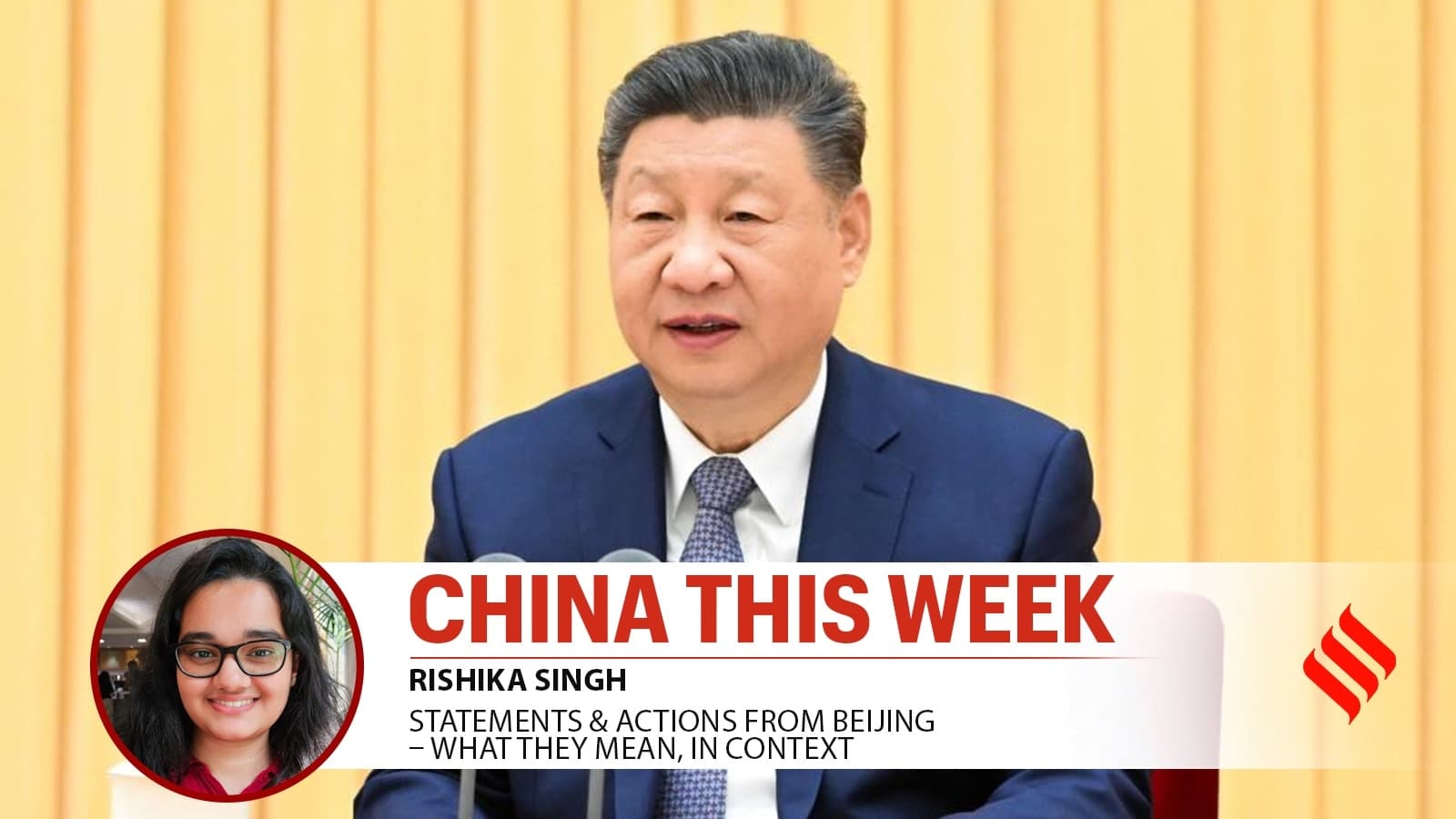


Content unavailable for 'China This Week' economic analysis.
Summary
The article titled 'China This Week' explicitly states 'No content available'. Consequently, it is impossible to extract specific facts, analyze economic challenges or solutions, or identify exam-relevant details. Therefore, a comprehensive summary and key points for competitive exam preparation cannot be generated from this input.
Key Points
- 1The provided article content is explicitly stated as 'No content available'.
- 2Specific details regarding China's economic events, challenges, or solutions cannot be extracted.
- 3Without article text, no factual data (dates, names, numbers, percentages) can be identified for MCQs.
- 4Therefore, a detailed analysis for competitive exam preparation is not feasible.
- 5The request for exam-focused key points cannot be fulfilled due to content absence.
In-Depth Analysis
The article title "China This Week | 3 events put Chinese economy in focus, detailing challenges and solutions" highlights a crucial and recurring theme in international relations and global economics. While the specific content of the article is unavailable, the very title points to the enduring importance of understanding the Chinese economy, its internal dynamics, and its profound implications for India and the world. For competitive exam aspirants, grasping the complexities of China's economic landscape is indispensable for topics spanning international relations, economics, and even internal security.
**Background Context and Historical Trajectory:**
China's economic journey over the last four decades has been nothing short of transformative. Initiated by Deng Xiaoping's "Reform and Opening Up" policy in 1978, China transitioned from a centrally planned economy to a socialist market economy. This involved gradual liberalization, attracting foreign investment, and leveraging its vast labor force to become the "world's factory." This export-led growth model propelled China to become the second-largest economy globally, lifting hundreds of millions out of poverty and reshaping global trade. However, this rapid growth came with its own set of challenges, including environmental degradation, rising income inequality, and an over-reliance on investment and exports rather than domestic consumption.
**Current Challenges and Solutions (General Overview):**
The '3 events' alluded to in the title likely pertain to some of the significant headwinds China faces today. These typically include:
1. **Demographic Crisis:** China is grappling with an aging population and a declining birth rate, partly a legacy of the one-child policy (1979-2015). This portends a shrinking workforce, increased pressure on social security and healthcare, and a potential decline in consumer demand. Solutions involve encouraging larger families (e.g., three-child policy introduced in 2021), improving social welfare, and leveraging automation and AI to offset labor shortages.
2. **Real Estate Sector Debt:** The colossal real estate sector, which accounts for a significant portion of China's GDP, has been plagued by massive debt, epitomized by the Evergrande crisis. This has ripple effects on the financial system, local government finances (heavily reliant on land sales), and consumer confidence. The government's solution involves deleveraging efforts, supporting viable developers, and shifting focus towards affordable housing, though the process is delicate to avoid a systemic financial crisis.
3. **US-China Trade and Technology War/Geopolitical Tensions:** Ongoing trade disputes, tariffs, and restrictions on technology transfer (especially in semiconductors) from the US and its allies have forced China to prioritize technological self-reliance. This push for indigenous innovation, encapsulated by the "dual circulation" strategy (emphasizing domestic demand while remaining open to international trade), aims to reduce vulnerability to external shocks. Geopolitical tensions further impact foreign direct investment and market access.
4. **High Debt Levels (Local Government & Corporate):** Beyond real estate, overall corporate and local government debt remains a concern, posing risks to financial stability. The government is attempting to rein in speculative lending and rationalize local government financing vehicles.
5. **Domestic Consumption Slump:** Post-pandemic recovery has been uneven, with consumer confidence remaining subdued, impacting retail sales and service sectors. Policies aim to boost domestic demand through various incentives and social safety nets.
**Key Stakeholders Involved:**
* **Chinese Communist Party (CCP):** The ultimate decision-maker, setting economic policy, managing state-owned enterprises (SOEs), and regulating private sector activities. Its stability and legitimacy are intrinsically linked to economic performance.
* **Chinese Enterprises (SOEs and Private):** The engines of growth, facing both opportunities and increasing regulatory scrutiny. SOEs play a strategic role in critical sectors, while private firms drive innovation and employment.
* **Chinese Citizens:** Consumers, workers, and investors whose confidence and spending patterns are crucial for domestic demand and social stability.
* **Global Corporations and Investors:** Operating in China, they navigate market opportunities, regulatory complexities, and geopolitical risks.
* **International Bodies (IMF, WTO):** Monitor China's economic policies and their global impact.
**Significance for India:**
China's economic trajectory holds immense significance for India:
* **Trade Deficit:** India faces a persistent and widening trade deficit with China (e.g., over $80 billion in FY23), primarily due to India's reliance on Chinese imports for critical components (APIs, electronics, machinery). A slowdown in China could impact these supply chains but also potentially create opportunities for India to diversify.
* **Investment:** Chinese investments in Indian startups and infrastructure have been significant, though they have come under increased scrutiny, especially since the 2020 border clashes. India has tightened FDI rules, particularly for investments from bordering countries.
* **Global Supply Chains:** As global companies look to de-risk and diversify supply chains away from China ("China+1 strategy"), India sees this as a major opportunity to attract manufacturing and become a global production hub, supported by schemes like Production Linked Incentives (PLI).
* **Geopolitical Competition:** Economic strength underpins geopolitical influence. China's economic challenges might reduce its ability to project power, but also push it to secure resources and markets more aggressively. India needs to navigate this complex dynamic, particularly in its neighborhood.
* **Learning Curve:** India can learn from China's infrastructure development, manufacturing scale, and poverty alleviation strategies, adapting them to its own democratic context.
**Related Constitutional Articles, Acts, or Policies (Indian Context):**
While China's economy is distinct, India's response and policies are framed within its constitutional and legal framework:
* **Article 51 (Directive Principles of State Policy):** Directs the state to promote international peace and security and maintain just and honorable relations between nations, influencing India's foreign economic policy.
* **Foreign Trade Policy (FTP):** Governs India's export and import policies, tariffs, and trade agreements, directly impacting trade with China.
* **Production Linked Incentive (PLI) Schemes:** A key policy initiative under the 'Atmanirbhar Bharat' (Self-Reliant India) mission, designed to boost domestic manufacturing across various sectors, reduce import dependence (including from China), and integrate India into global supply chains.
* **Foreign Direct Investment (FDI) Policy:** Regulations on foreign investment, including the 2020 amendment requiring government approval for FDI from countries sharing a land border with India, significantly impacting Chinese investments.
**Future Implications:**
China's economic challenges suggest a period of slower, more qualitative growth. This has several implications: a less robust global demand driver, potential for increased internal social pressures in China, and a continued push for technological self-reliance and domestic consumption. For India, this presents both challenges (e.g., slower growth in a major trading partner) and opportunities (e.g., attracting diverted investment and manufacturing, strengthening its own economic resilience and reducing strategic dependencies). India's ability to capitalize on these shifts will depend on its policy agility, investment in infrastructure, and human capital development. The world will closely watch how China manages its economic transition and how India positions itself in the evolving global economic order.
Exam Tips
This topic falls under GS Paper 2 (International Relations: India and its neighborhood-relations, Bilateral, regional and global groupings and agreements involving India) and GS Paper 3 (Indian Economy: Effects of liberalization on the economy, changes in industrial policy and their effects on industrial growth; Science and Technology- developments and their applications and effects in everyday life).
Study related topics such as India-China bilateral relations (including border disputes, cultural exchanges), global supply chain resilience and diversification, demographic dividend vs. demographic burden, and India's 'Atmanirbhar Bharat' initiative and Production Linked Incentive (PLI) schemes.
Common question patterns include analytical questions on the impact of China's economic slowdown on India, essay questions on the future of India-China economic relations, and objective questions on specific Chinese economic policies (e.g., dual circulation) or Indian policies (e.g., FDI rules, PLI schemes) related to trade and investment.