



Relevant for Exams
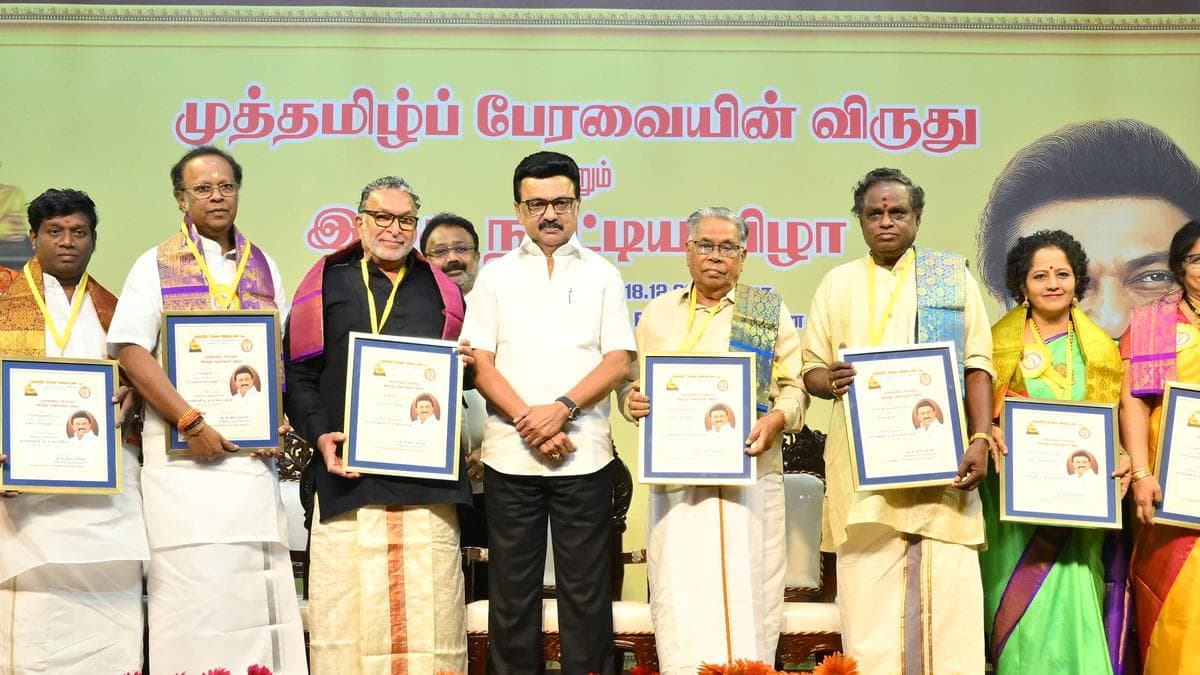
TN CM M.K. Stalin presented Muthamizh Peravai awards to artistes.
Summary
Chief Minister M.K. Stalin presented Muthamizh Peravai awards to artistes, an event signifying the Tamil Nadu government's commitment to recognizing cultural contributions. While specific details regarding the recipients and date are unavailable, such awards are important for state-level competitive exams to understand government initiatives in arts and culture.
Key Points
- 1The awards were presented by Chief Minister M.K. Stalin.
- 2The name of the awards conferred is "Muthamizh Peravai awards".
- 3The recipients of these awards are identified as "artistes".
- 4This event signifies a cultural recognition initiative by the Tamil Nadu state government.
- 5The news is relevant for state-level competitive exams focusing on cultural awards and government patronage in Tamil Nadu.
In-Depth Analysis
The presentation of "Muthamizh Peravai awards" by Chief Minister M.K. Stalin to artistes signifies a crucial aspect of state governance in India: the promotion and preservation of regional language and culture. This event, while seemingly localized to Tamil Nadu, holds broader implications for understanding India's diverse cultural fabric and the role of state governments in nurturing it.
**Background Context and Historical Roots:**
Tamil Nadu boasts one of the world's oldest living cultures and languages, Tamil, which holds the status of a classical language in India. The state's history is replete with dynasties like the Cholas, Pandyas, and Cheras, who were ardent patrons of art, literature, music, and drama. This historical legacy of state patronage laid the groundwork for modern governmental initiatives. Post-independence, the Dravidian movement, which gained significant political traction in Tamil Nadu, placed immense emphasis on Tamil identity, language, and culture. Leaders like C.N. Annadurai and M. Karunanidhi consistently championed the cause of Tamil language and arts, often framing it as a counter-narrative to perceived linguistic and cultural hegemony. This historical context explains the deep-seated commitment of successive Tamil Nadu governments to cultural promotion, viewing it not just as a policy but as an integral part of their political and social philosophy.
**What Happened: The Muthamizh Peravai Awards:**
Chief Minister M.K. Stalin presented the "Muthamizh Peravai awards" to various artistes. The term "Muthamizh" literally translates to "Triple Tamil" and traditionally refers to the three primary forms of Tamil expression: Iyal (literature/prose), Isai (music), and Nadagam (drama). "Peravai" means an assembly or council. Thus, the awards, by their very name, aim to provide comprehensive recognition to individuals who have made significant contributions across these diverse domains of Tamil arts. While specific details of recipients are not available, the act itself underscores the state's intent to honor cultural torchbearers and encourage the continuity of traditional and contemporary Tamil artistic forms.
**Key Stakeholders Involved:**
1. **Tamil Nadu Government (Chief Minister M.K. Stalin):** As the primary patron, the government initiates and funds these awards, reflecting its policy commitment to cultural preservation and promotion. The Chief Minister's personal involvement adds significant weight and visibility to the initiative.
2. **Department of Tamil Development / Art and Culture:** These state departments are typically responsible for identifying eligible artistes, organizing the award ceremonies, and implementing broader cultural policies.
3. **Artistes:** The recipients are the core beneficiaries and, more importantly, the custodians and innovators of Tamil culture. Their recognition serves as an encouragement for their continued work and inspires younger generations.
4. **Tamil Society:** The awards reinforce cultural pride and provide a platform for the public to appreciate the rich heritage of their state.
**Significance for India and Broader Themes:**
This initiative holds profound significance for India. Firstly, it highlights the vibrant linguistic and cultural diversity that defines the nation. India is a union of states, each with its unique cultural identity, and the active promotion of regional arts by state governments is crucial for maintaining this pluralism. Such awards contribute to the "soft power" of India, showcasing its rich heritage on a global stage. Economically, while direct impact might be limited, cultural promotion can indirectly boost tourism, create employment in related industries (e.g., handicrafts, cultural events management), and foster a creative economy. Socially, these awards foster a sense of identity, pride, and cohesion among the populace. This also connects to the broader theme of federalism, where states exercise autonomy in cultural matters, contributing to the overall strength of the Indian Union.
**Constitutional and Policy References:**
Several constitutional provisions implicitly support such state-level cultural initiatives:
* **Article 29 (Protection of interests of minorities):** While Tamil is a majority language in Tamil Nadu, this article broadly safeguards the cultural rights of any section of citizens having a distinct language, script, or culture. This underpins the state's responsibility to preserve and promote its unique cultural identity.
* **Article 350A (Facilities for instruction in mother-tongue at primary stage):** This article, while specific to education, reflects the constitutional emphasis on linguistic identity and the mother tongue, which is intrinsically linked to cultural promotion.
* **Seventh Schedule (State List):** "Theatres and dramatic performances; cinemas subject to the provisions of entry 60 of List I; sports, entertainments and amusements" (Entry 33) and "Libraries, museums and other similar institutions controlled or financed by the State; ancient and historical monuments and records other than those declared by or under law made by Parliament to be of national importance" (Entry 12) fall under the State List. This explicitly grants state governments the legislative and executive competence to undertake initiatives like cultural awards and promote arts.
* **Directive Principles of State Policy (DPSP):** Although not directly enforceable, the spirit of promoting education, culture, and the overall welfare of the people, as enshrined in Part IV of the Constitution, encourages state action in these areas.
**Future Implications:**
The continued presentation of awards like the Muthamizh Peravai awards suggests a sustained commitment by the Tamil Nadu government to its cultural agenda. This could lead to increased funding for cultural institutions, the establishment of more academies and research centers for Tamil arts, and greater promotion of Tamil culture globally, especially among the Tamil diaspora. Challenges might include ensuring inclusivity across various art forms and regions, adapting to modern artistic expressions while preserving traditional ones, and securing adequate financial resources. Nevertheless, such initiatives are vital for ensuring that India's rich cultural heritage continues to thrive and evolve for generations to come.
Exam Tips
This topic falls under 'Art & Culture' (State Specific) and 'Current Affairs' in the UPSC, State PSC, and SSC syllabi. Focus on the purpose of the awards and the cultural significance for Tamil Nadu.
Related topics to study include other major state and national cultural awards (e.g., Sangeet Natak Akademi Awards, Padma Awards), the history of the Dravidian movement, and the cultural policies of various state governments.
Common question patterns can include: 'What is Muthamizh Peravai related to?', 'Which state government presents the Muthamizh Peravai awards?', 'Which constitutional articles empower states to promote culture?', or questions about the three components of 'Muthamizh'.