



Relevant for Exams
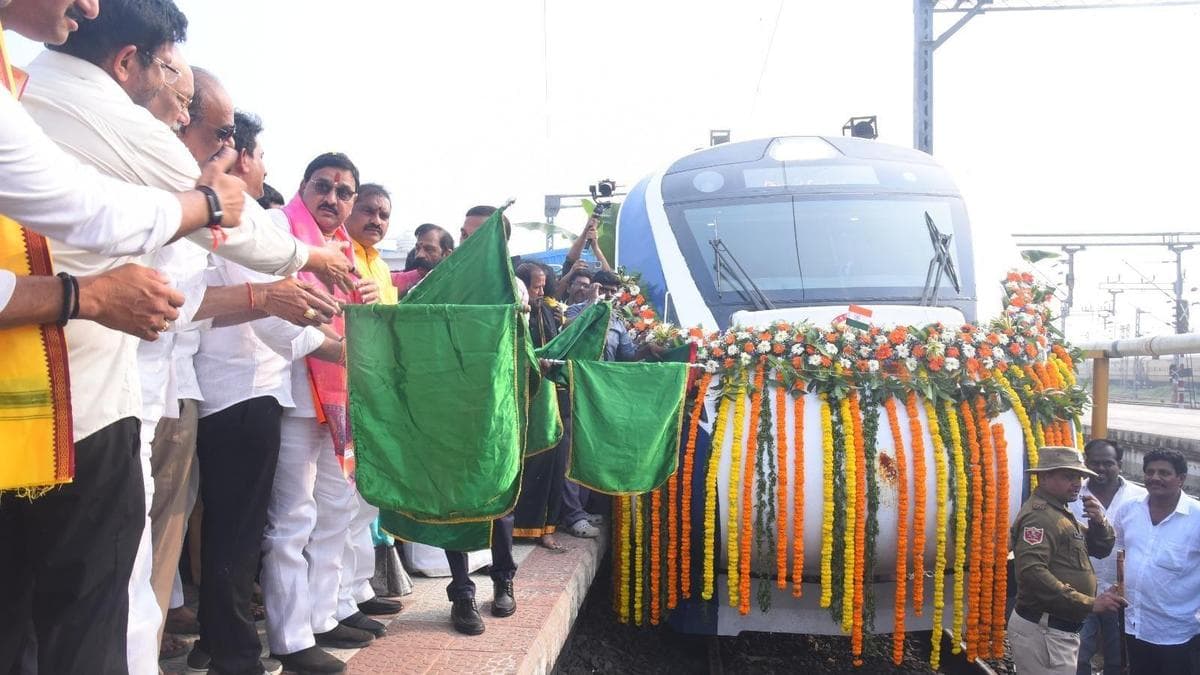
Narsapur-MGR Chennai Central Vande Bharat Express launched, boosting regional rail connectivity.
Summary
A new Vande Bharat Express service has commenced, connecting Narsapur to MGR Chennai Central station. This initiative enhances regional rail connectivity and signifies the ongoing expansion of India's modern semi-high-speed train network. For competitive exams, this highlights government focus on infrastructure development and specific railway routes, important for general awareness and transport geography.
Key Points
- 1The new Vande Bharat Express service connects Narsapur as its origin station.
- 2The destination for this Vande Bharat Express is MGR Chennai Central station.
- 3The train is a Vande Bharat Express, part of India's semi-high-speed rail network.
- 4Key intermediate halts include Bhimavaram Town, Gudivada, Vijayawada, Tenali, Ongole, Nellore, and Renigunta.
- 5The launch contributes to the expansion of modern railway infrastructure across India.
In-Depth Analysis
The launch of the Vande Bharat Express connecting Narsapur to MGR Chennai Central marks another significant stride in India's ongoing railway modernization journey. This event is not merely about a new train service; it encapsulates the broader vision of enhancing connectivity, promoting indigenous manufacturing, and boosting regional development across the nation.
**Background Context and Evolution of Indian Railways:**
Indian Railways, one of the world's largest railway networks, has been the backbone of India's transport system since its inception in 1853. While it has historically focused on expanding its reach and carrying capacity, recent decades have seen a concerted push towards speed, comfort, and technological advancement. The 'Make in India' initiative, launched in 2014, provided a significant impetus for domestic manufacturing across various sectors, including railways. This policy aimed to reduce reliance on imports, foster innovation, and create jobs within the country. The Vande Bharat Express project emerged directly from this vision, conceived as India's first semi-high-speed, self-propelled train set, designed and manufactured entirely within India by the Integral Coach Factory (ICF) in Chennai. The first Vande Bharat Express was flagged off in February 2019, connecting Delhi and Varanasi, setting a new benchmark for rail travel in India.
**The Specifics of the Narsapur-Chennai Vande Bharat Launch:**
This particular Vande Bharat Express service links Narsapur to MGR Chennai Central, traversing through key towns like Bhimavaram Town, Gudivada, Vijayawada, Tenali, Ongole, Nellore, and Renigunta. This route is strategically important for connecting a significant part of Andhra Pradesh, particularly the coastal regions, with the major metropolitan hub of Chennai. The service aims to drastically cut down travel time, offering a more convenient and efficient mode of transport for passengers. The stops chosen reflect a balance between catering to major population centers and maintaining the semi-high-speed character of the train.
**Key Stakeholders Involved:**
Several key stakeholders are central to such initiatives. Firstly, the **Ministry of Railways** and **Indian Railways** itself are the primary drivers, responsible for policy formulation, infrastructure development, and operational management. The **Integral Coach Factory (ICF) Chennai** is a crucial stakeholder, being the indigenous manufacturer of these state-of-the-art train sets, embodying the success of the 'Make in India' program. **Passengers** are direct beneficiaries, gaining from improved connectivity, reduced travel times, and enhanced comfort. **Local economies** along the route, including those in Narsapur, Bhimavaram Town, and other halting stations, stand to benefit from increased tourism, business activity, and ancillary services. Finally, the **Central Government** provides the overarching policy framework and financial support for such large-scale infrastructure projects.
**Significance for India:**
This new service holds multi-faceted significance for India. Economically, it promises to invigorate regional trade and tourism by facilitating faster movement of people, thereby boosting local businesses and creating both direct and indirect employment opportunities. Socially, it enhances regional integration, making inter-state travel more accessible and comfortable for citizens. From an infrastructure perspective, it's a testament to India's commitment to modernizing its railway network, aligning with the broader objectives of the **National Rail Plan (NRP) 2030** and the **PM Gati Shakti National Master Plan**. The NRP 2030 aims to create a 'future-ready' railway system, while Gati Shakti seeks to integrate infrastructure planning for multi-modal connectivity, ensuring seamless movement of people and goods. Furthermore, the Vande Bharat Express series showcases India's technological prowess and manufacturing capabilities, reinforcing the 'Make in India' narrative on a global stage.
**Constitutional and Policy Context:**
Railways fall under the **Union List** (Entry 22) of the **Seventh Schedule** of the Indian Constitution, granting the central government exclusive legislative and executive powers over this sector. This constitutional provision underpins the central government's authority to plan, fund, and execute large-scale railway projects like the Vande Bharat network. The development of Vande Bharat trains is also a direct outcome of government policies such as 'Make in India' and 'Atmanirbhar Bharat' (Self-Reliant India), which prioritize indigenous development and manufacturing to reduce import dependence and boost domestic industries. The **Railway Act, 1989**, governs the operation and management of railways in India, providing the legal framework for services like this.
**Future Implications:**
The successful rollout of more Vande Bharat services, including this Narsapur-Chennai route, signifies a clear trajectory for the future of Indian Railways. The government plans to introduce hundreds of such trains across the country, connecting all major cities. Beyond the existing chair car versions, prototypes for **Vande Sleeper** trains are under development to cater to longer overnight journeys. Furthermore, **Vande Metro** services are envisioned for short-distance intercity travel, akin to regional rapid transit systems. This expansion not only promises to transform passenger experience but also positions India as a potential exporter of advanced railway technology, further strengthening its economic and strategic standing on the global stage. The continued focus on enhancing speed, safety, and efficiency through technological upgrades and infrastructure development will be crucial for India's sustained growth and connectivity.
Exam Tips
This topic falls under 'Indian Geography (Transport)' and 'Indian Economy (Infrastructure)' in the UPSC Civil Services Exam (Prelims & Mains GS-I/III), State PSCs, SSC, and other competitive exams. It's also vital for 'Current Affairs' and 'Government Schemes'.
Study related topics like the National Rail Plan 2030, PM Gati Shakti National Master Plan, Dedicated Freight Corridors (DFCs), High-Speed Rail (Bullet Train) projects, and the 'Make in India' initiative. Understand the economic and social benefits of infrastructure development.
Common question patterns include direct questions on the Vande Bharat Express's features, manufacturing location (ICF Chennai), key routes, and its connection to government policies. Expect questions comparing it with other types of trains or its role in regional development and indigenous technology.
Be prepared for questions on the constitutional provisions related to railways (Seventh Schedule - Union List, Entry 22) and the institutional framework (Ministry of Railways, Railway Board).
Memorize the names of key stations on significant routes, especially those connecting state capitals or major economic hubs, as these are frequently asked in general knowledge sections.
Related Topics to Study
Full Article
The train will halt at Bhimavaram Town, Gudivada, Vijayawada, Tenali, Ongole, Nellore and Renigunta before reaching MGR Chennai Central station