

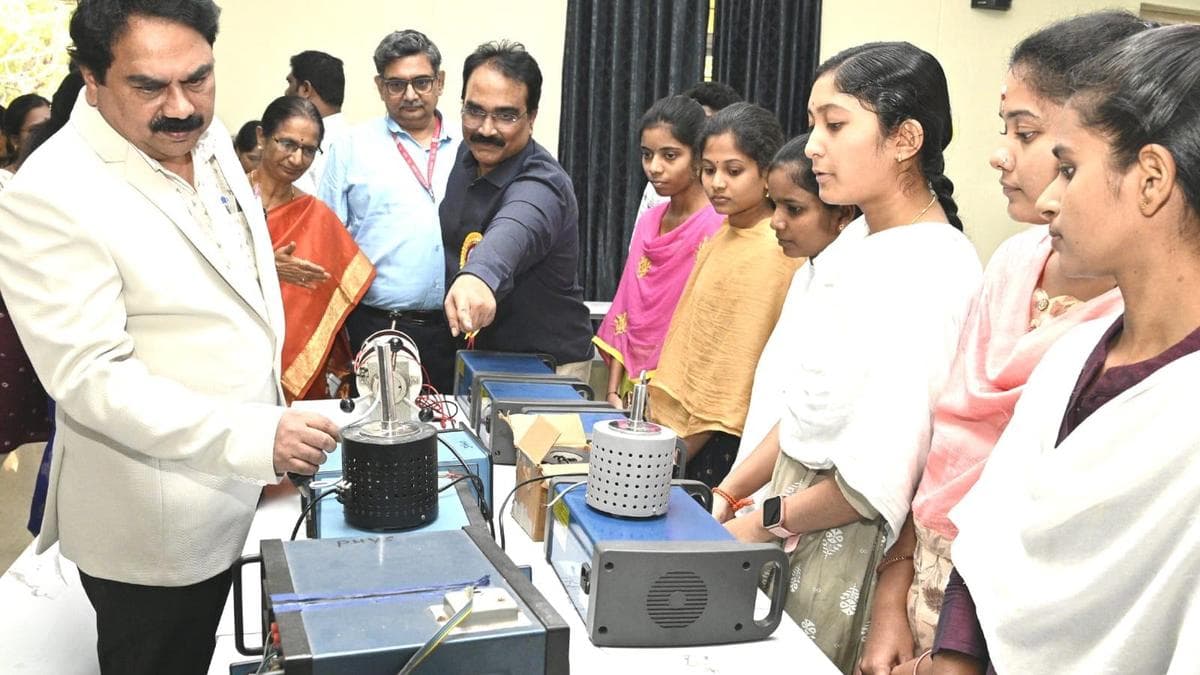


Article content missing; unable to extract specific facts on laboratory excellence.
Summary
The provided article explicitly states 'No content available', making it impossible to extract specific details, events, or their significance for competitive exam preparation. While the title 'Call to build a culture of laboratory excellence' suggests a national initiative related to scientific or health infrastructure, without the actual text, no factual analysis or precise summary can be generated for exam purposes.
Key Points
- 1No article content was provided for analysis.
- 2Specific facts, dates, names, or numbers cannot be extracted.
- 3Unable to identify any constitutional or legal provisions.
- 4The significance for competitive exams cannot be assessed without text.
- 5Please provide the full article content for a complete analysis.
In-Depth Analysis
The title "Call to build a culture of laboratory excellence", while lacking specific article content, strongly indicates a national emphasis on improving the quality and reliability of laboratory services across India. This is a critical area with far-reaching implications for public health, scientific research, industrial standards, and international trade. Understanding this theme requires delving into the underlying necessity, the current landscape, and the potential future trajectory.
**Background Context:** India's scientific and technological journey has been remarkable, yet challenges persist in maintaining uniform high standards across its vast network of laboratories. The COVID-19 pandemic served as a stark reminder of the indispensable role of robust diagnostic and research laboratory infrastructure. It highlighted the need for rapid, accurate testing, reliable data, and swift research capabilities. Prior to the pandemic, concerns regarding the quality of diagnostic tests, pharmaceutical products, and environmental monitoring often surfaced, underscoring the fragmented nature of quality control. Initiatives like 'Make in India' and 'Aatmanirbhar Bharat' further necessitate a strong emphasis on quality to ensure that Indian products and services meet global benchmarks.
Historically, while premier institutions in India have maintained high standards, a significant portion of laboratories, particularly in the public and smaller private sectors, have struggled with issues like outdated equipment, lack of skilled personnel, insufficient funding for calibration and maintenance, and inconsistent adherence to quality management systems. This creates a gap between aspirations for scientific leadership and the ground reality of quality assurance.
**What This Call Implies:** A 'call to build a culture of laboratory excellence' suggests a concerted effort to move beyond mere compliance to fostering an ingrained ethos of quality, precision, and reliability. This would involve systematic improvements in infrastructure, personnel training, standardization, accreditation, and regulatory oversight. It's not just about acquiring new machines but about cultivating a mindset where accuracy, ethical practice, and continuous improvement are paramount.
**Key Stakeholders Involved:** This initiative would involve a diverse array of stakeholders. The **Government of India**, through ministries like Health & Family Welfare, Science & Technology, Environment, Forests & Climate Change, and Commerce & Industry, would be central in formulating policies and providing funding. **Regulatory bodies** such as the National Accreditation Board for Testing and Calibration Laboratories (NABL) under the Quality Council of India (QCI), the Bureau of Indian Standards (BIS), and the Central Drugs Standard Control Organization (CDSCO) would play crucial roles in setting standards and accreditation. **Research institutions** (e.g., ICMR, CSIR, DBT institutes) and **universities** are vital for cutting-edge research and training. The **private sector**, encompassing diagnostic chains, pharmaceutical companies, and industrial testing labs, is a major service provider and would need to adopt and drive these standards. Finally, **healthcare professionals, scientists, and technicians** are the frontline implementers of laboratory practices.
**Significance for India:** The push for laboratory excellence holds immense significance for India. **Public Health** stands to gain immensely from accurate diagnostics, effective disease surveillance, and robust vaccine/drug development. This directly impacts citizen well-being and improves pandemic preparedness. In **Research & Development**, credible laboratory results are the bedrock of scientific progress, fostering innovation and enhancing India's global standing in science. **Economically**, adherence to international quality standards is crucial for India's exports, especially in pharmaceuticals, food products, and manufactured goods. It builds trust in 'Made in India' products and makes India a more attractive destination for R&D investment. Socially, it builds public trust in scientific institutions and healthcare systems, ensuring equitable access to reliable services. Environmentally, accurate lab testing is vital for monitoring pollution and ensuring compliance with environmental regulations.
**Constitutional & Policy References:** While there isn't one specific article, the theme touches upon several constitutional principles. **Article 47** of the Directive Principles of State Policy mandates the State to improve public health. The **Seventh Schedule** distributes responsibilities: 'Public Health and Sanitation' (State List), 'Scientific Research' and 'Coordination and determination of standards in institutions for higher education or research' (Union List), and 'Education' (Concurrent List). Key legislation includes the **Drugs and Cosmetics Act, 1940**, which regulates drug quality; the **Food Safety and Standards Act, 2006**; and the **Environment (Protection) Act, 1986**. Government policies like the **National Health Policy**, **National Policy on Science, Technology and Innovation (STI Policy)**, and initiatives such as the **National Health Mission** and the **Ayushman Bharat Digital Mission** all implicitly or explicitly rely on strong laboratory infrastructure and quality assurance.
**Future Implications:** A successful drive towards laboratory excellence would lead to a more standardized and accredited laboratory ecosystem across India. This would foster greater collaboration, facilitate data sharing, and enhance the country's capacity to respond to health crises and drive scientific breakthroughs. It could position India as a global hub for research, development, and high-quality manufacturing, attracting foreign investment and talent. The emphasis on quality will also trickle down to education, promoting better training for future scientists and technicians, thereby creating a virtuous cycle of improvement and innovation.
Exam Tips
This topic primarily falls under GS Paper II (Governance, Social Justice - Health) and GS Paper III (Science & Technology, Indian Economy - Industry, Infrastructure). Be prepared for questions on government initiatives, regulatory bodies, and the socio-economic impact of quality standards.
Study related topics such as the structure and functions of NABL, QCI, BIS, and CDSCO. Understand the National Health Policy, Science, Technology and Innovation Policy, and major government schemes related to health infrastructure and R&D funding.
Common question patterns include: 'Discuss the challenges in achieving laboratory excellence in India and suggest measures.' 'Analyze the role of accreditation bodies in ensuring quality standards in Indian laboratories.' 'Examine the impact of robust laboratory infrastructure on India's public health and economic growth.'
Focus on recent government policies and initiatives aimed at boosting R&D and quality standards. Understand the difference between quality control, quality assurance, and accreditation.
Be ready to link this topic to broader themes like 'Make in India', 'Aatmanirbhar Bharat', and India's global competitiveness in sectors like pharmaceuticals and biotechnology.