



Relevant for Exams
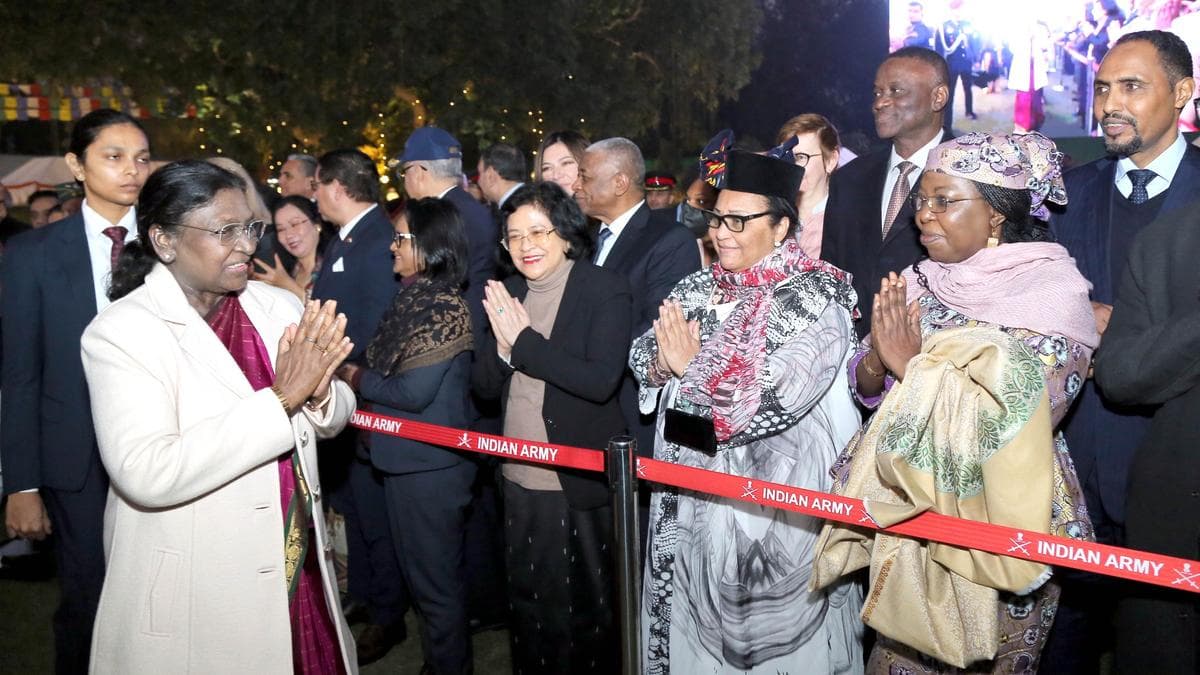
Army celebrates Vijay Diwas, highlighting 1971 victory and indigenous defence technology.
Summary
The Indian Army celebrated Vijay Diwas, commemorating India's decisive victory in the 1971 war against Pakistan. This annual event highlights the Army's ongoing transformation into a modern, innovative, and self-reliant force, emphasizing the crucial role of indigenous technology in national defence. For competitive exams, understanding the historical context of Vijay Diwas and India's 'Atmanirbhar Bharat' initiative in defence is vital.
Key Points
- 1Vijay Diwas is celebrated annually on December 16.
- 2It commemorates India's victory over Pakistan in the 1971 Indo-Pak War.
- 3The war led to the liberation of Bangladesh (formerly East Pakistan).
- 4Approximately 93,000 Pakistani soldiers surrendered to the Indian Army in 1971.
- 5The celebrations emphasized the Indian Army's transformation towards a modern, innovative, and self-reliant force, leveraging indigenous technology.
In-Depth Analysis
Vijay Diwas, celebrated annually on December 16, is a poignant reminder of India's decisive military victory over Pakistan in the 1971 Indo-Pak War, which led to the liberation of Bangladesh. More than just a commemoration of a historical event, the recent celebrations, as highlighted by the Defence Ministry, underscore the Indian Army's ongoing transformation into a modern, innovative, and self-reliant force, with a particular emphasis on indigenous technology. This dual focus—remembering past glory and looking towards future self-sufficiency—is critical for understanding India's strategic trajectory.
The background to the 1971 war is rooted in the flawed partition of British India in 1947, which created East and West Pakistan as a single nation geographically separated by over 1,600 kilometers of Indian territory. This geographical absurdity was compounded by deep-seated cultural, linguistic, and economic disparities. East Pakistan, predominantly Bengali-speaking and culturally distinct, felt marginalized and exploited by the Urdu-speaking political and military elite of West Pakistan. The breaking point arrived with the 1970 general elections, where the Awami League, led by Sheikh Mujibur Rahman, swept the polls in East Pakistan, securing an overall majority in the national assembly. However, the West Pakistani establishment refused to hand over power, leading to widespread protests. In March 1971, the Pakistani military launched 'Operation Searchlight,' a brutal crackdown aimed at suppressing Bengali nationalism, resulting in widespread atrocities, genocide, and a massive refugee influx into India. Estimates suggest nearly 10 million refugees poured into India, primarily West Bengal, Tripura, and Assam, creating an unbearable economic and social burden.
India, under Prime Minister Indira Gandhi, initially provided humanitarian aid and covert support to the Mukti Bahini (Bengali liberation forces). As the refugee crisis escalated and international efforts to resolve the conflict failed, India decided to intervene. On December 3, 1971, Pakistan launched pre-emptive air strikes on Indian airfields, triggering a full-scale war. The Indian Armed Forces—Army, Navy, and Air Force—launched a coordinated multi-front offensive. The swift campaign in the East culminated in the surrender of approximately 93,000 Pakistani soldiers, led by Lt. Gen. A.A.K. Niazi, to the joint command of Indian forces and Mukti Bahini, headed by Lt. Gen. Jagjit Singh Aurora, on December 16, 1971, in Dhaka. This historic surrender marked the birth of Bangladesh as an independent nation.
Key stakeholders in this conflict included the Indian government and its armed forces, particularly Prime Minister Indira Gandhi and Chief of Army Staff General Sam Manekshaw, whose strategic acumen was pivotal. On the Pakistani side, President Yahya Khan and later Zulfiqar Ali Bhutto led a regime that fundamentally miscalculated the situation. The Awami League and the Mukti Bahini were the primary representatives of the aspirations of East Pakistan. Internationally, the United States, under President Nixon, tilted towards Pakistan, even sending its Seventh Fleet to the Bay of Bengal, while the Soviet Union solidified its support for India through the Indo-Soviet Treaty of Peace, Friendship and Cooperation signed in August 1971, providing crucial diplomatic and military backing, effectively deterring Chinese intervention.
The significance of Vijay Diwas for India is multifaceted. It cemented India's position as a regional power, demonstrating its military prowess and diplomatic skill. It was also a humanitarian intervention that ended a genocide. The war significantly altered the geopolitical landscape of South Asia, transforming India's western and eastern borders. Today, the celebration's emphasis on indigenous technology reflects India's ambition for 'Atmanirbhar Bharat' (self-reliant India) in defence. This matters immensely for national security, reducing dependence on foreign suppliers, boosting domestic industry, creating jobs, and fostering technological innovation. Policies like the Defence Acquisition Procedure (DAP) 2020, which prioritizes Indian design, development, and manufacturing, and the establishment of defence industrial corridors, are direct manifestations of this commitment. This aligns with the broader constitutional framework, where defence is a Union List subject (Seventh Schedule, Entry 1, 2, 4), underscoring the central government's exclusive responsibility for national security and military preparedness.
The future implications are profound. India's push for defence indigenization is not merely about manufacturing hardware but about building a robust defence ecosystem involving research and development (DRDO), public sector undertakings (PSUs), and a growing private sector. This will enable India to address evolving threats, from conventional warfare to cyber and space warfare, with tailored, cutting-edge solutions. Furthermore, a self-reliant defence industry can become a significant exporter, enhancing India's strategic influence and economic standing globally. The lessons from 1971, particularly the need for swift decision-making and robust military capabilities, continue to guide India's strategic thinking, ensuring its armed forces remain agile, modern, and equipped to protect national interests in an increasingly complex global environment.
Exam Tips
**Syllabus Section & Related Topics**: This topic primarily falls under 'Modern Indian History' (Post-Independence India), 'Indian Polity and Governance' (Defence and Security), and 'International Relations' (India's foreign policy, India-Pakistan/Bangladesh relations). Students should study it alongside topics like the Cold War's impact on India, India's defence policy evolution, and the 'Atmanirbhar Bharat' initiative.
**Common Question Patterns**: Expect questions on the causes and consequences of the 1971 war, key figures (Indira Gandhi, Sam Manekshaw, Sheikh Mujibur Rahman), the timeline of events leading to the liberation of Bangladesh, and the significance of Vijay Diwas. In current affairs, questions may focus on government policies for defence indigenization (e.g., DAP 2020, Defence Corridors) and India's role in regional security.
**Constitutional & Policy References**: Be prepared to quote relevant constitutional entries (e.g., Union List entries related to defence) and government policies (e.g., Defence Acquisition Procedure, Make in India in Defence). Understand how these policies aim to achieve self-reliance and modernize the armed forces.
**Analytical & Comparative Questions**: For UPSC Mains, be ready for analytical questions comparing the 1971 war with other conflicts, discussing its impact on India's foreign policy, or critically evaluating the progress of defence indigenization efforts. For Prelims, focus on factual details, dates, and names.
Related Topics to Study
Full Article
The Defence Ministry said the celebrations highlighted the Indian Army’s steady transformation into a modern, innovative and self-reliant force