



Relevant for Exams
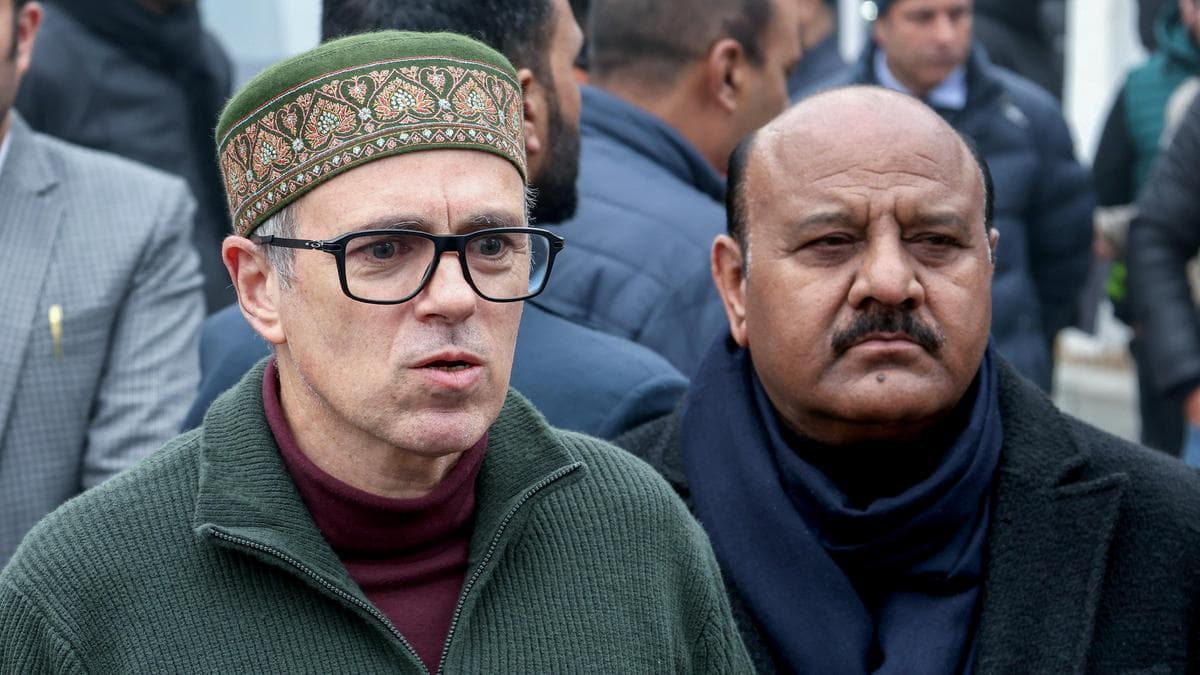
Omar Abdullah demands action against MLAs for interfering in national power projects in Kishtwar.
Summary
Former Jammu & Kashmir Chief Minister Omar Abdullah has urged serious action against opposition MLAs for allegedly interfering with power projects in Kishtwar. Abdullah emphasized that these projects are institutions of national importance, crucial not just for J&K but for the entire country's development. This highlights the challenges of political interference in critical infrastructure projects in strategic regions, which is significant for understanding governance and development issues for competitive exams.
Key Points
- 1Former J&K Chief Minister Omar Abdullah made a statement regarding interference in power projects.
- 2The alleged interference specifically concerns power projects located in the Kishtwar district of Jammu & Kashmir.
- 3Abdullah stressed that these power projects are classified as 'institutions of national importance'.
- 4He highlighted that the benefits of these projects extend beyond J&K to the 'entire country'.
- 5The call for action is directed against opposition MLAs accused of hindering project progress.
In-Depth Analysis
The statement by former Jammu & Kashmir Chief Minister Omar Abdullah regarding alleged interference by opposition MLAs in power projects in Kishtwar brings to light critical issues concerning governance, infrastructure development, and national interest in strategically important regions of India. Kishtwar district, nestled in the Pir Panjal range, is often referred to as a 'Power House' due to its immense hydroelectric potential from rivers like Chenab. This region is pivotal for India's energy security and sustainable development goals.
**Background Context and What Happened:**
Jammu & Kashmir, particularly its mountainous regions, possesses vast untapped hydroelectric resources. Harnessing this potential is crucial for meeting the energy demands of the Union Territory and the entire northern grid. Projects like the Kishtwar-Dulhasti, Pakal Dul, and Kiru hydroelectric projects are significant undertakings by central public sector enterprises, primarily NHPC (National Hydroelectric Power Corporation), aimed at tapping this potential. These projects involve massive investment, complex engineering, and significant socio-environmental considerations, including land acquisition and displacement. Omar Abdullah's statement points to a recurring challenge: political interference. He alleged that opposition MLAs are obstructing these 'institutions of national importance,' emphasizing that their benefits extend far beyond J&K to the 'entire country.' Such interference can manifest in various forms, including instigating local protests, delaying clearances, or creating bureaucratic hurdles, often for narrow political gains.
**Key Stakeholders Involved:**
Several entities are intricately involved. The **Government of India**, through its Ministry of Power and PSUs like NHPC, is the primary driver and investor in these large-scale projects, viewing them through the lens of national energy security and regional development. The **Jammu & Kashmir Union Territory Administration** plays a crucial role in facilitating land acquisition, providing security, and ensuring local clearances. **Political parties**, both ruling and opposition, are key actors; while the ruling dispensation aims for project completion, opposition parties might leverage local grievances or political differences to obstruct progress. The **local population** of Kishtwar is another critical stakeholder, directly affected by land acquisition, environmental changes, and displacement, but also potential beneficiaries of employment and improved infrastructure. Finally, the **project developers and contractors** are responsible for the on-ground execution.
**Why This Matters for India:**
This issue holds profound significance for India. Firstly, **energy security** is paramount. India is striving to increase its clean energy share, and hydro-power from regions like J&K is vital for a stable grid and reducing reliance on fossil fuels. Delays in these projects directly impact national energy targets. Secondly, **economic development** in J&K is critical for stability and integration. Infrastructure projects bring investment, create employment opportunities, and improve local living standards, countering historical narratives of neglect and underdevelopment. Thirdly, from a **strategic and national integration** perspective, successful project execution in a sensitive border region like J&K reinforces India's developmental agenda and governance capabilities. Political interference undermines the credibility of the administration and can fuel local discontent, potentially exploited by inimical forces. Lastly, it highlights broader **governance challenges** in India, where political maneuvering can impede crucial public projects, leading to cost overruns, delays, and a loss of public trust.
**Historical Context and Future Implications:**
The history of J&K has been marked by political instability and conflict, which often hampered development initiatives. The abrogation of Article 370 and 35A on August 5, 2019, and the reorganization of J&K into a Union Territory, was partly aimed at streamlining governance and accelerating development by integrating it more closely with national frameworks. While this move theoretically reduced local legislative hurdles for central projects, local political dynamics, and the interplay between regional aspirations and national priorities, remain complex. The Kishtwar projects thus become a test case for the efficacy of the new administrative structure in facilitating development. Future implications include the need for the UT administration to develop robust mechanisms to insulate critical infrastructure projects from political meddling, ensure transparent land acquisition and rehabilitation, and engage effectively with local communities to mitigate grievances. Successful completion of these projects could serve as a powerful symbol of progress and stability in the region, attracting further investment.
**Related Constitutional Articles, Acts, or Policies:**
Several legal and policy frameworks are relevant. **Electricity** falls under the Concurrent List (Entry 38 of List III, Seventh Schedule), allowing both the Centre and states to legislate. However, major hydro-power projects involving inter-state rivers or national grids often come under significant central purview. The **Electricity Act, 2003**, governs the generation, transmission, distribution, and trading of electricity across India. For land acquisition, the **Right to Fair Compensation and Transparency in Land Acquisition, Rehabilitation and Resettlement Act, 2013 (LARR Act)**, is crucial. Environmental clearances are governed by the **Environmental Protection Act, 1986**, and the **Forest (Conservation) Act, 1980**. The administration of Union Territories, including J&K, is provided for under **Article 239** and **Article 239A** (for UTs with legislative assemblies, like J&K currently is envisioned to have). These frameworks aim to ensure systematic project execution, but local political will and administrative efficiency are equally vital.
Exam Tips
This topic falls under GS Paper II (Governance, Polity, Centre-State Relations, Vulnerable Sections) and GS Paper III (Indian Economy, Infrastructure, Energy, Internal Security) for UPSC. For State PSCs, it's relevant for General Studies on Governance and Economy.
When studying, focus on the 'multi-dimensional' aspects: economic (energy security, development), political (governance, federalism, regional politics), and social (displacement, rehabilitation, local engagement).
Prepare for questions on challenges to infrastructure development in India, the role of federalism in project execution, the significance of J&K's development for national security, and the balance between development and environmental concerns. Expect case study-based questions or analytical questions on political interference.
Relate this to broader government initiatives like the National Hydroelectric Power Policy, 'Power for All' scheme, and efforts towards renewable energy targets. Understand the role of PSUs in national development.
Practice essay writing on topics like 'Development vs. Democracy: The Indian Context' or 'Challenges to India's Energy Security' using examples like the Kishtwar projects.
Related Topics to Study
Full Article
“It should be viewed seriously. These are institutions of national importance and no interference should be allowed. Such projects are not just for J&K but the entire country,” said Omar Abdullah