



Relevant for Exams
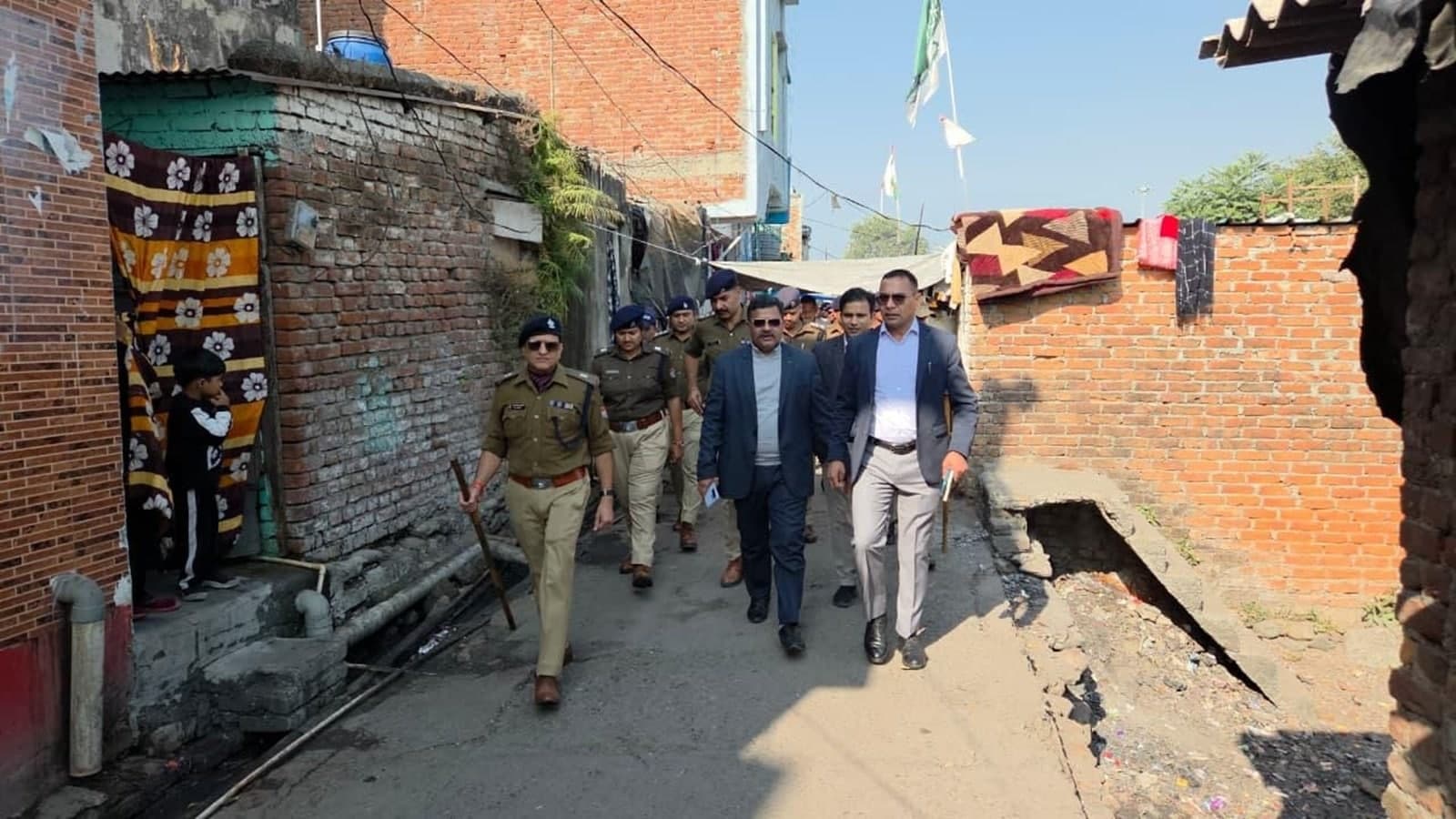
Haldwani's 50,000 residents await Supreme Court ruling on critical land encroachment allegations.
Summary
Over 50,000 residents in Haldwani, Uttarakhand, are currently awaiting a crucial Supreme Court ruling concerning allegations of land encroachment. This high-stakes legal battle highlights significant issues surrounding land rights, urban planning, and the role of the judiciary in resolving large-scale displacement concerns. For competitive exams, this case is relevant for understanding judicial processes, land laws, and socio-economic challenges in India.
Key Points
- 1The dispute involves over 50,000 people residing in Haldwani, a city in Uttarakhand.
- 2The central issue revolves around allegations of land encroachment.
- 3The matter is currently under consideration by the Supreme Court of India.
- 4The phrase 'A sword placed on our necks' reflects the severe existential threat perceived by the affected residents.
- 5This case is significant for understanding challenges in land rights, urban development, and judicial intervention in India.
In-Depth Analysis
The Haldwani encroachment case represents a poignant and complex challenge at the intersection of land rights, development, and human dignity in India. At its core, the dispute involves the fate of over 50,000 residents, some of whom have lived for generations in what the Indian Railways claims is its land in Haldwani, Uttarakhand. The phrase 'A sword placed on our necks' vividly captures the existential threat perceived by these families, whose homes, livelihoods, and futures hang precariously on the Supreme Court's verdict.
**Background Context and What Happened:**
For decades, a significant population has resided in various localities within Haldwani, including Gafoor Basti, Malik Ka Bagicha, and Ravi Shankar Nagar. These residents, a diverse mix of daily wage earners, small business owners, and families, have built their lives, established schools, hospitals, and places of worship on land they believed was theirs, or at least where their long occupation had granted them a de facto right to stay. Many possess documents like house tax receipts, electricity bills, and even lease deeds, dating back to the British era, which they present as proof of their legal or semi-legal residency. However, the Indian Railways maintains that the land, approximately 78 acres along a 2.2 km stretch, belongs to them and is crucial for future expansion and development projects. This claim is rooted in historical records, though the exact demarcation and legal status of some parcels have been subject to dispute.
The immediate crisis erupted in December 2022 when the Uttarakhand High Court ordered the eviction of these residents within a week, directing the railways to remove all 'encroachments' after giving notice. This abrupt order triggered widespread panic and protests, as it threatened mass displacement without a clear rehabilitation plan. The residents swiftly moved the Supreme Court, seeking a stay on the High Court's order. On January 5, 2023, the Supreme Court intervened, staying the eviction order and observing that 'a workable solution' needs to be found, acknowledging the humanitarian aspect and the long period of occupation by the residents. The apex court questioned how such a large number of people could be evicted overnight, especially those who had lived there for decades, and highlighted the need for the state government to explore rehabilitation options.
**Key Stakeholders Involved:**
1. **Indian Railways:** The primary claimant of the land, asserting its ownership for operational and expansion purposes. Their interest lies in reclaiming what they consider their property for public utility projects.
2. **Over 50,000 Residents:** The most vulnerable stakeholders, facing potential homelessness and loss of livelihood. Their primary interest is securing their homes and ensuring a dignified existence, with claims based on long-term occupation and various forms of documentation.
3. **Uttarakhand State Government:** Plays a crucial mediating role. While it must uphold legal directives, it also has a responsibility towards its citizens' welfare. The state's challenge is to find a balance between supporting the Railways' claims and implementing humane rehabilitation policies.
4. **Uttarakhand High Court:** Issued the initial eviction order, emphasizing the legal ownership of the land by the Railways.
5. **Supreme Court of India:** The final arbiter, tasked with balancing property rights, the right to life and livelihood, and the principles of natural justice. Its intervention underscores the judiciary's role in protecting fundamental rights.
**Why This Matters for India:**
This case is profoundly significant for India, highlighting several critical issues. Firstly, it exposes the persistent challenge of **informal settlements and urban planning** in rapidly developing cities. The lack of clear land records, coupled with historical migration and the absence of affordable housing, often leads to such disputes. Secondly, it brings to the fore the debate around the **right to shelter and livelihood** as an intrinsic part of the fundamental Right to Life under **Article 21** of the Indian Constitution. Landmark judgments like *Olga Tellis v. Bombay Municipal Corporation (1985)* have affirmed that the right to livelihood is integral to the right to life, and eviction without proper rehabilitation violates this right. While the right to property (now a constitutional right under **Article 300A**) is also vital, the judiciary often seeks to balance it with human rights.
Thirdly, the case underscores the **role of the judiciary** in social justice. The Supreme Court's stay on the High Court's order demonstrates judicial sensitivity to humanitarian concerns, preventing a mass displacement catastrophe. This aligns with the **Directive Principles of State Policy (DPSP)**, particularly **Article 38** (State to secure a social order for the promotion of welfare of the people) and **Article 39** (State to direct its policy towards securing adequate means of livelihood). The case also tests the efficacy of **rehabilitation and resettlement policies** in India, often found wanting in large-scale displacement scenarios.
**Future Implications:**
The Supreme Court's eventual ruling will set a crucial precedent for similar land disputes across the country. It could lead to:
1. **Stronger Rehabilitation Frameworks:** The court might direct the state and railways to formulate a comprehensive, time-bound rehabilitation plan, influencing future policies under acts like the **Right to Fair Compensation and Transparency in Land Acquisition, Rehabilitation and Resettlement Act, 2013** (though not directly applicable to eviction from government land, its principles are relevant).
2. **Emphasis on Due Process:** The ruling will reinforce the need for meticulous verification of claims, proper notice, and humane treatment during eviction processes, preventing arbitrary actions under the **Public Premises (Eviction of Unauthorised Occupants) Act, 1971**.
3. **Better Land Management:** The case highlights the urgent need for digitisation and clear demarcation of land records, especially those belonging to public entities, to prevent future encroachments and protracted legal battles.
4. **Socio-political impact:** The decision will have significant social and political ramifications, influencing public trust in governmental institutions and the judiciary's ability to deliver justice. It might also spur political parties to address the housing and land rights of urban poor more effectively.
In essence, the Haldwani case is not just about land; it's about the dignity of life, the delicate balance between development and human rights, and the evolving jurisprudence of social justice in India.
Exam Tips
This topic primarily falls under GS-II (Polity & Governance – particularly Fundamental Rights, DPSP, Judiciary, Government Policies) and GS-I (Indian Society – Urbanization, Social Issues). Understand the interplay between these sections.
Focus on landmark Supreme Court judgments related to the 'Right to Life' (Article 21) and its interpretation to include the 'Right to Shelter' and 'Right to Livelihood' (e.g., Olga Tellis case). Also, know Article 300A (Right to Property) and relevant DPSP articles (38, 39).
Practice analytical questions that require balancing conflicting rights (e.g., state's development needs vs. citizens' right to shelter) and the role of judicial intervention in such socio-economic disputes. Be prepared for case study-based questions.
Study the provisions and intent of the Public Premises (Eviction of Unauthorised Occupants) Act, 1971, and general principles of rehabilitation and resettlement policies in India.
Understand the difference between 'encroachment' and 'long-term occupation' and how courts differentiate between deliberate illegal occupation and situations arising from historical circumstances or state inaction.