



Relevant for Exams
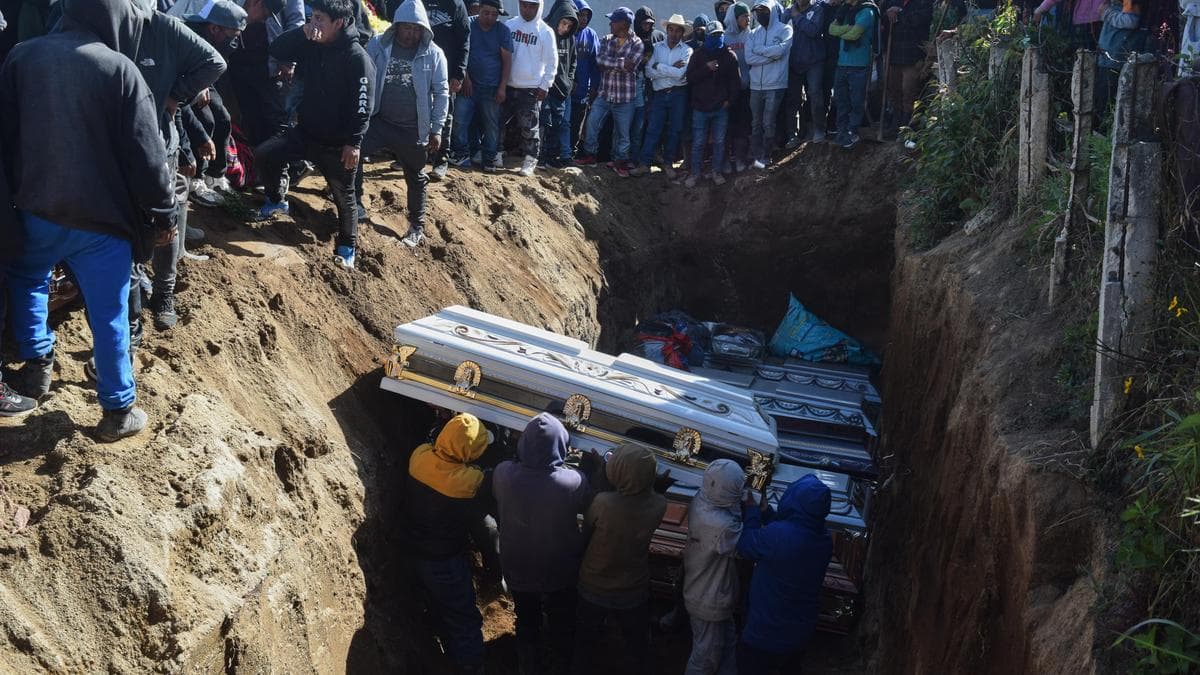
Guatemala's Solola department sees 13 dead in Indigenous clashes; President Arevalo declares 15-day 'state of prevention'.
Summary
Thirteen people died in clashes within an Indigenous region in Guatemala's Solola department, prompting President Arevalo to declare a 15-day "state of prevention." This event is significant for competitive exams as it highlights regional conflicts, international geography, and governmental responses to internal unrest, relevant for general awareness and world affairs sections.
Key Points
- 1The clashes occurred in the Solola department, an Indigenous region in Guatemala.
- 2A total of 13 people were reported dead due to the clashes.
- 3Guatemalan President Arevalo declared a 'state of prevention' in the affected Solola department.
- 4The 'state of prevention' was declared for a duration of 15 days.
- 5The conflict involved clashes within Indigenous communities in the specified region.
In-Depth Analysis
The tragic clashes in Guatemala's Solola department, resulting in 13 deaths and prompting President Arevalo to declare a 15-day 'state of prevention,' offer a poignant glimpse into the complex challenges faced by Indigenous communities globally. While geographically distant, this incident holds significant lessons for Indian competitive exam aspirants, particularly concerning governance, internal security, and the rights of marginalized populations.
**Background Context and What Happened:**
Guatemala, a Central American nation, has a long and often tumultuous history marked by profound social inequalities, poverty, and ethnic divisions. Indigenous Maya peoples constitute a significant portion of its population, yet they have historically suffered from marginalization, discrimination, and lack of access to resources and political power. The Solola department, where these clashes occurred, is an Indigenous region, suggesting that the conflict likely stems from deep-seated issues. While the specific trigger for the recent violence remains unclear from the summary, such incidents often arise from disputes over land, natural resources (like water or minerals), ancestral territories, ethnic identity, or even political representation. These tensions can escalate quickly in regions where state presence is weak, or where historical grievances simmer beneath the surface. The declaration of a 'state of prevention' by President Arevalo is a governmental response aimed at restoring order, typically involving enhanced security measures and restrictions on certain civil liberties to prevent further escalation.
**Key Stakeholders Involved:**
At the forefront are the **Indigenous communities** themselves, who are both victims and, unfortunately, sometimes participants in these clashes. Their struggles are often rooted in historical injustices dating back to the colonial era and exacerbated by modern developmental pressures. The **Guatemalan government**, led by President Arevalo, is a crucial stakeholder, responsible for maintaining law and order, protecting its citizens, and addressing the root causes of conflict. Local authorities within the Solola department also play a critical role in mediation and enforcement. Beyond these, **civil society organizations** and **human rights groups** often monitor such situations, advocating for the rights of Indigenous peoples and pushing for peaceful resolutions. International bodies might also become involved if the situation deteriorates or if human rights violations are alleged.
**Why This Matters for India:**
While there is no direct economic or political impact on India, this event provides critical insights into universal themes relevant to India's own governance and social fabric. India, with its vast diversity and significant tribal population (Scheduled Tribes), faces similar challenges related to land rights, resource allocation, and the integration of marginalized communities. The Guatemalan situation underscores the importance of:
1. **Effective Governance:** How a state responds to internal unrest, especially in sensitive ethnic regions, is a testament to its governance capabilities. India's approach to Naxalism or insurgencies in the Northeast, for instance, requires a delicate balance of security measures and developmental initiatives.
2. **Indigenous Rights and Land Disputes:** The core issues in Guatemala often revolve around ancestral land and resource control. India has its own history of tribal displacement due to development projects, leading to unrest. The need for robust legal frameworks like the **Panchayats (Extension to Scheduled Areas) Act (PESA), 1996**, and the **Forest Rights Act (FRA), 2006**, which empower tribal communities and protect their land rights, becomes evident.
3. **Conflict Resolution:** Understanding the dynamics of inter-community clashes helps in analyzing similar situations within India, promoting peaceful resolution mechanisms, and ensuring justice.
**Historical Context and Broader Themes:**
Guatemala endured a brutal 36-year civil war (1960-1996) that disproportionately affected its Indigenous population. The conflict resulted in hundreds of thousands of deaths and disappearances, with the state often implicated in genocide against Maya communities. The peace accords signed in 1996 aimed to address these historical injustices, but deep-seated issues of poverty, inequality, and lack of land reform persist. These recurring clashes highlight that peace is not merely the absence of war but the presence of justice and equitable development. This aligns with broader themes of post-conflict reconstruction, nation-building, and the challenges of achieving inclusive growth in diverse societies.
**Future Implications:**
The immediate implication of the 'state of prevention' is increased security presence and potentially temporary stability. However, long-term peace requires addressing the fundamental grievances that fuel such conflicts. This includes land reform, equitable distribution of resources, strengthening local governance, ensuring political representation for Indigenous peoples, and investing in socio-economic development. Failure to do so could lead to renewed violence, further destabilizing the region and undermining democratic institutions. For India, this serves as a reminder that robust policies for tribal welfare, conflict resolution, and inclusive development are crucial for national cohesion and security.
**Related Constitutional Articles, Acts, or Policies (Indian Context):**
* **Article 46 (Directive Principles of State Policy):** Mandates the State to promote with special care the educational and economic interests of the weaker sections of the people, and, in particular, of the Scheduled Castes and the Scheduled Tribes, and to protect them from social injustice and all forms of exploitation.
* **Article 244 and the Fifth & Sixth Schedules:** Deal with the administration of Scheduled Areas and Tribal Areas, providing special provisions for the governance of tribal-dominated regions, aimed at protecting their unique culture and land rights.
* **Panchayats (Extension to Scheduled Areas) Act (PESA), 1996:** Extends the provisions of Part IX of the Constitution relating to Panchayats to the Scheduled Areas, empowering Gram Sabhas (village assemblies) with significant powers over natural resources and tribal welfare.
* **Forest Rights Act (FRA), 2006:** Recognizes and vests forest rights and occupation in forest-dwelling Scheduled Tribes and other traditional forest dwellers who have been residing in such forests for generations.
* **Internal Security & Emergency Provisions:** While Guatemala's 'state of prevention' is not equivalent to India's emergency provisions, it provides a context to study India's **Articles 352 (National Emergency)** and **356 (State Emergency)**, which grant the Union government extraordinary powers to deal with internal disturbances or breakdown of constitutional machinery, highlighting the legal frameworks for managing severe crises.
Exam Tips
This topic falls under 'General Awareness' and 'International Relations' for UPSC Civil Services Exam (GS Paper II - International Relations; GS Paper III - Internal Security) and State PSCs. For SSC, it's relevant for 'General Knowledge/Current Affairs'.
Study related topics like the history of Indigenous movements globally, international human rights conventions (e.g., UNDRIP), conflict resolution mechanisms, and the role of international organizations in peacebuilding.
Common question patterns include: identifying the country/region of conflict, understanding the root causes of ethnic conflicts, comparing governmental responses to internal unrest (e.g., 'state of prevention' vs. 'emergency'), and analyzing the significance of Indigenous rights in a global context. For UPSC, analytical questions linking global events to India's challenges (e.g., tribal rights, internal security) are common.
Related Topics to Study
Full Article
Arevalo announced at a press conference that he was declaring a 15-day "state of prevention" in the Solola department — where the two communities are located