



Relevant for Exams
No content provided for 'lunarcrete' article; exam-relevant fact extraction impossible.
Summary
The provided article on 'lunarcrete' contained no content, making it impossible to extract specific details regarding its definition, applications, or current research status. Consequently, a comprehensive analysis of its significance for competitive exams, including specific facts or implications, cannot be generated.
Key Points
- 1No factual information, dates, names, or numbers could be extracted from the provided article.
- 2The article explicitly stated 'No content available', precluding detailed analysis.
- 3Specifics regarding 'lunarcrete's' composition, purpose, or development status are absent.
- 4Assessment of its importance for space technology or construction is not possible.
- 5Lack of content prevents identification of direct MCQ-style questions from this input.
In-Depth Analysis
The concept of 'lunarcrete' represents a groundbreaking frontier in space exploration and construction, addressing the critical challenge of building sustainable habitats and infrastructure on the Moon. While the provided article offered no specific content, the topic itself is highly relevant for competitive exams, touching upon science, technology, international relations, and India's strategic ambitions in space.
**Background Context: Why Lunar Construction?**
The dream of establishing a permanent human presence on the Moon has persisted since the dawn of the Space Age. The Apollo missions (1969-1972) demonstrated humanity's capability to reach the Moon, but the focus was on short-duration visits. Today, with renewed global interest in lunar exploration, spearheaded by NASA's Artemis program and missions from ISRO, ESA, and CNSA, the objective has shifted from 'flags and footprints' to 'sustainable presence'. A key hurdle for long-term lunar habitation is the immense cost and logistical complexity of transporting building materials from Earth. Launching just one kilogram of payload into space costs thousands of dollars. This economic and logistical barrier necessitates the development of In-Situ Resource Utilization (ISRU) technologies, which involve using local resources available on celestial bodies. Lunarcrete is a prime example of such a technology.
**What is Lunarcrete?**
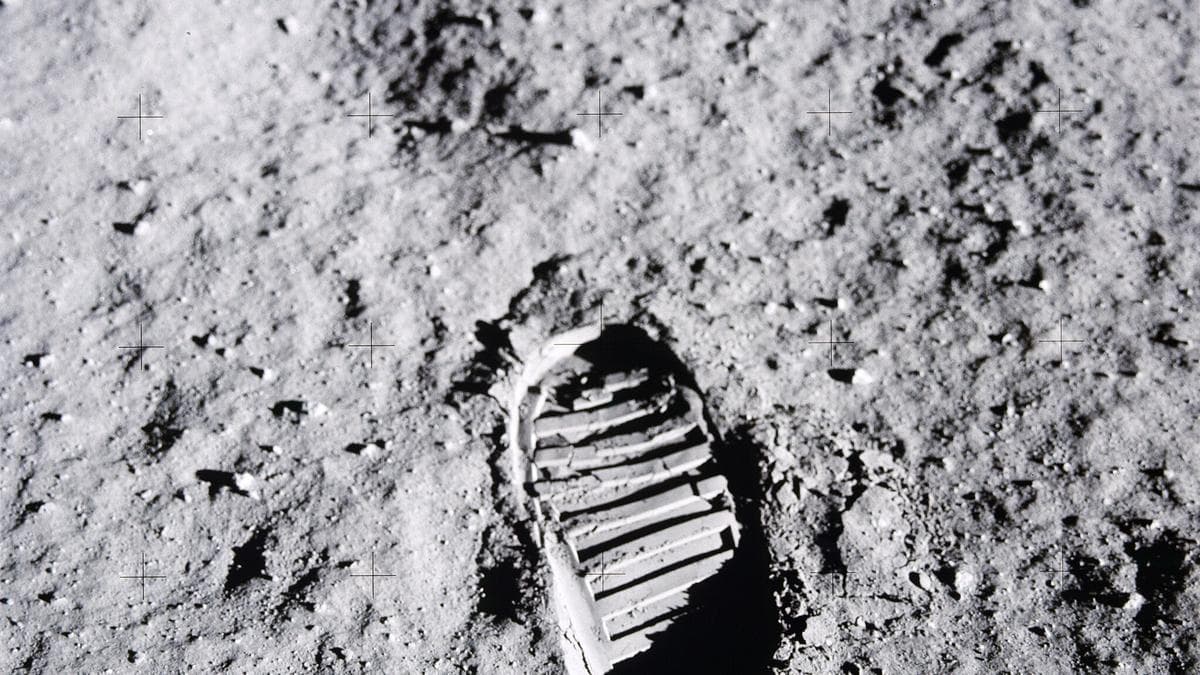
Lunarcrete is essentially a hypothetical or developing concrete-like material designed for construction on the Moon, primarily utilizing lunar regolith – the layer of dust, soil, broken rock, and other related materials present on the lunar surface. Unlike terrestrial concrete, which relies on water and cement (often derived from limestone), lunarcrete research explores various binding agents and techniques. These include: 1) **Sintering**: Heating regolith to high temperatures until particles fuse together, potentially using solar concentrators or microwaves. 2) **Binders**: Mixing regolith with local water ice (if available and processed), sulfur (found in some lunar regions), or imported polymers/epoxies. 3) **3D Printing**: Utilizing robotic systems to print structures layer by layer using regolith mixtures. The primary goal is to create strong, durable, radiation-shielding structures for habitats, landing pads, roads, and other essential infrastructure, significantly reducing reliance on Earth-supplied materials.
**Key Stakeholders Involved**
Multiple global entities are investing in lunarcrete research and related ISRU technologies. **Space Agencies** like NASA (through its Artemis program and various grants), the European Space Agency (ESA), China National Space Administration (CNSA), and the Indian Space Research Organisation (ISRO) are at the forefront. **Private Space Companies** such as SpaceX, Blue Origin, and various startups are also exploring off-world construction for future commercial ventures. **Research Institutions and Universities** worldwide are conducting material science experiments, developing robotic construction techniques, and simulating lunar environments. **Construction and Mining Companies** are also beginning to eye the potential for extraterrestrial operations, bringing their expertise in large-scale infrastructure development.
**Significance for India**
For India, the development of lunarcrete and ISRU technologies holds profound significance. ISRO has demonstrated its capabilities through successful missions like Chandrayaan-1, which confirmed water molecules on the Moon, and Chandrayaan-3, which achieved a soft landing near the lunar south pole. India's ambitious space program, including future plans for a lunar lander with a rover, a potential human spaceflight mission (Gaganyaan), and long-term aspirations for a lunar base, makes lunarcrete highly relevant. It can enable: **1) Self-reliance (Atmanirbhar Bharat) in Space:** Reducing dependence on costly Earth-bound supplies aligns with India's self-reliance goals. **2) Economic Opportunities:** Fostering innovation in material science, robotics, and space manufacturing, potentially creating new industries and jobs. **3) Strategic Advantage:** Establishing a presence on the Moon offers strategic benefits, including access to potential resources and a platform for deep space observation. **4) Scientific Advancement:** Pushing the boundaries of engineering and material science, with potential spin-off benefits for terrestrial applications.
**Historical Context and Future Implications**
Historically, the idea of lunar bases dates back to the early space race, but the technological hurdles were immense. The Outer Space Treaty of 1967, to which India is a signatory, governs activities in space, emphasizing peaceful use, non-appropriation of celestial bodies, and international cooperation. This treaty forms the legal framework for any future lunar construction. Looking ahead, successful development of lunarcrete could pave the way for permanent lunar settlements, resource extraction (e.g., Helium-3 for fusion energy), space tourism, and serve as a crucial stepping stone for human missions to Mars and beyond. It represents a paradigm shift from short-term expeditions to sustainable multi-planetary existence, fostering greater international collaboration through initiatives like the Artemis Accords, which India joined in 2023. India's Space Policy 2023 further encourages private sector participation, which will be vital for commercializing such advanced technologies.
**Related Constitutional Articles, Acts, or Policies**
While no direct constitutional article specifically mentions 'lunarcrete,' its development and implications are connected to broader constitutional principles and national policies:
* **Article 51 (Promotion of international peace and security):** India's space endeavors, including lunar construction, are conducted within the framework of international cooperation and peaceful use of outer space, aligning with this directive principle.
* **Article 51A(g) (Fundamental Duty):** While primarily focused on Earth's environment, the spirit of responsible resource utilization and scientific advancement for the betterment of humanity can be broadly linked to this duty, especially in the context of sustainable space exploration.
* **Outer Space Treaty of 1967:** As a signatory, India adheres to its principles of non-appropriation of celestial bodies, peaceful use, and international responsibility for national activities in space. Lunarcrete development must comply with these international legal norms.
* **India's Space Policy 2023:** This policy is highly relevant, as it emphasizes enhancing India's space capabilities, encouraging private sector participation, and pursuing deep space missions, all of which are directly supported by advancements like lunarcrete.
Exam Tips
This topic falls under GS Paper III (Science & Technology - Space Technology, Material Science) for UPSC and State PSC exams. For SSC and Defence exams, it can appear as general awareness questions on space technology or current affairs.
Study related topics like India's Chandrayaan missions (especially Chandrayaan-3 and its objectives), the Artemis Accords, In-Situ Resource Utilization (ISRU), and the basics of 3D printing technology, as questions often link these concepts.
Common question patterns include: MCQs on the definition of lunarcrete, its components, advantages, or the agencies involved; Mains questions on the significance of ISRU for lunar exploration, challenges of lunar construction, or India's role in future space endeavors.
Pay attention to keywords like 'regolith', 'ISRU', '3D printing in space', and 'Artemis program' as these are frequently tested.
Understand the difference between terrestrial concrete and lunarcrete – specifically the binding agents and construction methods suitable for the lunar environment.