



Relevant for Exams
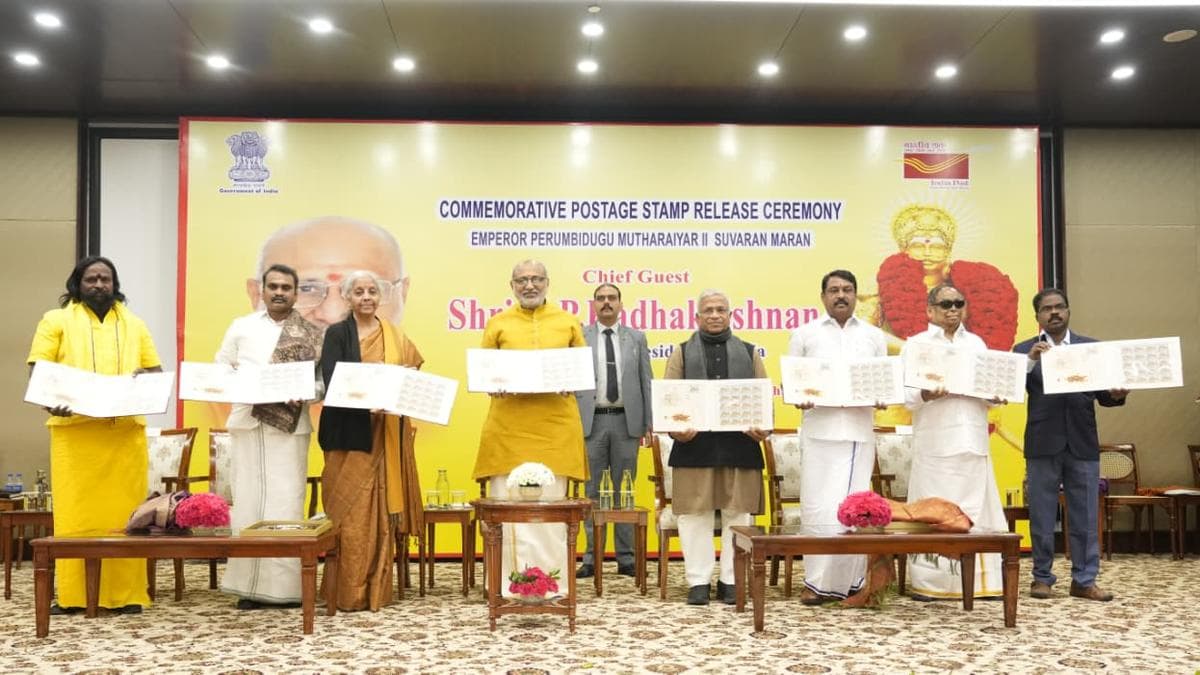
VP C.P. Radhakrishnan releases postage stamp honoring historical figure Perumbidugu Mutharaiyar.
Summary
Vice-President C.P. Radhakrishnan released a postage stamp in honour of Perumbidugu Mutharaiyar, a significant historical figure. This event underscores the government's commitment to recognizing and commemorating India's rich cultural heritage and historical personalities through philately. It is relevant for competitive exams as it touches upon national events, prominent figures, and cultural initiatives by the government.
Key Points
- 1The commemorative postage stamp was officially released by Vice-President C.P. Radhakrishnan.
- 2The postage stamp specifically honors the historical personality Perumbidugu Mutharaiyar.
- 3The release event highlights the role of India Post in preserving and promoting national heritage.
- 4Perumbidugu Mutharaiyar is recognized as a significant historical figure, likely a ruler or chieftain from ancient India.
- 5Such stamp releases aim to educate the public and commemorate contributions of important historical personalities.
In-Depth Analysis
The release of a commemorative postage stamp in honour of Perumbidugu Mutharaiyar by Vice-President C.P. Radhakrishnan signifies a crucial effort by the Government of India to acknowledge and integrate diverse regional histories into the broader national narrative. This event, while seemingly a small gesture, carries profound cultural, historical, and national integration implications, making it highly relevant for competitive exam aspirants.
**Background Context: Who was Perumbidugu Mutharaiyar?**
Perumbidugu Mutharaiyar refers to a lineage of powerful chieftains who ruled parts of present-day Tamil Nadu, particularly the area around Pudukkottai, from the 7th to the 9th centuries CE. The name 'Perumbidugu' was a title, meaning 'great thunderbolt,' denoting their military prowess. They were initially independent rulers and later served as feudatories to the mighty Pallavas and Pandyas, playing a significant role in the political landscape of ancient South India. Their inscriptions and monuments provide valuable insights into the socio-political and cultural conditions of their time. For instance, archaeological findings in regions like Narthamalai attest to their contributions to temple architecture and rock-cut cave shrines. Recognizing Perumbidugu Mutharaiyar is not just about a single ruler but about acknowledging a dynasty that contributed significantly to the regional heritage and identity of Tamil Nadu, often overshadowed by larger empires like the Cholas or Pallavas.
**What Happened and Key Stakeholders**
On this occasion, Vice-President C.P. Radhakrishnan officially released the commemorative postage stamp. As a high constitutional functionary, the Vice-President's involvement lends national significance and prestige to the event, underscoring the government's commitment to such cultural initiatives. The primary institutional stakeholder is **India Post**, under the **Ministry of Communications, Government of India**. India Post is responsible for the design, printing, and distribution of these stamps. Their role extends beyond postal services to include the preservation and promotion of national heritage through philately. Other stakeholders include historians, cultural organizations, and local communities, especially from Tamil Nadu, who have long advocated for the recognition of such regional heroes. The event highlights a collaborative effort between governmental bodies and cultural advocates to bring lesser-known historical figures into national prominence.
**Significance for India**
This act holds multifaceted significance for India. Firstly, it fosters **national integration** by bringing regional heroes into the national mainstream. India's history is a tapestry of diverse regional kingdoms and cultures, and recognizing figures like Perumbidugu Mutharaiyar helps in building a more inclusive national identity, demonstrating that contributions from all parts of the country are valued. Secondly, it serves as a powerful tool for **cultural preservation and promotion**. Stamps are miniature works of art and historical documents that educate the public, especially younger generations, about India's rich and varied past. They act as a medium for soft power, showcasing India's deep cultural heritage to the world. Thirdly, it underscores the government's commitment to the **'Ek Bharat Shreshtha Bharat'** initiative, which aims to promote mutual understanding and appreciation of India's diverse cultures. By celebrating a figure from Tamil Nadu, the government reinforces the idea of unity in diversity.
**Constitutional and Policy Linkages**
While there isn't a direct constitutional article governing the issuance of postage stamps, the spirit of such initiatives aligns with several constitutional provisions. **Article 49** of the Directive Principles of State Policy (DPSP) mandates the State's obligation to protect monuments, places, and objects of artistic or historic interest. Though stamps are not monuments, their issuance is an act of preserving and promoting historical memory. Furthermore, **Article 51A(f)**, a Fundamental Duty, states that it shall be the duty of every citizen to value and preserve the rich heritage of our composite culture. Governmental actions like this facilitate citizens in fulfilling this duty. The subject of 'Posts and Telegraphs' falls under **Entry 31 of the Union List** in the Seventh Schedule, granting the Central government exclusive legislative power over India Post. This empowers the Ministry of Communications to undertake such initiatives as part of its broader mandate. Such stamp releases are also part of India's broader **National Culture Policy**, which encourages the identification, preservation, and dissemination of India's cultural heritage.
**Future Implications**
The recognition of Perumbidugu Mutharaiyar sets a precedent for a more inclusive approach to historical commemoration. We can expect to see more such initiatives that bring 'unsung heroes' from various regions and communities into the national spotlight. This will likely spur renewed interest in regional history and archaeology, leading to deeper research and understanding of India's diverse past. In an increasingly digital world, philately continues to hold its ground as a tangible link to history and culture, serving as a unique educational tool. Such acts also reinforce India's commitment to celebrating its pluralistic heritage, both domestically and on the global stage, contributing to its soft power diplomacy. It signifies a continued governmental focus on cultural diplomacy and the use of national symbols to reinforce national identity and pride.
Exam Tips
This topic falls under 'Indian History (Ancient & Medieval)' and 'Indian Art & Culture' for UPSC and State PSC exams, and 'General Awareness' for SSC and Railway exams. Focus on the historical significance of the Mutharaiyar dynasty, their period, and their contributions to South Indian history and architecture.
When studying, connect this event to broader themes like national integration, cultural preservation, and the role of government in promoting heritage. Understand the functions of India Post and the significance of commemorative stamps as cultural artifacts and educational tools.
Be prepared for factual questions in Prelims/Objective exams: Who was Perumbidugu Mutharaiyar? Which region did he rule? What is the significance of commemorative stamps? For Mains/Descriptive exams, be ready to write essays or analytical answers on the importance of recognizing regional heroes for national identity and cultural unity, linking it to constitutional provisions and government policies.