



Relevant for Exams
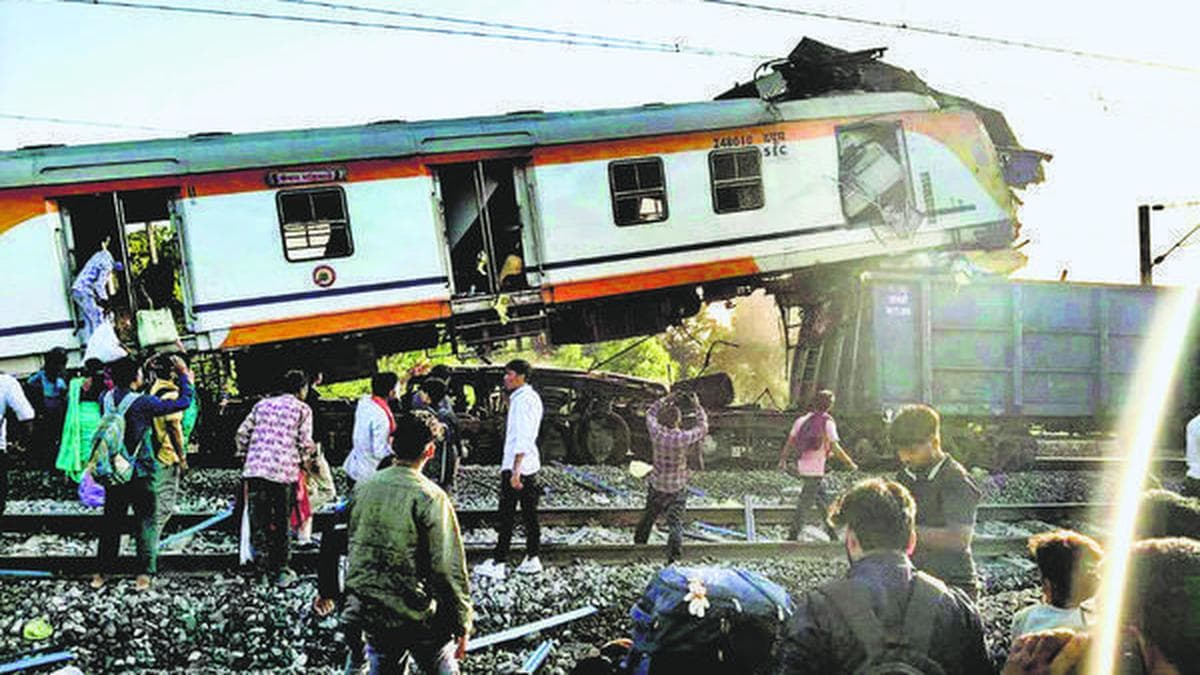
Bilaspur train accident: Top officials shifted after unfit loco pilot revealed by investigation.
Summary
Following an investigation into a train accident in Bilaspur, it was revealed that the loco pilot was 'unfit' to operate the train. This finding led to the shifting of top officials, underscoring critical concerns regarding railway safety and accountability. The incident highlights the importance of stringent fitness checks for railway personnel for competitive exams.
Key Points
- 1The incident involved a train accident that occurred in Bilaspur.
- 2An investigation into the accident revealed that the loco pilot was 'unfit' to run the train.
- 3Following the investigation report, top officials were shifted from their positions.
- 4The core issue identified was the unsuitability of the train operator.
- 5The event emphasizes the critical importance of railway safety protocols and personnel fitness.
In-Depth Analysis
Indian Railways, often termed the lifeline of the nation, is one of the world's largest railway networks, transporting billions of passengers and tons of freight annually. Its immense scale, however, also brings significant challenges, particularly concerning safety. The recent Bilaspur train accident, where the investigation revealed the loco pilot was 'unfit' to operate the train, leading to the shifting of top officials, serves as a stark reminder of the critical need for robust safety protocols and stringent personnel fitness assessments within this vital infrastructure.
**Background Context and What Happened:**
Indian Railways operates across diverse terrains and socio-economic landscapes, making its operations incredibly complex. Despite continuous efforts, train accidents, though declining over the years, remain a grave concern. These incidents often expose systemic flaws, ranging from infrastructure deficiencies to human error. In the Bilaspur incident, the initial reports pointed towards a mechanical or track issue, but the subsequent in-depth investigation unearthed a more alarming truth: the primary operator, the loco pilot, was deemed 'unfit.' This finding immediately shifted the focus from technical faults to human resource management and oversight. The direct consequence was the swift action taken by the Ministry of Railways, resulting in the transfer or removal of top officials, signifying a clear stance on accountability.
**Key Stakeholders Involved:**
Several entities play crucial roles in railway operations and safety. The **Ministry of Railways** and the apex **Railway Board** are responsible for policy formulation, budget allocation, and overall strategic direction. **Zonal Railways** (like South East Central Railway, under which Bilaspur falls) are the operational arms, implementing policies and managing day-to-day services. **Loco pilots** and other **railway staff** are the frontline operators, whose physical and mental fitness directly impacts safety. The **Commissioner of Railway Safety (CRS)**, an independent body under the Ministry of Civil Aviation, investigates serious railway accidents to determine causes and recommend preventive measures. Finally, **passengers and the general public** are the ultimate stakeholders, whose safety and trust are paramount.
**Why This Matters for India:**
This incident carries significant implications for India. Economically, railway safety directly impacts freight movement, which is crucial for industrial supply chains and agricultural produce distribution. Accidents cause delays, damage goods, and incur massive financial losses. Socially, public trust in the national transporter is eroded with every accident, especially when human error due to unfitness is identified. This can deter passenger travel, affecting tourism and national integration. Politically, such incidents put immense pressure on the government to ensure accountability and implement reforms. It highlights a critical governance challenge: ensuring that safety regulations are not just on paper but are rigorously enforced, and that personnel fitness is a continuous process, not a one-time check.
**Historical Context and Related Policies:**
India has a long history of railway accidents, which have often prompted significant policy shifts. Major accidents like the Gaisal train collision (1999) or the Firozabad rail disaster (1995) led to the formation of high-powered committees. The **Khanna Committee (1998)** and the **High-Level Safety Review Committee (Kakodkar Committee, 2012)** made extensive recommendations, focusing on track modernization, signaling systems, and human resource management. These committees repeatedly emphasized the need for better training, stress management, and stringent medical fitness for operational staff. The **Indian Railways Act, 1989**, is the primary legislation governing the operation and management of railways. Furthermore, under **Article 246 of the Constitution**, 'Railways' falls under Entry 22 of the Union List in the Seventh Schedule, granting the central government exclusive legislative power over it. The **Directive Principles of State Policy (DPSP)**, particularly Article 39(e), which directs the State to ensure that the health and strength of workers are not abused, also finds resonance here, underscoring the state's responsibility towards its railway employees.
**Future Implications:**
The Bilaspur incident underscores the urgent need for a multi-pronged approach to enhance railway safety. Firstly, there must be a re-evaluation and strengthening of medical and psychological fitness standards for all operational staff, particularly loco pilots. Regular, unannounced checks and comprehensive mental health support systems are crucial. Secondly, technological interventions like the indigenous **'Kavach' Automatic Train Protection (ATP) system** must be expedited across the network to prevent collisions caused by human error or signal passing at danger. Thirdly, accountability mechanisms need to be robust, ensuring that responsibility is fixed at all levels, from the frontline worker to senior management. The incident will likely spur greater scrutiny on recruitment, training, and oversight processes. As India embarks on ambitious projects like dedicated freight corridors and high-speed rail networks (e.g., Bullet Train), ensuring foundational safety and human resource reliability becomes even more critical for the success and public acceptance of these transformative initiatives. This event serves as a stark reminder that modernization must be accompanied by an unwavering commitment to the safety and well-being of both passengers and personnel.
Exam Tips
This topic primarily falls under the 'Indian Economy (Infrastructure)', 'Governance', and 'Current Affairs' sections of competitive exams. Questions might focus on the role of Indian Railways in the economy, safety challenges, and government initiatives.
Study related topics such as the structure and functioning of the Ministry of Railways and the Railway Board, the role of the Commissioner of Railway Safety (CRS), and major railway safety committees (e.g., Kakodkar Committee) and their recommendations. Understand the difference between various types of railway accidents and their causes.
Common question patterns include: (a) Factual questions on specific acts (e.g., Indian Railways Act, 1989), committees, or technological systems (e.g., Kavach). (b) Analytical questions on the causes of railway accidents, challenges in ensuring railway safety, or the economic/social impact of such incidents. (c) Policy-oriented questions on government measures to improve safety, future plans for railway modernization, or accountability mechanisms.
Related Topics to Study
Full Article
Investigation revealed that the loco pilot was ‘unfit’ to run the train