



Relevant for Exams
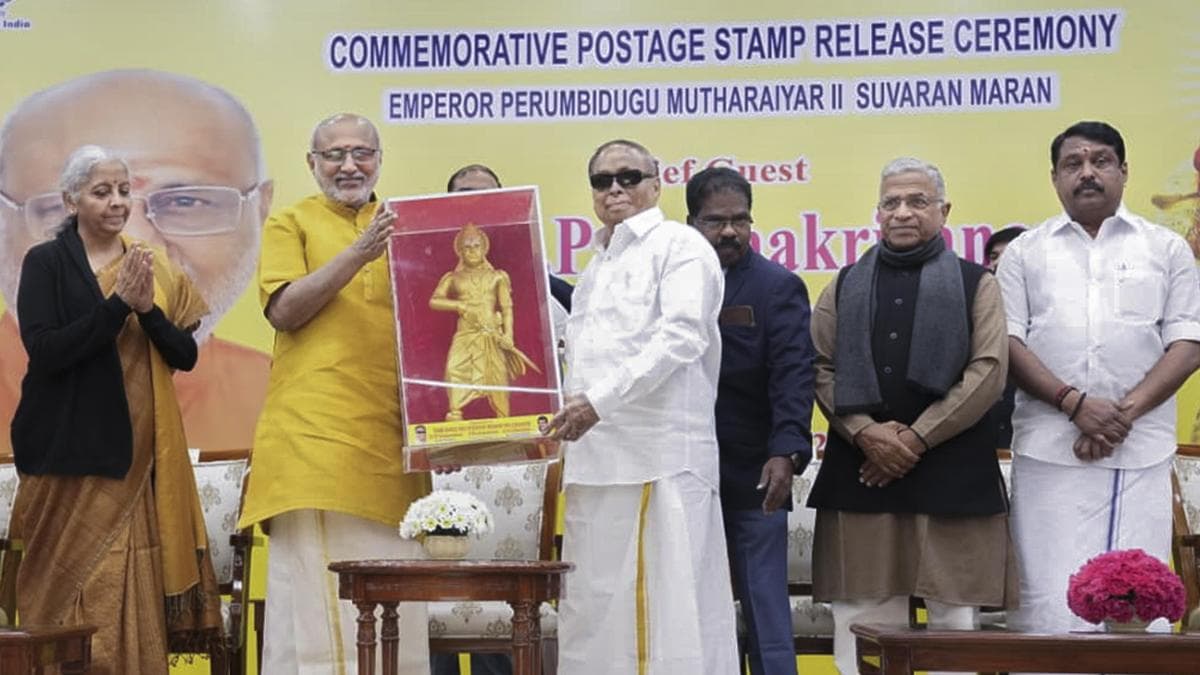
VP releases commemorative stamp for Tamil Emperor Perumbidugu Mutharaiyar II, lauds recognition of unsung heroes.
Summary
The Vice-President released a commemorative postage stamp honouring Emperor Perumbidugu Mutharaiyar II, a significant Tamil ruler. This initiative highlights the government's focus on recognizing previously unsung historical heroes and freedom fighters, particularly from regional histories. For competitive exams, this emphasizes the importance of cultural history, regional contributions, and current government efforts to revise historical narratives, making figures like Mutharaiyar II potential MCQ topics.
Key Points
- 1The Vice-President of India released a commemorative postage stamp.
- 2The postage stamp honours Emperor Perumbidugu Mutharaiyar II.
- 3Emperor Perumbidugu Mutharaiyar II was a significant Tamil king.
- 4The Vice-President stated that Tamil kings and freedom fighters did not receive due recognition earlier.
- 5The government's efforts are aimed at recognising unsung heroes to revive the nation's cultural pride.
In-Depth Analysis
The recent release of a commemorative postage stamp by the Vice-President of India, honouring Emperor Perumbidugu Mutharaiyar II, a significant Tamil ruler, is much more than a ceremonial event; it signifies a deliberate and broader governmental effort to reshape India's historical narrative. The Vice-President's statement, emphasizing that 'Tamil kings and freedom fighters didn't get due recognition earlier,' underscores a prevailing sentiment that certain regional histories and 'unsung heroes' have been overlooked in conventional historical accounts, which have often been perceived as Delhi-centric or focusing predominantly on North Indian dynasties.
**Background Context and What Happened:**
Historically, the study of Indian history, particularly at the national level, has faced criticism for its perceived bias towards certain periods, regions, and figures. Many regional kingdoms, powerful dynasties, and local heroes, especially from the southern, eastern, and northeastern parts of India, have often been relegated to footnotes or specialized academic studies rather than being integrated into the mainstream national consciousness. This has led to a sense of historical marginalization among various communities. The current government, since coming to power, has actively pursued a policy of rectifying this perceived imbalance by promoting figures and events that align with a broader, more inclusive, and often culturally nationalistic vision of Indian history. The release of a postage stamp for Emperor Perumbidugu Mutharaiyar II, who ruled parts of Tamil Nadu during the 7th-8th centuries CE, is a direct manifestation of this policy. Mutharaiyar II was a chieftain who controlled the Kaveri delta region, an important strategic and cultural area, before the rise of the Imperial Cholas. His dynasty played a crucial role in the political landscape of ancient Tamilakam, often navigating alliances and conflicts with the Pallavas and Pandyas, thereby contributing significantly to the cultural and architectural heritage of the region.
**Key Stakeholders Involved:**
The primary stakeholders in this event are the **Vice-President of India**, representing the highest echelons of the Indian state and lending significant weight to the initiative. The **Government of India**, particularly the **Ministry of Communications** (through India Post, which issues stamps) and the **Ministry of Culture**, are instrumental in identifying and promoting such figures. **Historians and cultural organizations** from Tamil Nadu and across India play a crucial role in research, advocacy, and shaping public discourse around these historical figures. Finally, the **general public**, especially communities and regions associated with these heroes, are significant beneficiaries as their cultural pride and regional identity are bolstered.
**Significance for India:**
This initiative holds multifaceted significance for India. Firstly, it's a move towards **cultural revival and national pride**. By recognizing regional heroes, the government aims to weave a richer, more diverse tapestry of national history, fostering a sense of shared heritage and pride across different communities. Secondly, it has **political implications**. Such recognitions often resonate deeply with regional sentiments, potentially garnering political support and reinforcing the narrative of a government that values all contributions to India's past. Thirdly, it contributes to **historical revisionism**, challenging existing historical frameworks and promoting alternative interpretations that highlight previously 'unsung' contributions. This can lead to a more nuanced understanding of India's composite culture. Economically, while not direct, cultural tourism and research grants related to such figures can see a boost.
**Historical Context and Broader Themes:**
The focus on Emperor Perumbidugu Mutharaiyar II brings attention to the often-overlooked regional kingdoms that thrived in various parts of India, co-existing or contending with larger empires. It reminds us that Indian history is not monolithic but a complex interplay of diverse regional powers. This move aligns with broader themes of **cultural nationalism** and the **re-evaluation of colonial and post-colonial historical narratives**. It implicitly critiques the idea that only certain historical figures or movements (e.g., the Delhi Sultanate, Mughals, or even the mainstream independence movement) warrant national recognition. The emphasis on 'Tamil kings' also highlights the rich and continuous literary, architectural, and administrative traditions of the South, often distinct from those in the North. This effort can be seen as part of a larger push to celebrate indigenous cultural roots and historical figures, connecting to a sense of 'Bharatiya' identity.
**Future Implications:**
This trend is likely to continue, with more such recognitions of regional heroes, local freedom fighters, and neglected historical figures across India. This could lead to a more decentralized and inclusive historical curriculum in schools and universities. It might also spark further academic research into these figures, leading to new discoveries and interpretations. However, it also carries the potential for political weaponization of history, where historical figures are selectively chosen to fit contemporary political narratives. The challenge will be to ensure that such recognitions are based on rigorous historical scholarship and genuinely contribute to a more comprehensive understanding of India's past, rather than serving narrow ideological agendas.
**Related Constitutional Articles, Acts, or Policies:**
While there isn't a direct constitutional article mandating the issuance of stamps for historical figures, the spirit of such initiatives aligns with **Article 51A(f) of the Indian Constitution**, which outlines a fundamental duty of every citizen 'to value and preserve the rich heritage of our composite culture.' By extension, the state, through its various organs, is expected to facilitate this. Furthermore, **Article 49 (Directive Principles of State Policy)** mandates the 'protection of monuments and places and objects of national importance from disfigurement, destruction, removal, disposal or export, as the case may be.' While Mutharaiyar II is a person, his legacy is tied to such heritage. The **Ministry of Culture's policies** regarding the promotion of art, culture, and historical research, as well as the **India Post Act** (which governs postal services, including commemorative stamps), are the direct policy frameworks enabling such initiatives.
Exam Tips
**General Studies Paper I (History & Culture):** This topic falls under 'Indian Heritage and Culture', specifically ancient/medieval South Indian history and the contemporary government's cultural policies. Pay attention to the Mutharaiyar dynasty, its timeline (7th-8th century CE), key rulers like Perumbidugu Mutharaiyar II, and their significance in the context of Pallava and Chola ascendancy. Questions might be asked about their contributions to art, architecture, or administration.
**Current Affairs & Government Policies:** Understand the broader context of the government's push to recognize 'unsung heroes' and its implications for national identity and cultural pride. Be aware of other similar initiatives (e.g., statues, museums, special postal covers) and the ministries involved (Ministry of Culture, Ministry of Communications).
**Mains Exam - Essay/GS Paper I & II:** This topic can be used as an example for essays on 'Revisiting History', 'Cultural Nationalism', 'Regional Identities and National Unity', or 'Government's role in promoting heritage'. In GS Paper II, it can relate to 'Governance' and 'Policies for cultural preservation'. Focus on both the positive aspects (inclusivity, pride) and potential criticisms (historical revisionism, political motives).
**Prelims - Fact-based MCQs:** Expect direct questions like 'Who was Perumbidugu Mutharaiyar II associated with?' or 'Which dynasty did Perumbidugu Mutharaiyar II belong to?' or 'Which constitutional article deals with preserving composite culture?' Also, 'Which government body issues commemorative stamps?'
**Connect to Fundamental Duties and DPSP:** Remember to link such initiatives to constitutional provisions like Article 51A(f) (Fundamental Duty to value and preserve composite culture) and Article 49 (DPSP for protection of monuments and places of national importance). This shows a deeper understanding of constitutional governance.
Related Topics to Study
Full Article
The V-P releases a commemorative postage stamp honouring Emperor Perumbidugu Mutharaiyar II; lauds government efforts recognising unsung heroes essential to revive nation’s cultural pride