



Relevant for Exams
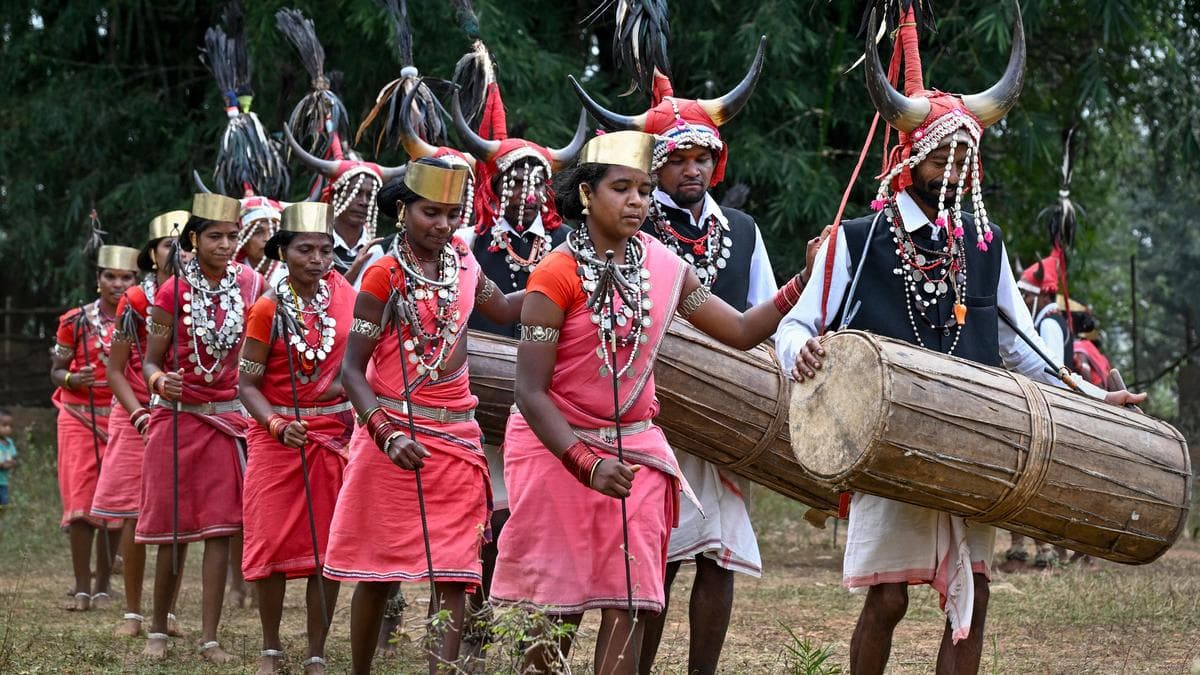
Bison Horn Maria dance of Dandami Madias in Bastar, Chhattisgarh, preserves ancient Gondwana culture.
Summary
The Bison Horn Maria dance, performed by the Dandami Maria community in Bastar, Chhattisgarh, is a significant tribal art form. This dance form reflects the ancient cultural heritage of the Gondwana region and serves as a powerful affirmation of the community's identity and living cultural soul. For competitive exams, this highlights the importance of tribal culture, art forms, and geographical locations in India.
Key Points
- 1The dance form is known as the Bison Horn Maria dance.
- 2It is performed by the Dandami Maria tribal community.
- 3The geographical location associated with this dance is Bastar, Chhattisgarh.
- 4The dance carries echoes of ancient Gondwana, indicating its historical roots.
- 5It serves as an affirmation of the identity and living cultural soul of the tribal community.
In-Depth Analysis
The Bison Horn Maria dance, performed by the Dandami Maria community in the Bastar region of Chhattisgarh, stands as a vibrant testament to India's rich tribal heritage. This ancient art form, echoing the historical and cultural legacy of the Gondwana region, is far more than just a dance; it is a profound affirmation of the community's identity, a living cultural soul that has remarkably endured the pressures of modernity. Understanding this dance provides critical insights into India's diverse cultural landscape, the challenges faced by indigenous communities, and the constitutional efforts to protect their unique way of life.
The Dandami Maria are a sub-group of the larger Gond tribal community, one of the largest indigenous groups in Central India. Their traditional homeland, Bastar, is renowned for its dense forests, unique tribal cultures, and a history of relative isolation that has allowed many ancient practices to persist. The Bison Horn Maria dance itself is characterized by its performers wearing elaborate headgear adorned with real bison horns, often decorated with feathers and shells. The dance is a communal celebration, typically performed during festivals, weddings, and other significant social gatherings. It involves rhythmic movements, often mimicking the gait of a bison, accompanied by traditional drums and wind instruments. This intricate performance is not merely entertainment but a ritualistic expression, deeply intertwined with their animistic beliefs, reverence for nature, and ancestral worship.
Historically, the Gondwana region, encompassing parts of modern-day Chhattisgarh, Madhya Pradesh, Maharashtra, and Odisha, has been a cradle of indigenous cultures for millennia. The 'Gondwana' itself refers to an ancient supercontinent, and culturally, it signifies a vast historical domain of the Gond people. The Bison Horn Maria dance carries these ancient echoes, reflecting a deep-seated connection to the land and its resources that has shaped their worldview and cultural practices over centuries. The resilience of this dance form, despite centuries of external influences, including colonial rule and post-independence development, highlights the inherent strength of tribal traditions in maintaining cultural continuity.
Several key stakeholders are involved in the preservation and promotion of this cultural heritage. Primarily, the **Dandami Maria community** themselves are the custodians of this tradition, passing down the intricate steps, music, and cultural significance from generation to generation. The **Government of Chhattisgarh** plays a crucial role through its Tribal Welfare Department and Tourism Department, initiating programs for cultural promotion, documentation, and economic support. The **Ministry of Tribal Affairs** at the central level provides broader policy frameworks, funding for tribal research institutes, and schemes for the promotion of tribal art and culture. Additionally, various **cultural organizations** like the Sangeet Natak Akademi, **NGOs**, and **academic researchers** contribute significantly through documentation, advocacy, and facilitating cultural exchanges.
The endurance of the Bison Horn Maria dance holds immense significance for India. It is a vital component of the nation's intangible cultural heritage, showcasing the incredible diversity that defines India. Preserving such art forms contributes to national identity, reminding us of the pluralistic fabric of society. From an economic perspective, promoting these dances can boost cultural tourism, providing sustainable livelihoods for tribal communities and integrating them into the broader economy without compromising their identity. Socially, it reinforces community bonds, preserves unique linguistic and artistic expressions, and ensures that indigenous knowledge systems continue to thrive. The global recognition of such unique art forms also enhances India's soft power and cultural diplomacy.
India's Constitution provides a robust framework for the protection of tribal cultures and rights. **Article 29** guarantees the right of any section of citizens having a distinct language, script, or culture to conserve the same. **Article 46** mandates the State to promote with special care the educational and economic interests of the weaker sections of the people, and, in particular, of the Scheduled Castes and the Scheduled Tribes, and to protect them from social injustice and all forms of exploitation. Furthermore, the **Fifth Schedule** of the Constitution provides for the administration and control of Scheduled Areas and Scheduled Tribes, allowing for special laws and governance mechanisms to safeguard their interests. The **Panchayats (Extension to Scheduled Areas) Act, 1996 (PESA)** specifically empowers Gram Sabhas in Scheduled Areas to safeguard and preserve the traditions and customs of the people, their cultural identity, community resources, and the customary mode of dispute resolution. The **Scheduled Tribes and Other Traditional Forest Dwellers (Recognition of Forest Rights) Act, 2006 (FRA)** also recognizes community forest rights, which often include access to forest resources for cultural and spiritual practices.
The future implications for the Bison Horn Maria dance, and tribal cultures in general, are multifaceted. While there is a growing appreciation for indigenous arts, challenges persist, including the impact of modernization, globalization, and economic pressures that can draw younger generations away from traditional practices. The Naxalite insurgency in Bastar has also historically posed a challenge to both development and cultural preservation efforts in the region. Sustainable preservation efforts must balance tradition with contemporary needs, ensuring economic upliftment without cultural erosion. This includes promoting responsible cultural tourism, documenting oral traditions, and ensuring that intellectual property rights over traditional knowledge are protected. Integrating aspects of tribal knowledge and arts into mainstream education can also foster greater appreciation and ensure their continuity, making these ancient beats resonate for generations to come, truly affirming the living cultural soul of India's tribal communities.
Exam Tips
This topic falls under 'Indian Heritage and Culture' (UPSC GS Paper I, State PSCs) and 'General Awareness - Art & Culture' (SSC). Focus on identifying the specific tribal community, the dance form's name, its geographical location, and its cultural significance.
Study related topics like other prominent tribal dances of India (e.g., Ghoomar, Bihu, Chhau), the Gondwana supergroup (for geographical/historical context), and the various constitutional provisions for Scheduled Tribes (Articles 29, 46, Fifth Schedule, PESA, FRA).
Common question patterns include 'Match the following' (dance form with state/community), direct questions on the cultural significance of tribal art, or descriptive questions on challenges to tribal culture and government initiatives for their preservation.
Pay attention to the role of government bodies (Ministry of Tribal Affairs, Sangeet Natak Akademi) and their schemes aimed at promoting tribal arts and culture.
Understand the difference between tangible and intangible cultural heritage and how this dance fits into the latter category, often asked in prelims as conceptual questions.
Related Topics to Study
Full Article
The Bison Horn Maria dance of the Dandami Madias in Chhattisgarh carries echoes of ancient Gondwana; despite modern influences, the art form endures, as an affirmation of the identity and living cultural soul of the tribal community