



Relevant for Exams
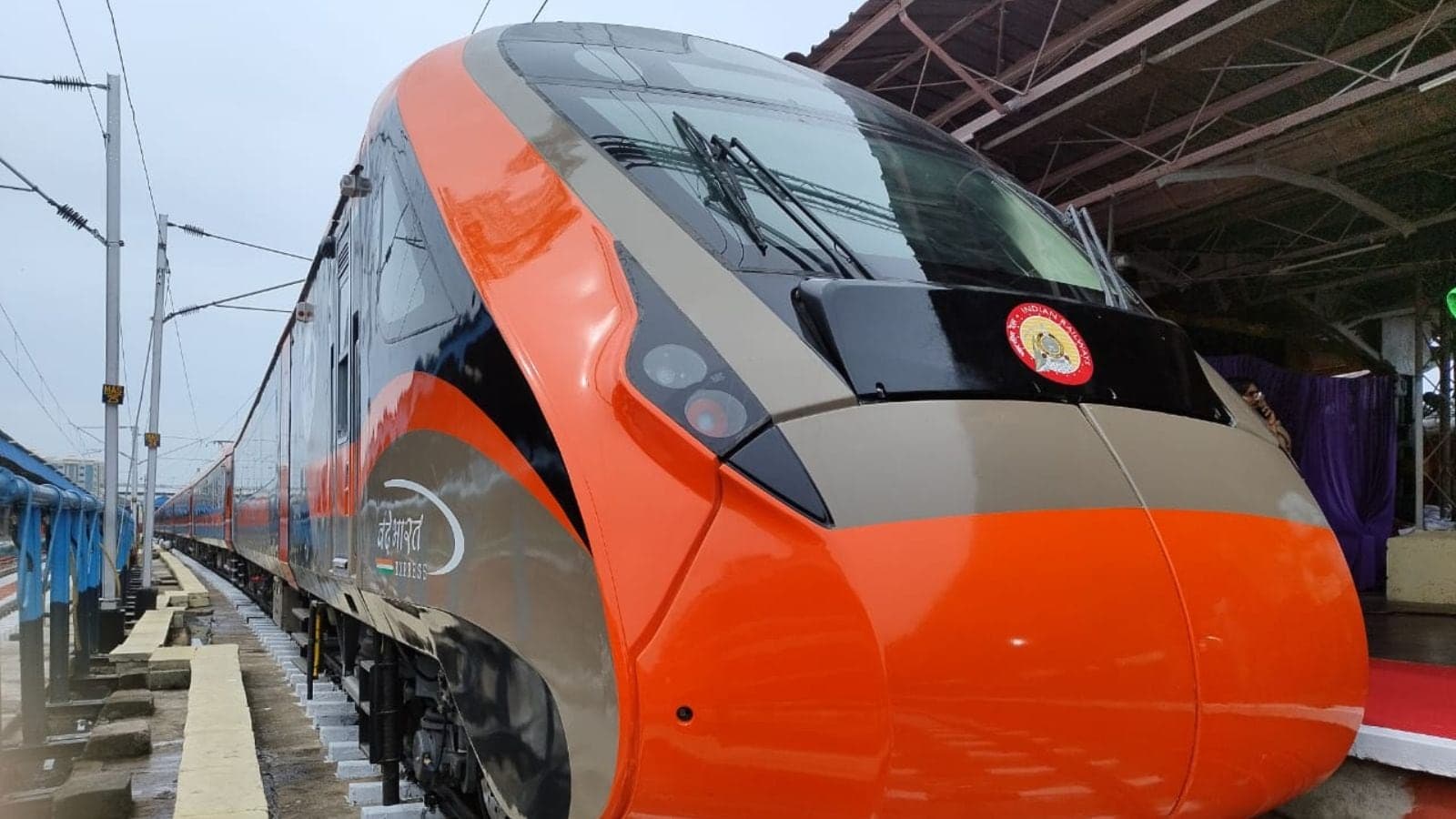
Narasapur–Chennai Vande Bharat train to launch on December 15, boosting railway connectivity.
Summary
A new Vande Bharat Express train service is scheduled to commence operations between Narasapur and Chennai starting December 15. This launch signifies a continued expansion of India's high-speed rail network, aiming to enhance connectivity and reduce travel time between key regions. For competitive exams, this highlights government focus on modernizing railway infrastructure, important for questions on transport, infrastructure development, and national projects.
Key Points
- 1The new Vande Bharat train service will connect Narasapur and Chennai.
- 2The service is slated to begin on December 15.
- 3It is a Vande Bharat Express, part of India's semi-high-speed rail network.
- 4Narasapur serves as the origin point for this new train route.
- 5Chennai is the destination city for the newly launched Vande Bharat service.
In-Depth Analysis
The launch of the Narasapur–Chennai Vande Bharat train service, scheduled to commence on December 15, marks another significant stride in India's ambitious railway modernization program. This event is not merely about introducing a new train route; it symbolizes the nation's commitment to enhancing connectivity, boosting economic activity, and showcasing indigenous technological prowess under the 'Make in India' initiative. Understanding this development requires delving into its background, stakeholder involvement, broader implications, and constitutional context.
**Background Context: The Genesis of Vande Bharat**
The Vande Bharat Express, formerly known as Train 18, represents India's first semi-high-speed, self-propelled train set. Conceived and manufactured by the Integral Coach Factory (ICF) in Chennai, it was a direct outcome of the 'Make in India' initiative, launched in 2014, aimed at fostering domestic manufacturing and reducing reliance on imports. The first Vande Bharat train was flagged off on February 15, 2019, connecting Delhi and Varanasi. The vision behind these trains was to provide world-class travel experience, reduce travel time significantly, and offer modern amenities, all while being cost-effective due to indigenous production. This initiative aligns with the government's broader strategy to upgrade railway infrastructure, which has historically been the lifeline of the nation, carrying millions of passengers and tons of freight daily.
**What Happened: The Narasapur–Chennai Connectivity**
The new Vande Bharat service connecting Narasapur in Andhra Pradesh to Chennai, the capital of Tamil Nadu, is a strategic addition to the growing network. Narasapur, located in the West Godavari district, is an important commercial hub, particularly known for its aquaculture and handloom industries. Chennai, on the other hand, is a major metropolitan, economic, and cultural center in South India. This new route is expected to significantly cut down travel time, providing a faster and more comfortable commuting option for business travelers, tourists, and daily commuters between these two regions. The specific details regarding travel time, stops, timings, and ticket prices, while crucial for passengers, reinforce the operational aspects of a critical infrastructure project.
**Key Stakeholders Involved**
Several entities play crucial roles in such a project. The **Indian Railways**, under the **Ministry of Railways**, is the primary stakeholder, responsible for conceptualization, planning, funding, implementation, and operation. The **Integral Coach Factory (ICF), Chennai**, stands as a pivotal stakeholder, being the manufacturer of the Vande Bharat train sets, embodying the success of 'Make in India'. **Passengers and local communities** along the route are direct beneficiaries, gaining improved connectivity and economic opportunities. **State governments** of Andhra Pradesh and Tamil Nadu also have a vested interest, as enhanced rail connectivity contributes to regional development and tourism.
**Why This Matters for India: Economic, Social, and Strategic Impact**
This launch holds immense significance for India. **Economically**, faster connectivity facilitates trade, tourism, and business interactions, potentially boosting regional GDPs. It supports the **'Atmanirbhar Bharat' (Self-Reliant India)** vision by demonstrating indigenous manufacturing capabilities in high-tech sectors. **Socially**, it improves accessibility for citizens, enhancing quality of life and fostering national integration by bringing diverse regions closer. From an **environmental perspective**, rail travel is generally more energy-efficient and less polluting per passenger-kilometer compared to road or air travel, contributing to sustainable development goals. Strategically, the expansion of modern rail networks is integral to India's overall infrastructure development, crucial for both civilian and defence logistics.
**Historical Context and Broader Themes**
Indian Railways has a rich history dating back to 1853. From steam locomotives to electric engines and now semi-high-speed trains, its evolution mirrors India's development journey. The Vande Bharat project aligns with broader themes of **governance and public service delivery**, aiming to provide efficient and reliable transport. It is also a key component of the **PM Gati Shakti National Master Plan**, launched in 2021, which seeks to create a multi-modal connectivity infrastructure for economic zones. This integrated approach to infrastructure planning and implementation is designed to break departmental silos and accelerate project execution.
**Constitutional Articles, Acts, and Policies**
Railways fall under the **Union List (Entry 22)** of the Seventh Schedule of the Indian Constitution, granting the central government exclusive legislative and executive powers over this sector. This constitutional provision underpins the Ministry of Railways' authority to plan and execute such nationwide projects. Key policies guiding these developments include the **National Rail Plan for India (2030)**, which aims to create a 'future-ready' railway system capable of handling projected growth in passenger and freight traffic. The **Indian Railways Act, 1989**, governs the administration and operation of railways in India. The impetus for indigenous manufacturing also draws from industrial policies supporting 'Make in India' and 'Atmanirbhar Bharat'.
**Future Implications**
The successful operation and expansion of Vande Bharat services pave the way for further advancements. We can anticipate more routes connecting various regions, including the introduction of 'Vande Metro' for shorter distances and 'Vande Sleeper' for overnight journeys. This will not only modernize passenger travel but also potentially free up existing lines for increased freight movement, thereby boosting logistics efficiency. The experience gained from Vande Bharat trains could also position India as an exporter of advanced railway technology in the future, further cementing its position as a global manufacturing hub.
Exam Tips
This topic primarily falls under **UPSC GS Paper 3 (Economy - Infrastructure, Industrial Policy)**, and **General Awareness sections for SSC, Banking, Railway, and State PSC exams (Indian Economy, Transport, Government Schemes)**. Focus on the 'Make in India' aspect, infrastructure development, and economic impact.
When studying, connect Vande Bharat to related topics like the **National Rail Plan for India (2030)**, **PM Gati Shakti National Master Plan**, and the broader **'Atmanirbhar Bharat' initiative**. Understand how these policies interlink to drive infrastructure growth.
Common question patterns include: (a) Factual questions on the origin, manufacturer (ICF Chennai), or key features of Vande Bharat trains; (b) Conceptual questions on the economic, social, or environmental impact of such projects; (c) Policy-based questions linking Vande Bharat to government initiatives like 'Make in India' or Gati Shakti. Be prepared for both objective and subjective questions.