



Relevant for Exams
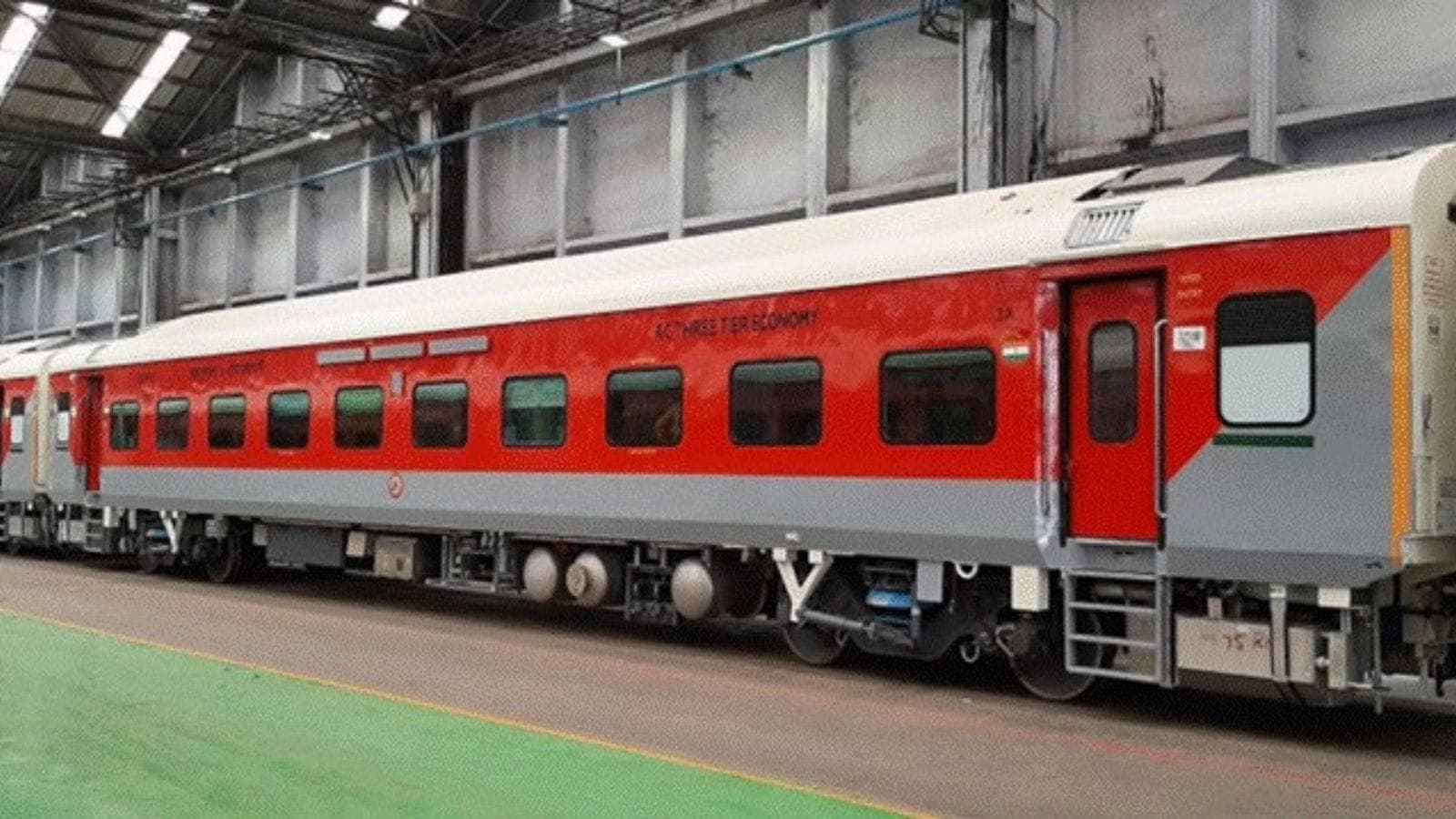
Indian Railways' LHB coach production up 18% in FY26, exceeding 4,200 coaches built.
Summary
Indian Railways has seen an 18% rise in Linke Hofmann Busch (LHB) coach production during FY26, with over 4,200 coaches built so far. This significant increase highlights the ongoing modernization efforts and commitment to enhancing passenger safety and comfort across the railway network. For competitive exams, this demonstrates government focus on infrastructure upgrade and technological adoption in public transport, making it relevant for questions on national development and railway initiatives.
Key Points
- 1Indian Railways recorded an 18% increase in Linke Hofmann Busch (LHB) coach production.
- 2Over 4,200 LHB coaches have been manufactured by Indian Railways to date.
- 3The reported production growth and total coaches built pertain to Fiscal Year 2026 (FY26).
- 4LHB coaches are advanced passenger coaches known for superior safety features, including anti-telescoping properties and disc brakes, compared to older ICF coaches.
- 5Increased LHB coach production is a key component of Indian Railways' strategy to modernize its fleet and enhance passenger safety and travel experience.
In-Depth Analysis
The recent announcement of an 18% rise in Linke Hofmann Busch (LHB) coach production during Fiscal Year 2026 (FY26), with over 4,200 coaches manufactured by Indian Railways so far, marks a significant milestone in the nation's ongoing railway modernization efforts. This development is not merely a statistic; it represents a fundamental shift in India's public transport infrastructure, aiming for enhanced safety, comfort, and efficiency.
**Background Context and Historical Shift:**
For decades, Indian Railways predominantly relied on Integral Coach Factory (ICF) coaches, first introduced in the 1950s. While robust, these coaches had inherent design limitations, particularly concerning safety. In the event of a collision or derailment, ICF coaches were prone to 'telescoping' – one coach overriding another, leading to severe damage and high casualties. This vulnerability became a critical concern, prompting the search for a safer alternative. The solution arrived in the form of Linke Hofmann Busch (LHB) coaches. Originating from Alstom-LHB GmbH of Germany, these coaches were first introduced in India in the early 2000s, initially through imports and later through indigenous manufacturing at Indian Railways' production units like the Integral Coach Factory (ICF) in Chennai, Rail Coach Factory (RCF) in Kapurthala, and Modern Coach Factory (MCF) in Raebareli. LHB coaches are designed with superior crashworthiness, featuring anti-telescoping mechanisms, disc brakes for better stopping power, and a modular interior that offers enhanced comfort and reduced noise levels compared to their ICF counterparts. Their lightweight stainless steel body also makes them more fuel-efficient and capable of higher speeds.
**What Happened and Key Stakeholders:**
The news highlights a robust increase in the production of these advanced coaches, signifying a focused drive to replace the older fleet. The figure of over 4,200 coaches built in FY26, with an 18% increase over the previous year, indicates a rapid acceleration in this transition. The primary **key stakeholder** is **Indian Railways** itself, operating under the **Ministry of Railways, Government of India**. They are responsible for setting targets, allocating resources, and overseeing the manufacturing units. The manufacturing units – ICF, RCF, and MCF – are critical for the actual production, embodying the 'Make in India' spirit. **Passengers** are direct beneficiaries, experiencing safer and more comfortable journeys. Furthermore, the **Indian economy and domestic industry** are significant stakeholders, as indigenous production creates jobs, fosters technological absorption, and reduces reliance on imports.
**Significance for India and Broader Themes:**
This increased production holds immense **significance for India** across multiple dimensions. From a **safety perspective**, it directly addresses a long-standing vulnerability in the railway system, potentially saving lives and reducing injuries in accidents. For **passenger experience**, LHB coaches offer superior comfort, better suspension, and improved amenities, enhancing the overall travel quality. Economically, this drive aligns perfectly with the government's **'Make in India' initiative**, promoting domestic manufacturing, creating skilled employment, and boosting ancillary industries. It also reflects a broader commitment to **infrastructure development**, which is crucial for India's economic growth and global competitiveness. The modernization of rolling stock is a key component of the **National Rail Plan 2030**, which envisions a future-ready railway system capable of handling increased traffic and higher speeds. This also indirectly supports environmental goals as LHB coaches, being lighter, are more energy-efficient. The investment in railway infrastructure is a testament to the government's focus on improving public services and connectivity, which are vital for inclusive growth.
**Constitutional and Policy References:**
Railways fall under the **Union List** (Entry 22) of the **Seventh Schedule** of the Indian Constitution, granting the Parliament exclusive power to legislate on this subject. The Ministry of Railways formulates policies and budgets under this constitutional mandate. The move towards LHB coaches is a direct outcome of policy directives aimed at modernizing the railway network, often articulated in annual Railway Budgets and long-term plans like the **National Rail Plan 2030**. The emphasis on indigenous production strongly resonates with the **'Make in India' policy**, launched in 2014, which aims to transform India into a global manufacturing hub. Furthermore, the provision of modern amenities in these coaches, including bio-toilets, aligns with broader government initiatives like **Swachh Bharat Abhiyan** (Clean India Mission).
**Future Implications:**
Looking ahead, the accelerated production of LHB coaches implies a faster phase-out of the older ICF fleet, leading to a more uniform and safer passenger experience across the network. This will likely contribute to a significant improvement in railway safety statistics. The enhanced speed potential of LHB coaches also opens avenues for increasing average train speeds, reducing travel times, and potentially allowing for more services on existing routes. As India continues to upgrade its track infrastructure and signaling systems, the full capabilities of LHB coaches can be leveraged. This domestic manufacturing prowess could also lead to India becoming an exporter of railway coaches to other developing nations, further cementing its position in the global railway industry. The continuous technological upgrade in railways is a critical step towards achieving a truly world-class public transportation system, supporting India's aspirations for economic growth and social development.
Exam Tips
This topic falls under General Studies Paper 3 (Economy, Infrastructure) for UPSC Civil Services Exam, focusing on infrastructure development, government policies, and 'Make in India' initiative. For SSC, Banking, and Railway exams, it's relevant for General Awareness sections, particularly on current affairs related to Indian Railways and government schemes.
Study related topics such as the National Rail Plan 2030, Dedicated Freight Corridors, High-Speed Rail Projects (e.g., Bullet Train), Railway Budget allocations, and the Public-Private Partnership (PPP) model in infrastructure development. Understanding the features of LHB vs. ICF coaches in detail is also crucial.
Common question patterns include factual questions (e.g., 'What is the primary safety feature of LHB coaches?', 'Which manufacturing units produce LHB coaches?'), policy-oriented questions (e.g., 'How does the increased LHB production align with the 'Make in India' initiative?'), and analytical questions (e.g., 'Discuss the significance of railway modernization for India's economic growth and safety'). Expect questions on the constitutional provisions related to railways as well.