



Relevant for Exams
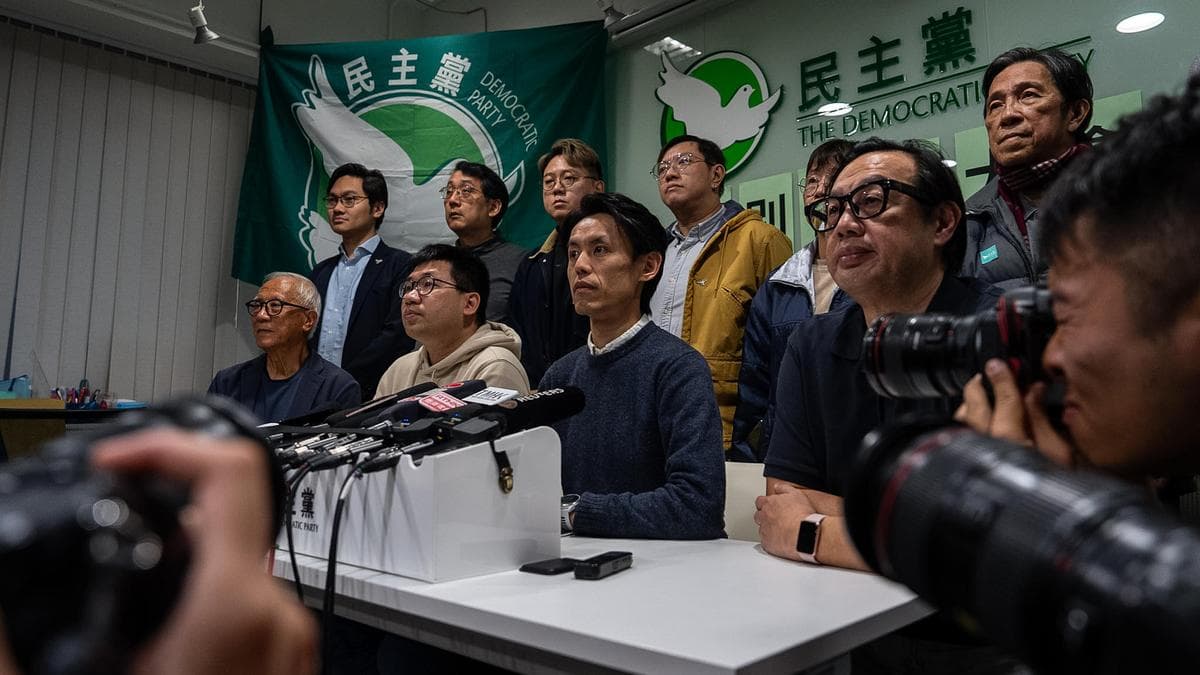
Hong Kong's Democratic Party, founded 1994, disbands after 30+ years of pro-democracy activism.
Summary
Hong Kong's largest pro-democracy party, The Democratic Party, founded in 1994, has voted to disband after over 30 years of advocating for universal suffrage. This significant development highlights the shrinking space for political dissent and pro-democracy movements in Hong Kong under increasing pressure from Beijing. It is crucial for understanding international political dynamics and the erosion of autonomy in the region for competitive exams.
Key Points
- 1Hong Kong's largest pro-democracy party, The Democratic Party, voted to disband.
- 2The Democratic Party was founded in the year 1994.
- 3The party was active for over 30 years, advocating for universal suffrage.
- 4It was known as a moderate Opposition party in Hong Kong.
- 5The party's primary objective was to push for universal suffrage in electing the city's leader.
In-Depth Analysis
The decision by Hong Kong's largest pro-democracy party, The Democratic Party, to disband after more than three decades of activism marks a watershed moment in the city's political landscape. Founded in 1994, just three years before the British handover of Hong Kong to China, the party was a prominent voice advocating for universal suffrage and democratic reforms within the framework of the 'One Country, Two Systems' principle. Its dissolution is not merely the end of a political entity but a stark symbol of the shrinking space for dissent and political freedom in Hong Kong, a development with significant geopolitical ramifications.
To understand this event, one must revisit the historical context. Hong Kong was a British colony for over 150 years. In 1984, the Sino-British Joint Declaration laid the groundwork for its return to China in 1997. This agreement, an international treaty, stipulated that Hong Kong would enjoy a 'high degree of autonomy' for 50 years under the 'One Country, Two Systems' framework, retaining its capitalist system, independent judiciary, and freedoms not available in mainland China. The Basic Law, Hong Kong's mini-constitution, enshrined these principles and promised the ultimate aim of universal suffrage for the election of the Chief Executive and the Legislative Council. The Democratic Party consistently pushed for the full realization of these democratic promises, often clashing with both the Hong Kong government and Beijing.
What happened is a culmination of years of escalating pressure. Following large-scale pro-democracy protests in 2014 (the 'Umbrella Movement') and particularly in 2019 (against a controversial extradition bill), Beijing adopted an increasingly hardline stance. In June 2020, China imposed the National Security Law on Hong Kong, bypassing the city's legislature. This law criminalized secession, subversion, terrorism, and collusion with foreign forces, with broad definitions that effectively stifled political opposition. Subsequently, electoral reforms were introduced in 2021, drastically reducing direct public representation and instituting a 'patriots only' rule for office-holders, ensuring loyalty to Beijing. Under this new political reality, many pro-democracy activists have been arrested, imprisoned, or forced into exile. The Democratic Party, as a moderate opposition force, found itself in an untenable position, unable to effectively participate or even exist without risking prosecution. Its decision to disband reflects the grim reality that the avenues for peaceful democratic advocacy have been effectively closed.
Key stakeholders in this unfolding drama include The Democratic Party itself, representing the aspirations of a significant portion of Hong Kong's population for genuine democracy. The Hong Kong government, once seen as having a degree of autonomy, is now largely perceived as an executor of Beijing's policies. The People's Republic of China, under President Xi Jinping, is the primary driver of these changes, prioritizing national security and political stability over the 'high degree of autonomy' promised to Hong Kong. The citizens of Hong Kong, particularly the younger generation, are grappling with the erosion of their freedoms and distinct identity. The international community, while expressing concern, has largely been unable to alter Beijing's course.
For India, this development carries significant implications. Geopolitically, it underscores China's growing assertiveness and its willingness to reshape regional orders, even at the cost of international agreements like the Sino-British Joint Declaration. India, sharing a contested border with China and navigating complex relations, must observe these developments closely, as they reflect a broader trend of China's expanding influence. Economically, Hong Kong has historically been a vital financial hub and a gateway for foreign investment into China, as well as a significant trading partner for India. Any instability or erosion of its unique financial and legal system could affect Indian businesses and investors operating in or through Hong Kong. Furthermore, as the world's largest democracy, India's foreign policy, though generally non-interventionist in internal affairs, often espouses democratic values. The suppression of democratic movements in Hong Kong poses a challenge to the global democratic order and raises questions about human rights, themes that resonate with India's own constitutional ethos, particularly its commitment to fundamental rights and the rule of law. While India does not have specific constitutional articles directly related to Hong Kong's autonomy, its foreign policy principles, often guided by Article 51 (Promotion of international peace and security) and the broader democratic values enshrined in its Preamble, would implicitly view such developments with concern regarding international norms and human rights.
Looking ahead, the future implications are profound. Hong Kong's unique status as an international financial center, built on its rule of law and freedoms, is now severely jeopardized. The 'One Country, Two Systems' model, once seen as a potential template for Taiwan's reunification with the mainland, now appears discredited, likely hardening Taiwanese public opinion against such a future. The disbandment of The Democratic Party signals a further consolidation of Beijing's control, potentially leading to Hong Kong becoming increasingly indistinguishable from other mainland Chinese cities in terms of political freedom. This erosion of autonomy sets a worrying precedent for international norms and the credibility of international agreements, impacting global diplomacy and the balance of power in Asia.
Exam Tips
This topic falls under 'International Relations' (UPSC Mains GS-II, State PSCs) and 'Current Affairs' (all exams). Focus on the 'One Country, Two Systems' principle, the Sino-British Joint Declaration (1984), and the National Security Law (2020) for factual questions.
Understand the cause-and-effect relationship: British handover -> 'One Country, Two Systems' promise -> Pro-democracy movements -> Beijing's crackdown (National Security Law, electoral reforms) -> Disbanding of parties. Questions may ask about the timeline or the reasons behind the erosion of Hong Kong's autonomy.
Prepare for questions on India's stance or the implications for India's foreign policy, economic interests, and democratic values. A comparative analysis with other regions facing similar geopolitical pressures (e.g., Taiwan) could also be asked.
Be aware of the key terms like 'universal suffrage,' 'Basic Law,' 'Umbrella Movement,' 'extradition bill,' and 'patriots governing Hong Kong' as they are crucial for understanding the nuances of the situation.
Practice essay writing on topics like 'The future of democracy in Asia' or 'Challenges to international law and treaties in the 21st century' using Hong Kong as a case study.
Related Topics to Study
Full Article
The Democratic Party, founded in 1994, was a moderate Opposition party that pushed for universal suffrage in electing the city's leader for decades