



Relevant for Exams
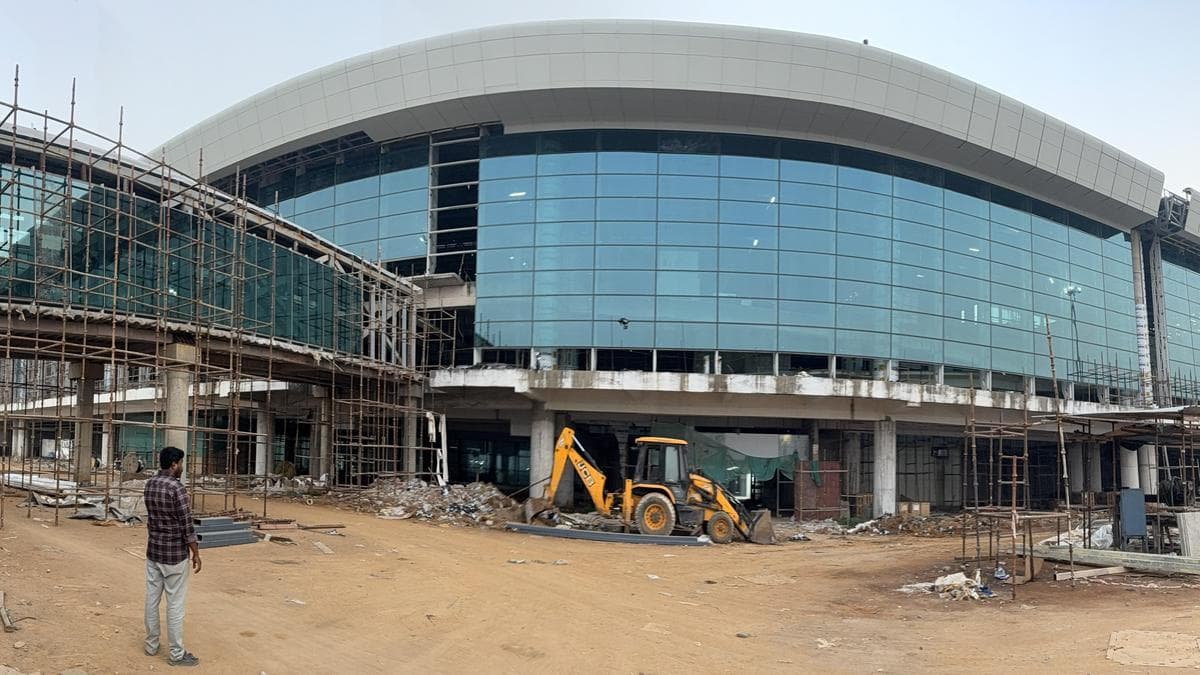
Vijayawada airport's new integrated terminal deadline pushed to March 31, over 80% complete.
Summary
The deadline for completing the new integrated terminal at Vijayawada airport has been extended to March 31. This infrastructure project is crucial for enhancing air connectivity and passenger capacity in the region. For competitive exams, this highlights ongoing infrastructure development projects, important airport locations, and project management timelines, particularly relevant for state-level general awareness questions.
Key Points
- 1The new integrated terminal project is located at Vijayawada airport.
- 2The revised deadline for completing the new terminal has been set for March 31.
- 3Currently, over 80% of the construction work for the new terminal has been completed.
- 4Commissioning of the new terminal is expected to take an additional two months after its completion.
- 5Key ongoing works include glass work, interiors, flooring, and baggage strip installation.
In-Depth Analysis
The news about the extended deadline for the new integrated terminal at Vijayawada airport offers a fascinating lens into India's ambitious infrastructure development, particularly in the civil aviation sector. This project is not merely about constructing a building; it's a critical component of India's strategy to enhance regional connectivity, boost economic growth, and empower Tier-2 and Tier-3 cities.
**Background Context and What Happened:**
India has witnessed an unprecedented surge in air travel over the last decade, driven by economic growth, a rising middle class, and government initiatives to make air travel more accessible. This growth has put immense pressure on existing airport infrastructure, necessitating rapid expansion and modernization. Vijayawada, strategically located in Andhra Pradesh and serving as a key economic and administrative hub, has seen a significant increase in passenger traffic. The existing facilities were becoming inadequate to handle the growing demand, prompting the need for a new, larger, and more modern integrated terminal. An integrated terminal implies handling both domestic and potentially international operations, streamlining passenger movement and improving overall efficiency.
The initial target for completing this new terminal faced delays, a common challenge in large-scale infrastructure projects due to various factors like land acquisition, regulatory clearances, supply chain issues, and unforeseen construction hurdles. The recent announcement of the deadline extension to March 31, with over 80% of the work completed (including crucial aspects like glass work, interiors, flooring, and baggage strip installation), indicates that the project is in its final stages. The subsequent two-month commissioning period highlights the extensive testing and operational readiness procedures required before an airport terminal can become fully functional.
**Key Stakeholders Involved:**
Several key players are central to this development. The primary stakeholder is the **Airports Authority of India (AAI)**, a statutory body under the Ministry of Civil Aviation, responsible for creating, upgrading, maintaining, and managing civil aviation infrastructure in India. AAI is the project owner and executor. The **Ministry of Civil Aviation** provides policy direction and oversight. The **Government of Andhra Pradesh** is crucial for facilitating land acquisition, providing necessary local clearances, and ensuring last-mile connectivity to the airport. Various **private construction companies and contractors** are involved in the actual execution of the project. Ultimately, the **passengers** and **local businesses** in Vijayawada and the surrounding regions are the ultimate beneficiaries and indirect stakeholders, as they will experience enhanced connectivity and economic opportunities.
**Significance for India:**
This project holds immense significance for India's development trajectory. Firstly, it directly contributes to **economic growth** by facilitating trade, tourism, and investment in the region. Improved air connectivity makes Vijayawada more attractive for businesses, leading to job creation and increased economic activity. Secondly, it aligns with the government's flagship **UDAN (Ude Desh ka Aam Nagrik) scheme**, which aims to enhance regional air connectivity by making air travel affordable and widespread. While Vijayawada is already a major city, an upgraded terminal further strengthens its role as a regional aviation hub, potentially opening up new routes to smaller towns. Thirdly, it is a testament to India's broader commitment to **infrastructure development**, a key pillar of economic growth, as envisioned under initiatives like the National Infrastructure Pipeline and the PM Gati Shakti Master Plan. These initiatives aim for integrated planning and synchronized project implementation across various modes of transport, including aviation, to reduce logistical costs and improve efficiency. Such projects also enhance India's global image as a rapidly developing economy with modern infrastructure.
**Historical Context and Constitutional Provisions:**
Civil aviation in India has a rich history, evolving from colonial beginnings to nationalization post-independence (e.g., Air India and Indian Airlines) and then liberalization in the 1990s. The establishment of the AAI in 1995, under the **Airports Authority of India Act, 1994**, consolidated the functions of the International Airports Authority of India and the National Airports Authority, giving it a comprehensive mandate over airport infrastructure. Constitutionally, civil aviation falls under the **Union List (List I)** of the Seventh Schedule, specifically **Entry 29**, which covers "Airways; aircraft and air navigation; provision of aerodromes; regulation and organisation of air traffic and of aerodromes; provision for aeronautical education and training and regulation of ports of entry and departure for air traffic to and from India." This clearly places the primary responsibility for aviation development with the central government. The **National Civil Aviation Policy, 2016**, further outlines the government's vision for making India the third-largest aviation market globally, promoting regional connectivity, and developing cargo infrastructure.
**Future Implications:**
The completion of the new integrated terminal at Vijayawada airport will have several positive future implications. It is expected to significantly increase passenger handling capacity, paving the way for more domestic and potentially international flights. This improved connectivity will further spur economic development in Andhra Pradesh, attracting more businesses, tourists, and investments. It will also enhance the passenger experience, with modern amenities and efficient operations. As India continues its trajectory of economic growth and urbanization, the demand for air travel will only intensify. Projects like the Vijayawada terminal set a precedent for future airport expansions and greenfield projects, potentially involving greater private sector participation under public-private partnership (PPP) models, as seen in other major Indian airports. This continuous infrastructure push is vital for India to maintain its growth momentum and integrate its regional economies more effectively.
Exam Tips
This topic falls under the 'Indian Economy' and 'Current Affairs (National)' sections of competitive exam syllabi. Focus on the role of infrastructure in economic development.
Study related topics like the UDAN scheme, the Airports Authority of India (AAI) and its functions, the National Civil Aviation Policy (2016), and the PM Gati Shakti Master Plan. Understand how these initiatives are interconnected.
Common question patterns include: identifying the location of new infrastructure projects, the government body responsible (e.g., AAI for airports), the objectives of related schemes (e.g., UDAN), and the constitutional basis for central government involvement (e.g., Seventh Schedule, Union List).
Be prepared for questions on the economic impact of such projects, including job creation, tourism boost, and regional development.
Memorize key facts like the Airports Authority of India Act, 1994, and specific constitutional articles like Entry 29 of the Union List.
Related Topics to Study
Full Article
Commissioning of the new terminal is likely to take two more months; currently, over 80% of the terminal has been completed, including glass work, interiors, flooring and baggage strip