



Relevant for Exams
Rahul Gandhi slams EC's independence, vows to change "immunity law" for election commissioners.
Summary
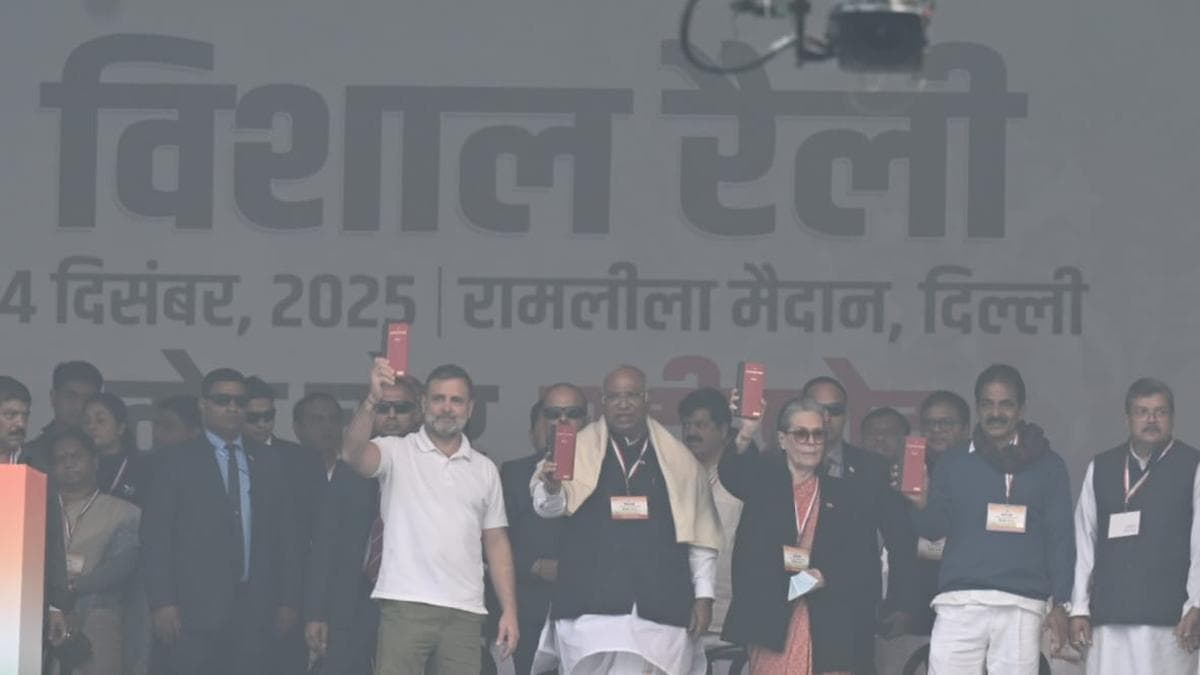
Rahul Gandhi, addressing a Congress rally against alleged 'vote chori', criticized the Election Commission of India (ECI), stating it should not be seen as aligned with PM Modi. He further alleged that PM Modi introduced a new law granting immunity to EC members and pledged that a Congress government would change this law and act against election commissioners. This issue is highly significant for competitive exams as it pertains to the independence of constitutional bodies and electoral reforms in India.
Key Points
- 1Congress leader Rahul Gandhi addressed a rally organized against alleged 'vote chori' (vote theft).
- 2He accused Prime Minister Modi of bringing a "new law to give immunity to Election Commissioners".
- 3Gandhi asserted that the Election Commission should remember it is the country's EC, not PM Modi's.
- 4He pledged that if Congress forms the government, they would change this specific law and take action against election commissioners.
- 5The statements highlight concerns regarding the independence and functioning of the Election Commission of India, a constitutional body.
In-Depth Analysis
The recent statements by Congress leader Rahul Gandhi, alleging 'vote chori' and criticizing the Election Commission of India (ECI) for perceived alignment with the ruling government, underscore profound concerns regarding the independence of constitutional bodies and the integrity of India's electoral process. His specific accusation about a 'new law' granting immunity to Election Commissioners and the pledge to overturn it if Congress comes to power brings a critical legislative development into sharp focus.
**Background Context and What Happened:**
India's Election Commission is a cornerstone of its democracy, enshrined in Article 324 of the Constitution, tasked with the superintendence, direction, and control of elections. Its independence is paramount to ensuring free and fair polls. Historically, the appointment of the Chief Election Commissioner (CEC) and Election Commissioners (ECs) was based on the recommendation of the government. This process came under scrutiny, leading to a significant Supreme Court judgment on March 2, 2023. In a landmark ruling, the apex court mandated that the appointment of the CEC and ECs should be done by a committee comprising the Prime Minister, the Leader of the Opposition in the Lok Sabha, and the Chief Justice of India (CJI). The Court emphasized that this reform was crucial to insulate the ECI from executive interference until Parliament enacted a law on the matter.
However, the government subsequently introduced and passed The Chief Election Commissioner and Other Election Commissioners (Appointment, Conditions of Service and Term of Office) Act, 2023, which came into effect on December 28, 2023. This new law altered the Supreme Court's prescribed selection committee. Instead of the CJI, the committee now consists of the Prime Minister (as Chairperson), a Union Cabinet Minister nominated by the Prime Minister, and the Leader of the Opposition in the Lok Sabha. Rahul Gandhi's 'new law' reference directly pertains to this legislation. While the Act does not explicitly grant 'immunity' in the traditional sense, it centralizes the appointment power with the executive, which critics argue indirectly shields Election Commissioners from accountability to broader, independent checks and balances, thereby compromising their perceived neutrality.
**Key Stakeholders Involved:**
1. **Election Commission of India (ECI):** The constitutional body responsible for conducting elections, now facing renewed scrutiny over its independence and the process of appointing its members.
2. **Indian National Congress (INC):** As the principal opposition party, they are vocal critics of the government's policies, particularly those impacting democratic institutions. Their allegations of 'vote chori' and criticism of the ECI reflect their distrust in the current electoral environment.
3. **Bharatiya Janata Party (BJP) / Government of India:** The ruling party that enacted the 2023 Act, defending it as a legitimate exercise of parliamentary power to legislate on a matter where the Constitution was silent on the specific appointment mechanism.
4. **Supreme Court of India:** Its 2023 judgment set a precedent for a more independent selection process, which was subsequently overridden by the legislative action. Future legal challenges to the 2023 Act are anticipated.
5. **The Electorate:** The ultimate stakeholders whose faith in the electoral process and the impartiality of the ECI is vital for the health of India's democracy.
**Why This Matters for India:**
This issue holds immense significance for India's democratic fabric. The ECI's independence is non-negotiable for upholding the fairness and credibility of elections. Any perception of executive overreach in its functioning or appointments can erode public trust, leading to questions about the legitimacy of election outcomes. Politically, it fuels intense debate between the ruling and opposition parties, potentially polarizing the electorate. Socially, a lack of faith in electoral integrity can lead to disillusionment and disengagement from the democratic process. Economically, a stable political environment, underpinned by credible elections, is crucial for investor confidence and sustained growth.
**Historical Context:**
The ECI has largely enjoyed a reputation for independence, particularly since the transformative tenure of CEC T.N. Seshan in the 1990s, who vigorously enforced the Model Code of Conduct and cracked down on electoral malpractices. This established a high benchmark for the ECI's assertiveness. However, criticisms regarding appointments and perceived biases have surfaced periodically. The current controversy harks back to fundamental debates about executive power, legislative supremacy, and judicial review, constantly balancing each other in India's constitutional scheme.
**Future Implications:**
The immediate future is likely to see continued political battles over the 2023 Act. The opposition is expected to challenge its constitutional validity in the Supreme Court, arguing that it undermines the ECI's independence and goes against the spirit of the Court's earlier judgment. The outcome of such legal challenges will be crucial. Furthermore, the ECI's actions and decisions in upcoming elections will be scrutinized more intensely than ever, with every move potentially interpreted through the lens of this ongoing debate. This could lead to a more politicized environment for the ECI, making its already challenging task even more arduous. The long-term implication could be a permanent shift in the balance of power concerning constitutional appointments, potentially setting a precedent for other independent bodies.
**Related Constitutional Articles, Acts, or Policies:**
* **Article 324:** Establishes the Election Commission and vests in it the power of superintendence, direction, and control of elections.
* **The Chief Election Commissioner and Other Election Commissioners (Appointment, Conditions of Service and Term of Office) Act, 2023:** This is the specific law at the heart of the controversy, replacing the previous Election Commission (Conditions of Service of Election Commissioners and Transaction of Business) Act, 1991. It outlines the new selection committee and conditions of service.
* **Article 142:** Grants the Supreme Court the power to pass any decree or order necessary for doing 'complete justice' in any case or matter pending before it, which was invoked in its March 2023 judgment.
* **Representation of the People Act, 1950 & 1951:** These Acts govern the conduct of elections, voter registration, qualifications/disqualifications of members, and electoral offenses, forming the statutory framework under which the ECI operates.
* **Model Code of Conduct:** A set of guidelines issued by the ECI for political parties and candidates to ensure free and fair elections, though not legally enforceable, it holds significant moral authority.
Exam Tips
This topic falls under the 'Indian Polity and Governance' section of the UPSC Civil Services Syllabus (GS-II) and is also relevant for SSC, Banking, Railway, and State PSC exams under General Awareness/Current Affairs. Focus on the constitutional provisions related to ECI.
Study the evolution of the Election Commission's powers, landmark judgments (like the March 2023 SC ruling), and the key provisions of The Chief Election Commissioner and Other Election Commissioners (Appointment, Conditions of Service and Term of Office) Act, 2023. Compare the old and new appointment mechanisms.
Understand the concept of 'independence of constitutional bodies' – why it's important, how it's ensured (or potentially undermined), and specific articles related to the removal and tenure of CEC/ECs (e.g., removal process similar to a Supreme Court judge for CEC, but not for ECs).
Expect objective questions on Article 324, the composition of the selection committee under the 2023 Act, and the tenure/removal process of CEC/ECs. For descriptive exams, prepare essays on challenges to electoral integrity, reforms needed in ECI, or the balance between legislative supremacy and judicial review.
Relate this issue to broader themes like separation of powers, checks and balances, and the role of the opposition in a democracy. Be prepared to discuss the arguments for and against the new appointment law.
Related Topics to Study
Full Article
PM Modi brought new law to give immunity to EC, we will change this law and act against election commissioners: Rahul Gandhi