



Relevant for Exams
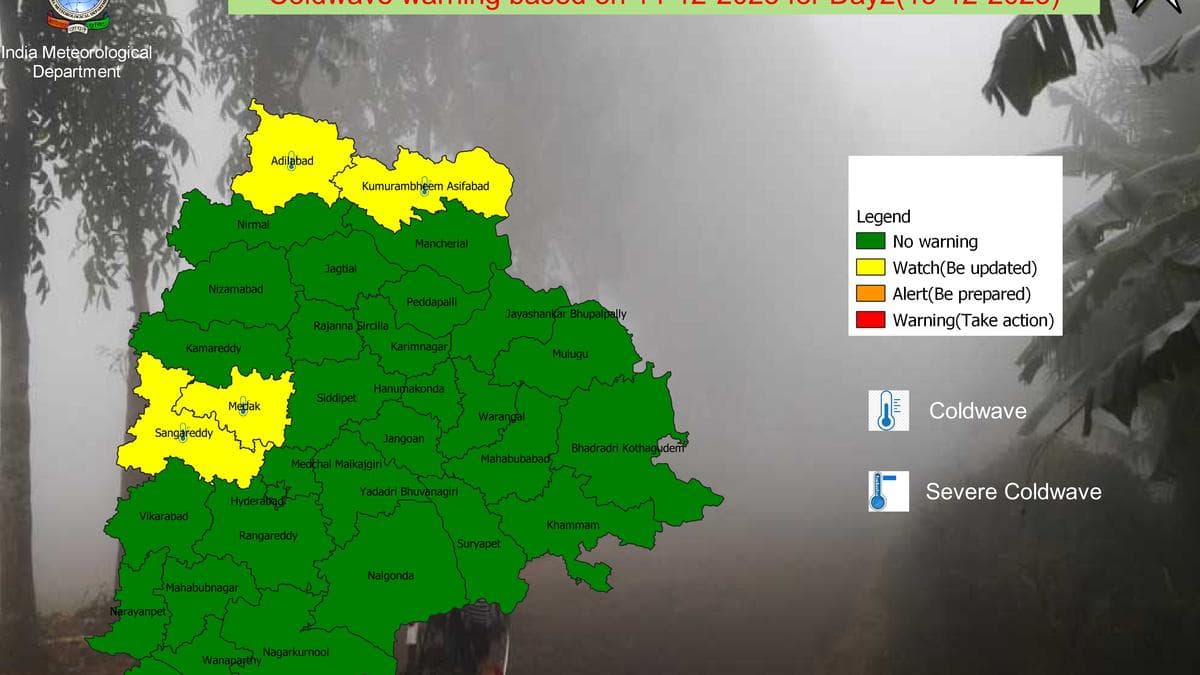
IMD issues cold wave alert for four Telangana districts on December 15.
Summary
The India Meteorological Department (IMD) issued a cold wave alert for December 15, affecting four districts in Telangana: Adilabad, Kumaram Bheem Asifabad, Sangareddy, and Medak. This highlights the IMD's role in weather forecasting and disaster preparedness, which is relevant for competitive exams focusing on geography, environment, and government agencies. Understanding such alerts is crucial for general awareness.
Key Points
- 1The India Meteorological Department (IMD) issued a cold wave alert.
- 2The cold wave conditions were predicted for December 15.
- 3Four districts in Telangana were specifically mentioned in the alert.
- 4The affected districts include Adilabad and Kumaram Bheem Asifabad.
- 5Sangareddy and Medak were also among the districts expected to experience cold wave conditions.
In-Depth Analysis
The India Meteorological Department's (IMD) cold wave alert for specific districts in Telangana on December 15, while seemingly a localized weather event, offers a rich landscape for understanding critical aspects of India's geography, environment, disaster management, and governance for competitive exam aspirants. This incident underscores the sophisticated mechanisms in place for weather forecasting and disaster preparedness in the country.
**Background Context and What Happened:**
Cold waves are a meteorological phenomenon characterized by a sudden drop in temperature, often significantly below average, accompanied by strong winds. In India, cold waves primarily affect the northern plains and parts of central and eastern India during the winter months (December to February). These are typically influenced by several factors: the southward movement of cold, dry air masses originating from the Himalayas and beyond (often linked to Western Disturbances), clear skies allowing for rapid nocturnal cooling, and specific topographical features. The IMD, established in 1875 and operating under the Ministry of Earth Sciences, is the primary agency responsible for meteorological observations, weather forecasting, and seismology in India. Its alerts are crucial for public safety and preparedness. In this instance, the IMD issued a specific cold wave alert for December 15, targeting isolated pockets of four Telangana districts: Adilabad, Kumaram Bheem Asifabad, Sangareddy, and Medak. This type of alert signifies that minimum temperatures are expected to be significantly lower than normal, posing risks to life, livestock, and agriculture.
**Key Stakeholders Involved:**
Several key stakeholders play crucial roles in such situations. Primarily, the **India Meteorological Department (IMD)** is the central authority responsible for monitoring weather patterns, issuing forecasts, and disseminating alerts. Their scientific expertise forms the bedrock of any preparedness strategy. At the state level, the **Telangana State Disaster Management Authority (TSDMA)**, along with district administrations (like those in Adilabad, Kumaram Bheem Asifabad, Sangareddy, and Medak), are responsible for translating these alerts into actionable plans. This includes issuing advisories to the public, coordinating with health services, agricultural departments, and local bodies for necessary precautions and relief measures. The **National Disaster Management Authority (NDMA)**, as the apex body, provides overall policy, guidelines, and support for disaster management across the country. Farmers and the general public are also vital stakeholders, as their awareness and adherence to advisories directly impact the efficacy of preparedness efforts.
**Significance for India:**
Cold waves have significant socio-economic implications for India. **Agriculture**, a lifeline for a large portion of the population, is particularly vulnerable. Crops like wheat, mustard, and various vegetables grown in the Rabi season can suffer damage due to frost, impacting yields and farmers' livelihoods. **Public health** is another major concern, with increased risks of hypothermia, respiratory illnesses, and cardiovascular problems, especially among vulnerable populations such as the elderly, children, and homeless individuals. Cold waves also strain **energy infrastructure** due to increased demand for heating, potentially leading to power outages. Economically, daily wage earners and outdoor workers face reduced opportunities. From a governance perspective, the efficiency of early warning systems and the coordinated response of various government agencies are tested, highlighting the importance of robust disaster management frameworks.
**Historical Context and Constitutional Provisions:**
India has a long history of experiencing severe winter conditions, particularly in its northern regions. The evolution of weather forecasting has come a long way from rudimentary observations to modern satellite imagery, Doppler radars, and numerical weather prediction models. This progress has significantly enhanced the IMD's capacity to provide timely and accurate alerts. From a constitutional standpoint, disaster management falls under the broad ambit of the **Seventh Schedule** of the Constitution, which delineates powers between the Union and States. While 'disaster management' is not explicitly listed, elements like 'public order,' 'public health,' and 'economic and social planning' are concurrent or state subjects, necessitating collaborative action. The **Disaster Management Act, 2005**, is the cornerstone legislation, establishing the National Disaster Management Authority (NDMA) at the central level, State Disaster Management Authorities (SDMAs), and District Disaster Management Authorities (DDMAs). This Act provides a legal and institutional framework for effective disaster management, including preparedness, mitigation, response, and rehabilitation. Furthermore, various government policies, such as the **National Policy on Disaster Management, 2009**, emphasize a holistic and proactive approach to disaster risk reduction.
**Future Implications:**
Looking ahead, the frequency and intensity of extreme weather events, including cold waves, are subject to the broader impacts of **climate change**. While specific predictions for cold waves are complex and vary regionally, climate change is generally expected to increase weather variability and the likelihood of extremes. This necessitates continuous investment in advanced meteorological technology, research into climate modeling, and strengthening of early warning systems. Future implications also include a greater focus on building community resilience, developing climate-smart agricultural practices to protect crops, and enhancing public health infrastructure to cope with cold-related illnesses. The incident in Telangana, therefore, serves as a reminder of the ongoing need for vigilance, preparedness, and adaptive strategies in the face of evolving climatic patterns and the crucial role of scientific institutions like the IMD in safeguarding lives and livelihoods.
Exam Tips
This topic falls under 'Geography' (Climatology, Indian Climate), 'Environment & Ecology' (Extreme Weather Events, Climate Change Impacts), 'Disaster Management' (Institutional Framework, Early Warning Systems), and 'Indian Polity' (Constitutional Provisions, Government Agencies) sections of competitive exam syllabi.
Study related topics like the causes of different weather phenomena in India (e.g., Monsoons, Western Disturbances, El Niño/La Niña), the structure and functions of key scientific bodies like IMD, NDMA, and ISRO, and the details of the Disaster Management Act, 2005.
Common question patterns include factual questions on IMD's establishment year or its parent ministry, conceptual questions on the causes and impacts of cold waves, policy-based questions on the provisions of the Disaster Management Act, and current affairs questions linking recent events to national policies or international agreements on climate change.
Related Topics to Study
Full Article
According to IMD’s latest bulletin, cold wave conditions are very likely to prevail in isolated pockets of Adilabad, Kumaram Bheem Asifabad, Sangareddy and Medak.