

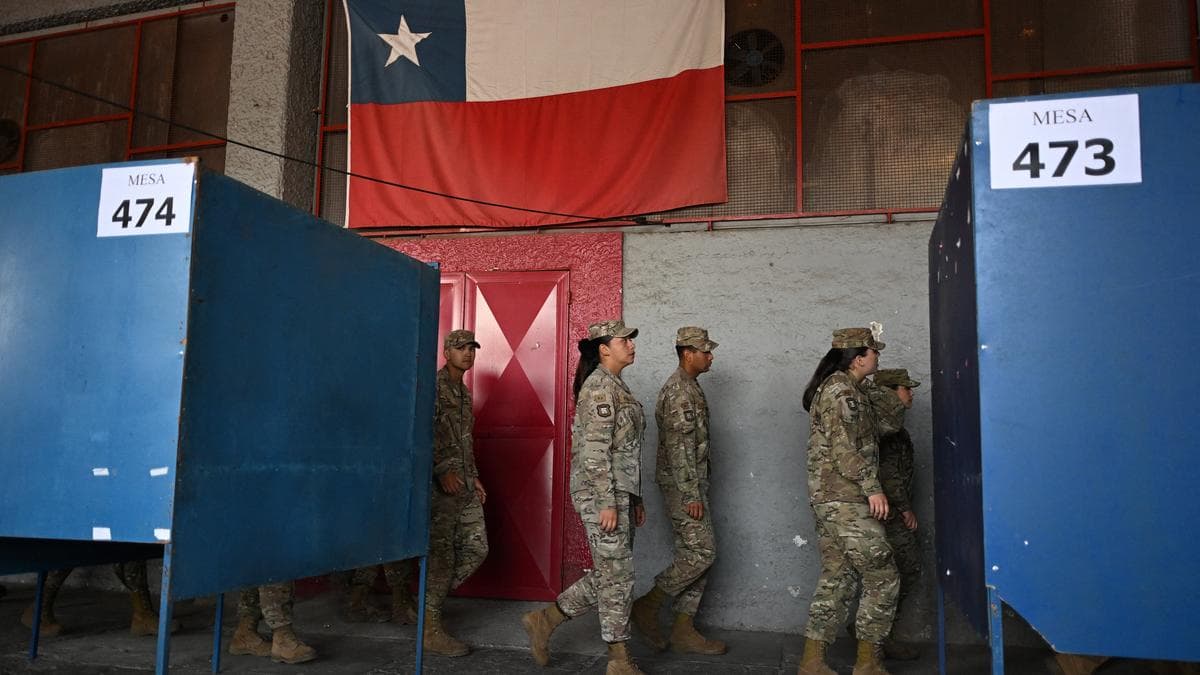


Relevant for Exams
Far-right candidate Jose Antonio Kast leads Chile's presidential election polls.
Summary
Chile is set to elect a new President, with far-right candidate Jose Antonio Kast emerging as the strong front-runner. His campaign, centered on tough-on-crime and anti-migrant policies, resonates with a significant portion of the Chilean electorate. This development is crucial for competitive exams as it highlights global political shifts towards conservative ideologies and helps understand international current affairs and geopolitical trends.
Key Points
- 1The presidential election is taking place in Chile.
- 2Jose Antonio Kast is identified as the strong front-runner in the polls.
- 3Kast is described as a 'far-right' candidate.
- 4His key campaign messages include 'tough-on-crime' policies.
- 5Kast also advocates for an 'anti-migrant' stance.
In-Depth Analysis
Chile, a nation known for its robust economy and stable democratic institutions in Latin America, found itself at a critical political juncture with the emergence of far-right candidate Jose Antonio Kast as a front-runner in its presidential elections. This development is not an isolated incident but rather a symptom of deeper socio-economic and political currents sweeping across the globe, including Latin America.
**Background Context and Historical Threads:**
Chile has a complex political history. After decades of democratic rule, it experienced a brutal military dictatorship under General Augusto Pinochet from 1973 to 1990. This era, marked by severe human rights abuses, also laid the foundation for Chile's neoliberal economic model. Following the return to democracy, Chile achieved significant economic growth, largely due to its export-oriented economy, particularly copper. However, this growth also led to widening income inequality, privatized public services, and a sense of alienation among many citizens. This simmering discontent erupted dramatically in October 2019, when a metro fare hike triggered massive, widespread protests. These demonstrations quickly evolved into a broader movement demanding a new constitution to replace the Pinochet-era document, greater social justice, and an end to neoliberal policies. The protests led to a national plebiscite, where Chileans overwhelmingly voted to draft a new constitution, a process currently underway.
**What Happened and Key Stakeholders:**
In this volatile environment, the presidential election became a battleground for two starkly different visions for Chile. Jose Antonio Kast, a former congressman, emerged as the candidate for the far-right Republican Party. His campaign gained significant traction by focusing on a 'tough-on-crime' message, promising to restore order amidst perceived lawlessness following the 2019 protests. He also advocated for an 'anti-migrant' stance, tapping into anxieties about immigration, particularly from Venezuela and Haiti. Kast's platform, which includes conservative social values, lower taxes, and a reduced state role, resonated with a segment of the electorate yearning for stability and a return to traditional values. His main opponent was Gabriel Boric, a former student protest leader representing a broad left-wing coalition, who advocated for greater social spending, environmental protection, and a more robust welfare state. The key stakeholders in this election were diverse: the Chilean electorate grappling with economic anxieties and social change, the political parties representing the left and right spectrums, and international observers keenly watching the trajectory of one of Latin America's most influential nations.
**Why This Matters for India:**
While seemingly distant, political shifts in countries like Chile have various implications for India. Firstly, in terms of **geopolitics and international relations**, India, as a rising global power, tracks democratic processes and political stability across regions. A significant shift towards the far-right in a prominent Latin American democracy can influence regional alignments and global political discourse, which India needs to understand for its multilateral engagements. Secondly, **economic implications** are notable. Chile is a vital trading partner for India, particularly for strategic minerals like copper (Chile is the world's largest producer) and lithium (critical for electric vehicles). India and Chile have a Preferential Trade Agreement (PTA) in place. Political instability or drastic policy changes under a new administration could impact trade flows, supply chains, and investment opportunities for Indian companies. Thirdly, the rise of populist, nationalist, and anti-immigrant narratives in Chile reflects a global trend. India, being the world's largest democracy with its own diverse social fabric, can draw lessons from such developments regarding the interplay of economic inequality, social anxieties, and political discourse. It highlights how issues of law and order, migration, and national identity can be leveraged in electoral politics, prompting introspection on similar dynamics within India.
**Future Implications and Broader Themes:**
Should a far-right candidate like Kast win, Chile could witness significant policy shifts. This might include a more conservative approach to social issues (e.g., abortion rights, LGBTQ+ rights), a stricter stance on immigration, and potentially a more market-friendly, less interventionist economic policy. Such a shift could also complicate the ongoing constitutional reform process, potentially leading to further social polarization. For Latin America, it could signal a continued pendulum swing in political ideologies, challenging the recent rise of left-leaning governments in some parts of the continent. Globally, it reinforces the broader theme of democratic backsliding or the rise of illiberal democracies, where strongman leaders gain power on platforms of order and nationalism, often at the expense of liberal democratic norms and human rights.
**Related Constitutional Articles, Acts, or Policies (Indian Context):**
While Chile's election doesn't directly involve Indian constitutional articles, India's engagement with such events is guided by its own constitutional principles and foreign policy. The **Preamble of the Indian Constitution** enshrines ideals of justice, liberty, equality, and fraternity, which guide India's commitment to democratic values globally. India's foreign policy, articulated in **Article 51 of the Constitution**, aims to promote international peace and security, foster respect for international law, and encourage settlement of international disputes by arbitration. This article implicitly guides India's interest in stable, democratic, and rule-of-law-abiding nations worldwide. Furthermore, India's commitment to human rights, often reflected in its international commitments, aligns with observing how other nations address issues of migration and civil liberties, which are central to Kast's platform. The broader theme of democratic governance and the challenges posed by populism are highly relevant to India's own constitutional framework of parliamentary democracy and federalism.
Exam Tips
This topic falls under UPSC GS Paper II (International Relations, Comparative Politics) and GS Paper I (World History - rise of right-wing ideologies, populism). For SSC/Banking/Railway, focus on current affairs facts: country, capital, new president, and their political leaning.
When studying international elections, always note the country, its capital, the victorious candidate, their political ideology (left, right, center, far-left, far-right), and 1-2 key policy stances. Also, identify any major geopolitical or economic significance of that country.
Common question patterns include: 'Who is the newly elected President of Chile?', 'Which political ideology does Jose Antonio Kast represent?', 'What were the key issues in the recent Chilean presidential election?', or match-the-following questions involving leaders and their countries/parties.
Related Topics to Study
Full Article
Polls show Jose Antonio Kast as the strong front-runner, with his tough-on-crime and anti-migrant message seemingly registering with Chileans