



Relevant for Exams
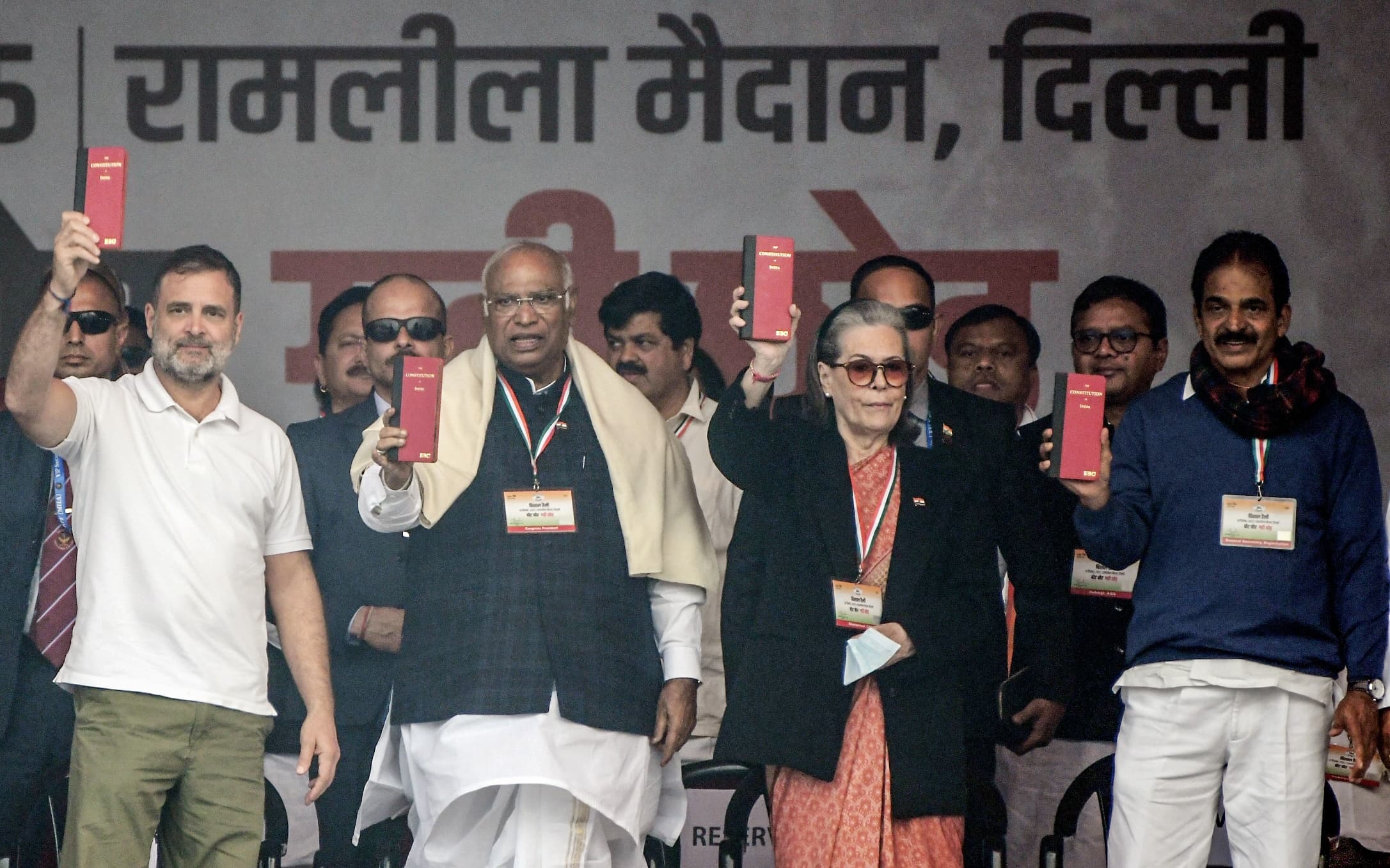
Congress leaders target three Election Commissioners at Delhi rally, raising questions on ECI's neutrality.
Summary
Congress leaders Priyanka and Rahul Gandhi targeted three Election Commissioners at a rally in Delhi, signaling strong discontent with the Election Commission of India's (ECI) functioning. This event highlights the ongoing political scrutiny on the ECI, a crucial constitutional body responsible for conducting free and fair elections. For exams, understanding the ECI's structure, powers, and constitutional provisions (Article 324) is paramount.
Key Points
- 1The Election Commission of India (ECI) is an autonomous constitutional body established under Article 324 of the Indian Constitution.
- 2The ECI is responsible for administering elections to the Lok Sabha, Rajya Sabha, State Legislative Assemblies, and the offices of President and Vice-President.
- 3It typically consists of a Chief Election Commissioner (CEC) and two Election Commissioners (ECs), appointed by the President of India.
- 4Election Commissioners hold office for a term of six years or until they attain the age of 65 years, whichever is earlier.
- 5The CEC can be removed from office only through a process similar to that of a Supreme Court judge, ensuring independence.
In-Depth Analysis
The recent targeting of three Election Commissioners by prominent Congress leaders, Priyanka and Rahul Gandhi, at a Delhi rally, signals a growing political discontent and scrutiny directed towards the Election Commission of India (ECI). This event is not an isolated incident but rather a manifestation of deeper concerns about the perceived independence and impartiality of this crucial constitutional body, especially in the run-up to and during major elections.
**Background Context and What Happened:**
At its core, the ECI is the bedrock of India's democratic process. Established under **Article 324** of the Indian Constitution, it is tasked with the monumental responsibility of superintending, directing, and controlling the preparation of electoral rolls and the conduct of elections to Parliament, State Legislatures, and the offices of President and Vice-President. The ECI is designed to be an autonomous body, ensuring free and fair elections, which are the very essence of a vibrant democracy. However, in recent years, particularly during intensely contested elections, various political parties, including the Congress, have voiced concerns regarding the ECI's decisions, its enforcement of the Model Code of Conduct, and the appointment process of its members. The specific incident of Congress leaders publicly targeting Election Commissioners highlights a significant erosion of trust and a direct challenge to the institution's perceived neutrality.
**Key Stakeholders Involved:**
* **Election Commission of India (ECI):** Comprising a Chief Election Commissioner (CEC) and typically two Election Commissioners (ECs), they are appointed by the President of India. They hold office for a term of six years or until they attain the age of 65 years, whichever is earlier. The CEC enjoys a security of tenure akin to a Supreme Court judge, removable only by a process similar to parliamentary impeachment. Other ECs can be removed by the President on the recommendation of the CEC. This structure is designed to insulate them from executive pressure. Their impartiality is paramount for democratic legitimacy.
* **Political Parties (e.g., Congress):** As direct participants in the electoral process, political parties are key stakeholders. Their role includes contesting elections, forming governments, and, crucially, acting as watchdogs over the ECI's functioning. When parties lose faith in the ECI's impartiality, it can lead to allegations that undermine the electoral process itself.
* **The President of India:** The appointing authority for the CEC and ECs, playing a critical constitutional role in initiating the process.
* **The Judiciary (Supreme Court):** The Supreme Court plays a vital role in interpreting constitutional provisions related to the ECI and has, at times, intervened to ensure the ECI's independence.
**Why This Matters for India and Historical Context:**
The independence of the ECI is non-negotiable for India's democratic health. Any perception of bias, whether real or imagined, can severely impact public trust in election outcomes, potentially leading to social unrest and political instability. Historically, the ECI, particularly under strong CECs like T.N. Seshan in the 1990s, gained immense credibility for its strict enforcement of rules, curbing malpractices, and ushering in significant electoral reforms. This era solidified its image as an impartial guardian of democracy. However, in recent decades, the ECI has increasingly faced scrutiny, with allegations ranging from delayed action on Model Code of Conduct violations to questions about the timing of election announcements. The current political climate, characterized by intense partisan rivalry, has put even greater pressure on the ECI to demonstrate its unwavering neutrality.
**Constitutional Provisions and Recent Developments:**
Beyond **Article 324**, the **Representation of the People Act, 1950** and **1951**, outline further details regarding electoral rolls, conduct of elections, and qualifications/disqualifications of members. A significant development affecting ECI's independence occurred in March 2023, when the Supreme Court, in the case of *Anup Baranwal v. Union of India*, ruled that the appointment of the CEC and ECs should be based on the recommendation of a committee comprising the Prime Minister, the Leader of the Opposition in the Lok Sabha, and the Chief Justice of India. This was a landmark judgment aimed at ensuring greater executive insulation in appointments. However, the Parliament subsequently passed the **Chief Election Commissioner and Other Election Commissioners (Appointment, Conditions of Service and Term of Office) Act, 2023**, which replaced the Chief Justice of India in the selection committee with a Union Cabinet Minister nominated by the Prime Minister. This legislative change has reignited debates about the ECI's independence, with critics arguing it gives the executive undue influence over appointments.
**Future Implications:**
The current political targeting and the recent changes in the appointment process have significant future implications. Firstly, it could further erode public confidence in the ECI, making election results more susceptible to challenges and accusations of unfairness. Secondly, it places immense pressure on the Election Commissioners to act with utmost transparency and impartiality to rebuild trust. Thirdly, it underscores the need for a broad political consensus on safeguarding the autonomy of constitutional bodies. The judiciary may again be called upon to review the new appointment law. The health of India's democracy hinges on the unwavering faith of its citizens in the fairness of its electoral process, and thus, the ECI's perceived and actual independence remains paramount. The ongoing debate highlights a critical juncture for institutional integrity in India.
Exam Tips
This topic falls under 'Indian Polity and Governance' in the UPSC Civil Services Syllabus (GS Paper II) and similar sections for State PSCs, SSC, Banking, Railway, and Defence exams. Focus on constitutional bodies and their functions.
Study Article 324 thoroughly, including the composition, appointment, tenure, and removal process of the ECI members. Pay special attention to the differences in the removal process of the CEC and other ECs.
Understand the recent Supreme Court judgment (Anup Baranwal v. Union of India, March 2023) and the subsequent legislative changes (Chief Election Commissioner and Other Election Commissioners (Appointment, Conditions of Service and Term of Office) Act, 2023) regarding the appointment process. Questions often focus on these contemporary developments.
Be prepared for questions on the powers and functions of the ECI, its role in ensuring free and fair elections, and challenges to its independence. Also, study related topics like the Model Code of Conduct and electoral reforms.
Common question patterns include direct questions on constitutional articles, comparative analysis of appointment/removal procedures, and analytical questions on the ECI's independence and its impact on Indian democracy.