



Relevant for Exams
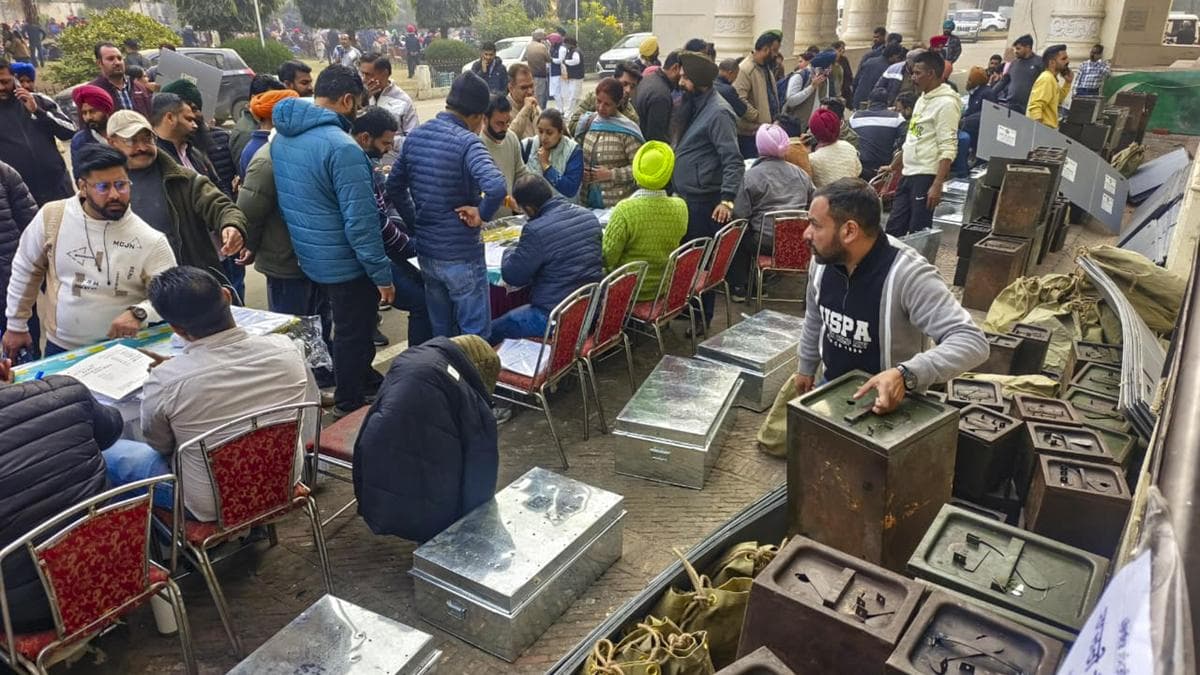
Punjab's Zila Parishad & Panchayat Samiti elections held; 8% polling till 10 am, counting on Dec 17.
Summary
Zila Parishad and Panchayat Samiti elections were conducted in Punjab, with polling commencing at 8 a.m. and concluding at 4 p.m. These local body elections are fundamental for strengthening grassroots democracy and decentralization, aligning with the principles of the 73rd Constitutional Amendment. The counting of votes is slated for December 17, making the event significant for understanding state-level electoral processes and local self-governance for competitive exams.
Key Points
- 1Elections were held for Zila Parishad and Panchayat Samiti bodies.
- 2The polling took place in the state of Punjab.
- 3Polling commenced at 8 a.m. and was scheduled to continue till 4 p.m.
- 4An initial polling percentage of 8% was recorded till 10 a.m.
- 5The counting of votes for these elections is scheduled for December 17.
In-Depth Analysis
The news about 8% polling in Zila Parishad and Panchayat Samiti elections in Punjab, though a specific event, opens a crucial window into the broader framework of local self-governance in India, a cornerstone of its democratic structure. For competitive exam aspirants, understanding these elections goes beyond mere facts; it delves into constitutional principles, administrative decentralization, and the practical functioning of democracy at the grassroots level.
**Background Context and Historical Evolution:**
India's journey towards local self-governance has been long and evolutionary. While the idea of 'Gram Swaraj' was deeply rooted in Mahatma Gandhi's vision, formal decentralized administration saw early forms during British rule, notably with Lord Ripon's Resolution of 1882, which is often considered the 'Magna Carta' of local self-government in India. Post-independence, the Directive Principles of State Policy (DPSP) in Article 40 of the Constitution mandated the State to 'organise village panchayats and endow them with such powers and authority as may be necessary to enable them to function as units of self-government.' However, these were not legally binding, leading to inconsistent implementation across states.
The real impetus came with various committees set up to strengthen Panchayati Raj Institutions (PRIs). The Balwant Rai Mehta Committee (1957) recommended a three-tier Panchayati Raj system – Gram Panchayat at the village level, Panchayat Samiti at the block level, and Zila Parishad at the district level – which was adopted by Rajasthan (Nagaur district, 1959) and Andhra Pradesh. Later, the Ashok Mehta Committee (1977) suggested a two-tier system, among other reforms. Despite these efforts, PRIs often suffered from inadequate powers, financial resources, and irregular elections.
This led to the landmark 73rd Constitutional Amendment Act of 1992, which gave constitutional status to Panchayati Raj Institutions, making their establishment and functioning mandatory. This Act added Part IX to the Constitution, titled 'The Panchayats,' encompassing Articles 243 to 243O, and introduced the Eleventh Schedule, listing 29 subjects under the purview of Panchayats. Similarly, the 74th Constitutional Amendment Act of 1992 dealt with Urban Local Bodies. These amendments fundamentally transformed local governance, ensuring regular elections, reservations for Scheduled Castes, Scheduled Tribes, and women, and the establishment of State Election Commissions and State Finance Commissions.
**What Happened and Key Stakeholders:**
In this context, the Zila Parishad and Panchayat Samiti elections in Punjab are a direct manifestation of the 73rd Amendment. Zila Parishads operate at the district level, while Panchayat Samitis function at the block or intermediate level, both crucial for planning and implementing development programs within their respective jurisdictions. The polling in Punjab, commencing at 8 a.m. and concluding at 4 p.m., with vote counting scheduled for December 17, signifies the democratic process in action for these rural local bodies.
Key stakeholders involved are manifold: first, the **voters** of Punjab, who exercise their franchise to elect local representatives, directly participating in grassroots democracy. Second, the **candidates** vying for seats in these bodies, often backed by political parties, represent local aspirations and political ambitions. Third, **political parties** (like the Indian National Congress, Aam Aadmi Party, Shiromani Akali Dal, Bharatiya Janata Party, etc., in Punjab) actively contest these elections, viewing them as a crucial indicator of their strength at the local level and a training ground for future leaders. Fourth, the **State Election Commission (SEC)**, a constitutional body established under Article 243K, is solely responsible for the superintendence, direction, and control of the preparation of electoral rolls and the conduct of all elections to the Panchayats. Lastly, the **state government** plays a critical role in framing laws, allocating funds, and generally empowering these local bodies, as per the constitutional mandate.
**Significance for India and Future Implications:**
These local elections hold immense significance for India. They are vital for **strengthening grassroots democracy**, allowing citizens to directly participate in decision-making processes that affect their daily lives. This decentralization of power brings governance closer to the people, enhancing **accountability and transparency**. Panchayats are instrumental in **local development**, implementing schemes related to sanitation, health, education, rural infrastructure, and poverty alleviation, as outlined in the Eleventh Schedule. The provisions for **reservations** for SC/ST and women ensure inclusive governance, bringing marginalized voices into the mainstream political discourse. Moreover, local elections serve as a **political training ground**, nurturing leadership skills and providing experience for future state and national politics.
Looking ahead, the effective functioning of Zila Parishads and Panchayat Samitis is crucial for equitable development. The results of such elections often reflect the mood of the electorate and can influence state politics. However, challenges persist, including financial dependency on state governments (despite the State Finance Commissions under Article 243I), capacity building for elected members, and bureaucratic interference. Future implications hinge on how well these local bodies are empowered, funded, and allowed to function autonomously, truly realizing the vision of 'Gram Swaraj' and robust local self-governance across India. The success of these institutions is paramount for India's federal structure and its commitment to democratic principles at every level.
Exam Tips
This topic falls under 'Indian Polity and Governance' in the UPSC Civil Services Syllabus (GS Paper II) and State Public Service Commission exams. Focus on the constitutional provisions (Articles 243-243O, Eleventh Schedule).
Study the evolution of Panchayati Raj Institutions (PRIs), including key committees like Balwant Rai Mehta, Ashok Mehta, L.M. Singhvi, and Gadgil Committee. Understand their recommendations and how they shaped the 73rd Amendment.
Be prepared for questions on the functions and powers of Zila Parishads, Panchayat Samitis, and Gram Panchayats. Also, understand the role and composition of the State Election Commission and State Finance Commission.
Common question patterns include direct questions on constitutional articles, features of the 73rd Amendment, challenges faced by PRIs, and the significance of local self-governance for rural development and democracy.
Compare and contrast the 73rd and 74th Constitutional Amendment Acts, noting their similarities and differences in terms of structure, functions, and constitutional bodies.
Related Topics to Study
Full Article
The polling began at 8 a.m. amid tight security arrangements and is slated to continue till 4 p.m.; the counting of votes will take place on December 17.