



Relevant for Exams
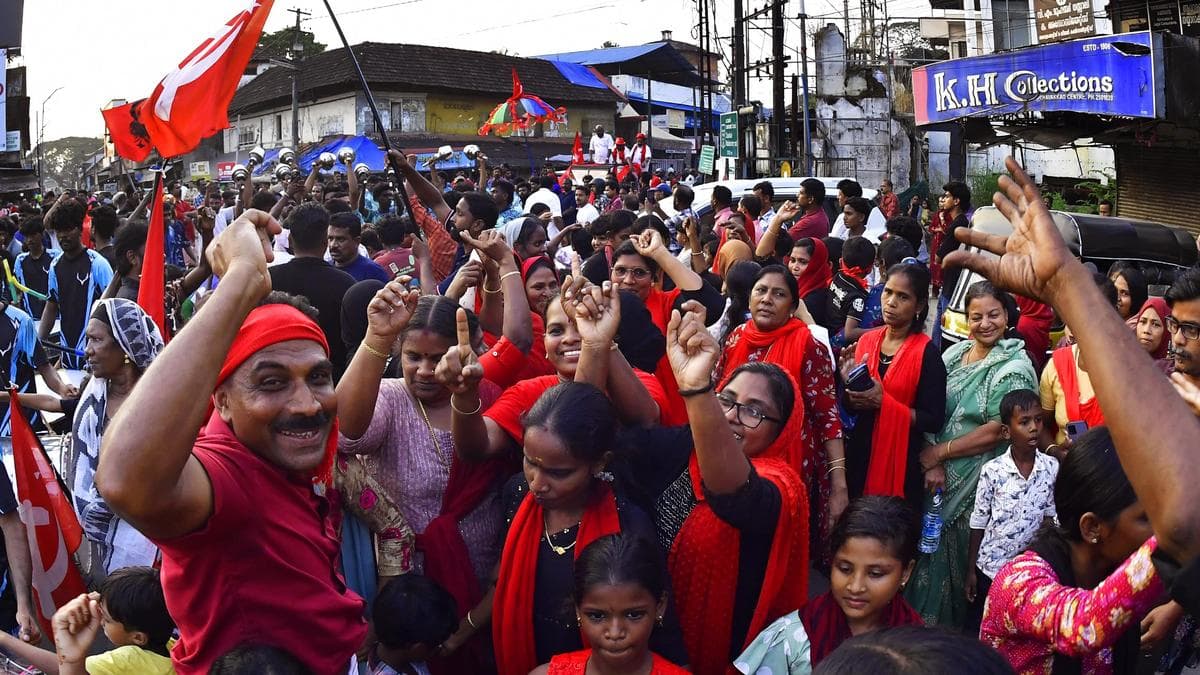
District panchayat verdicts serve as 'wake-up call' for parties ahead of Assembly polls, LDF and UDF share 7 each.
Summary
The recent district panchayat election verdicts are being interpreted as a 'wake-up call' for political parties, potentially indicating future trends for the upcoming Assembly polls in the state. While LDF and UDF each secured 7 district panchayats, experts caution against direct correlation, citing the 2010 local body polls where similar results did not reflect in subsequent Assembly elections. This analysis highlights the complex interplay between local and state-level political outcomes for competitive exam aspirants.
Key Points
- 1The recent verdicts pertain to district panchayats in a state.
- 2LDF and UDF each secured 7 district panchayats in the current results.
- 3The verdicts are being viewed as a 'wake-up call' for political parties.
- 4Experts reference the 2010 local body polls where district panchayat results did not reflect in subsequent Assembly elections.
- 5The outcomes are being analyzed for their potential indication of political winds ahead of upcoming Assembly polls.
In-Depth Analysis
The recent verdicts in district panchayat elections, which saw the Left Democratic Front (LDF) and United Democratic Front (UDF) each securing seven district panchayats in a prominent Indian state, serve as a pivotal moment for political analysis. While experts caution against a direct correlation with upcoming Assembly polls, these results are widely perceived as a 'wake-up call' for political parties, prompting them to reassess strategies and public sentiment. This scenario offers a rich ground for understanding the intricacies of India's multi-tiered democratic system and its implications for competitive exam aspirants.
**Background Context and What Happened:**
India's democratic framework is built on a three-tier system: the Union government, State governments, and Local Self-Governments (LSGs). The District Panchayats fall under the latter, representing the highest tier of rural local self-governance. These bodies are crucial for grassroots development and administration, managing local infrastructure, welfare schemes, and public services. The particular state in question, known for its vibrant political landscape dominated by the LDF and UDF coalitions, regularly witnesses intense competition in local body elections. The recent outcome, where both major fronts achieved an equal share of district panchayats, indicates a closely contested political environment and suggests a lack of overwhelming mandate for either side at the local level.
**Key Stakeholders Involved:**
Several key stakeholders are critically involved in this political dynamic. The **LDF** and **UDF** are the primary political coalitions, comprising various regional and national parties, whose electoral fortunes are directly impacted. Their respective leaderships, party cadres, and candidates at the local level are the immediate players. The **electorate**, comprising citizens eligible to vote in these local body elections, are the ultimate decision-makers, reflecting their satisfaction or dissatisfaction with current governance and future aspirations. **State Election Commissions** (SECs) play a crucial, independent role in conducting these elections fairly and transparently, as mandated by the Constitution. Finally, **political analysts and media** act as interpreters, dissecting results and offering insights into potential future trends, often shaping public discourse and party strategies.
**Why This Matters for India and Historical Context:**
These local election results hold profound significance for India's democratic health. They are a direct manifestation of **democratic decentralization**, a core principle enshrined by the **73rd Constitutional Amendment Act of 1992**. This landmark amendment, which added Part IX and the Eleventh Schedule to the Constitution, institutionalized Panchayati Raj Institutions (PRIs) across rural India. It mandated the establishment of Gram Panchayats, Intermediate Panchayats (Block/Taluka level), and District Panchayats, ensuring regular elections, reservation of seats for Scheduled Castes/Tribes and women (Article 243D), and the establishment of State Election Commissions (Article 243K) and State Finance Commissions (Article 243I). The objective was to empower local communities, foster grassroots leadership, and enable local self-governance in planning and implementing development programs.
Historically, local body elections have often been viewed as a litmus test for the mood of the electorate ahead of state Assembly or national parliamentary elections. However, as the article points out, this correlation is not always direct. The reference to the 2010 local body polls, where district panchayat results did not accurately predict the subsequent Assembly election outcome, serves as a crucial reminder. This phenomenon highlights the distinct dynamics at play in local versus state-level politics, where issues, candidate profiles, and voter priorities might differ significantly. Nevertheless, a strong performance in local bodies can provide a psychological boost, strengthen party organization at the grassroots, and offer valuable insights into local grievances and aspirations.
**Future Implications and Constitutional References:**
For the state in question, the equal split in district panchayats signals a highly competitive environment for the upcoming Assembly polls. Both LDF and UDF will need to recalibrate their strategies, address local issues more effectively, and potentially forge new alliances or consolidate existing ones. The results might lead to a greater focus on local development agendas in their state-level manifestos. From a broader Indian perspective, such outcomes reinforce the importance of strengthening PRIs, ensuring their fiscal autonomy (as envisioned by Article 243I for State Finance Commissions), and enhancing their administrative capacities. The effective functioning of these bodies is vital for achieving sustainable development goals and ensuring inclusive growth, directly impacting rural welfare and governance effectiveness across the nation.
In essence, these district panchayat results, while not a definitive predictor, serve as a vital indicator of political currents. They underscore the enduring relevance of the 73rd Constitutional Amendment Act in fostering grassroots democracy and remind political parties of the need for continuous engagement and responsiveness to local concerns, making them a critical topic for understanding Indian polity and governance.
Exam Tips
This topic falls under 'Indian Polity and Governance' in UPSC GS-II and State PSC syllabi. Focus on the constitutional provisions related to Panchayati Raj (Part IX, Articles 243-243O, 73rd Amendment Act, 1992), especially the mandated features and roles of State Election Commissions and State Finance Commissions.
Study the evolution of Panchayati Raj in India, from its historical roots (e.g., Lord Ripon's Resolution) to post-independence efforts (Balwant Rai Mehta Committee, Ashok Mehta Committee) leading up to the 73rd Amendment. Understand the challenges faced by PRIs (e.g., funding, functional autonomy, capacity building).
Expect questions on the significance of local self-governance for democratic decentralization, women's empowerment, and rural development. Analytical questions might ask about the correlation (or lack thereof) between local and state/national election results, requiring a nuanced understanding of political dynamics.
Be prepared for factual questions on the composition, powers, and functions of District Panchayats, Intermediate Panchayats, and Gram Panchayats. Also, know the specific constitutional articles associated with reservations, duration of bodies, and powers to impose taxes.
Compare and contrast the 73rd (rural) and 74th (urban) Constitutional Amendment Acts, noting their similarities and differences in structure, functions, and constitutional provisions. This integrated approach helps in comprehensive understanding.
Related Topics to Study
Full Article
The verdicts are believed to be indicative of the way the political wind is blowing in the State ahead of the Assembly polls. However, experts point to the case of 2010 local body polls, when a good showing in the district panchayats, did not exactly reflect in the subsequent Assembly election. LDF and UDF share 7 district panchayats this time.