



Relevant for Exams
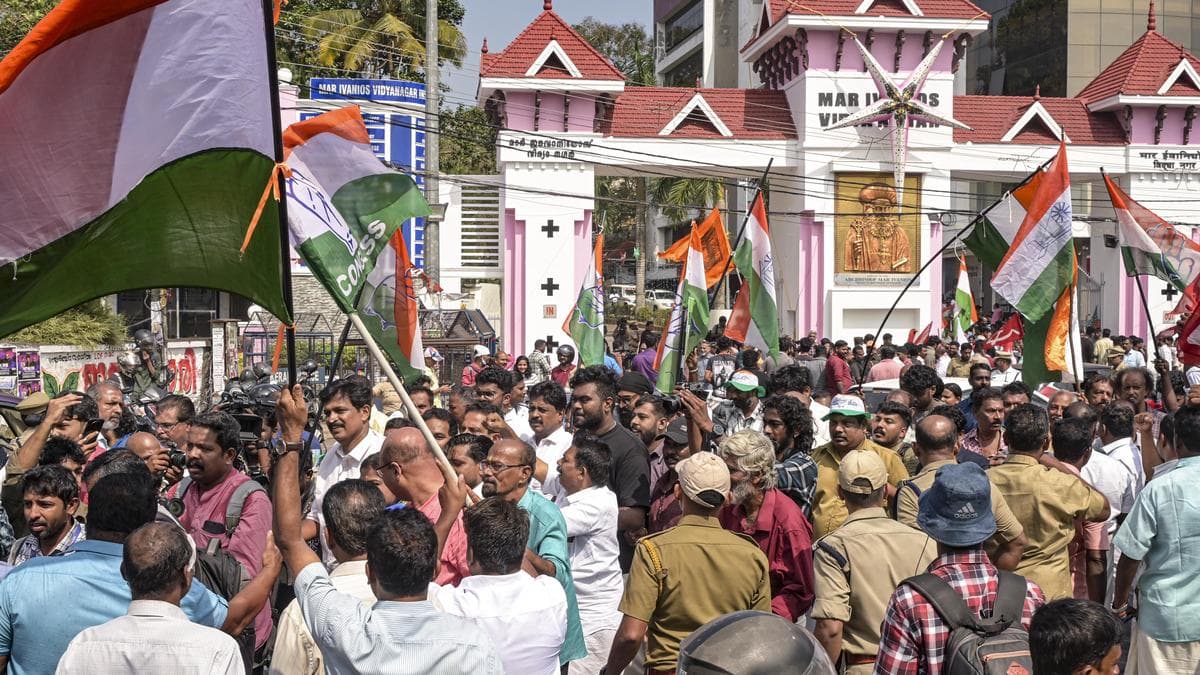
Anti-incumbency leads to Left's rout in Kerala local body polls, especially in UDF strongholds.
Summary
The Left Front faced a significant defeat in recent local body elections in Kerala, particularly in the districts of Kottayam, Idukki, Ernakulam, and Malappuram. This setback is attributed to anti-incumbency sentiment and urban voters turning away from the Left. For competitive exams, this highlights the dynamics of state-level politics and the significance of local governance outcomes in reflecting public mood.
Key Points
- 1The Left Front suffered a pronounced defeat in recent local body polls held in Kerala.
- 2The rout was particularly evident in four specific districts: Kottayam, Idukki, Ernakulam, and Malappuram.
- 3These mentioned districts are historically recognized as 'old citadels' of the United Democratic Front (UDF).
- 4The primary reason identified for the Left's poor performance was prevailing anti-incumbency sentiment.
- 5Urban voters specifically turned their back on the Left Front during these local body elections.
In-Depth Analysis
Kerala's political landscape is a fascinating study in India's vibrant democracy, often characterized by a strong bipolar contest between the Left Democratic Front (LDF) and the United Democratic Front (UDF). The recent local body election results, where the incumbent Left Front suffered a significant defeat, offer crucial insights into voter sentiment, the dynamics of anti-incumbency, and the critical role of local governance in India. This outcome is particularly pronounced in districts like Kottayam, Idukki, Ernakulam, and Malappuram, historically considered UDF bastions.
**Background Context and What Happened:**
Kerala has a unique political history, marked by a consistent alternation of power between the LDF and the UDF. This 'anti-incumbency' phenomenon has been a recurring theme, with voters often opting for a change after a single term. The LDF, led primarily by the Communist Party of India (Marxist) or CPI(M), came to power in the state in 2016 and had been in office for a significant period leading up to these local elections. Local body elections in India, encompassing Gram Panchayats, Block Panchayats, District Panchayats, Municipalities, and Municipal Corporations, are often seen as a crucial barometer of public mood ahead of state assembly elections. They reflect grassroots issues, local development, and the performance of local representatives. In these specific polls, the LDF's rout, especially in urban areas and traditional UDF strongholds, signals a strong wave of discontent against the ruling coalition.
**Key Stakeholders Involved:**
1. **Left Democratic Front (LDF):** As the incumbent ruling coalition in Kerala, their performance in these local body polls is a direct reflection of public perception of their governance at both state and local levels. The CPI(M) is the dominant party, alongside other left-wing parties like the CPI. They faced scrutiny over various state-level issues and local governance effectiveness.
2. **United Democratic Front (UDF):** The primary opposition coalition, led by the Indian National Congress, saw these results as a significant boost. The UDF comprises other parties like the Indian Union Muslim League (IUML) and various factions of the Kerala Congress. Their ability to capitalize on anti-incumbency sentiment and mobilize voters, particularly in their traditional strongholds and urban centres, was key to their success.
3. **Voters:** The electorate, especially urban voters, played a decisive role. Their 'turning back' on the Left indicates a shift in priorities or dissatisfaction with the LDF's policies and performance. Local issues such as infrastructure, waste management, public services, and the implementation of welfare schemes heavily influence voter behaviour in these elections.
4. **State Election Commission:** This independent constitutional body is responsible for the superintendence, direction, and control of the preparation of electoral rolls and the conduct of all elections to the Panchayats and the Municipalities in the state, as per **Article 243K** and **Article 243ZA** of the Indian Constitution, respectively.
**Why This Matters for India:**
This outcome holds significant implications for India's democratic fabric and federal structure. Firstly, it underscores the vitality of local self-governance, enshrined by the **73rd and 74th Constitutional Amendment Acts of 1992**. These amendments mandated the establishment of Panchayats and Municipalities, respectively, as institutions of self-government, devolving powers and responsibilities for economic development and social justice. The results reaffirm that these grassroots bodies are crucial platforms for public expression and accountability.
Secondly, state-level political dynamics, as seen in Kerala, contribute to the broader national narrative. While the Left parties have a limited national presence, their strength in Kerala is significant. A setback here could further impact their overall influence. The rise and fall of regional political fortunes often reflect socio-economic changes, policy impacts, and the effectiveness of governance, themes relevant across India.
Thirdly, the 'anti-incumbency' factor is a pervasive feature of Indian elections. This Kerala example demonstrates how even strong, well-organized parties can face public dissatisfaction. It serves as a reminder to all political parties across the country about the importance of good governance, addressing public grievances, and maintaining public trust.
**Historical Context and Future Implications:**
Kerala's political history is replete with instances of power alternating between the LDF and UDF. This pattern highlights a politically aware electorate that frequently holds its elected representatives accountable. The current defeat of the LDF is not an isolated event but rather a continuation of this historical trend. Historically, the Left has championed social welfare and public distribution systems, which have been hallmarks of Kerala's development model.
Looking ahead, these local body results will undoubtedly influence the strategy for the upcoming state assembly elections. For the LDF, it necessitates a thorough introspection, an evaluation of their governance model, and a recalibration of their electoral strategy to counter the perceived anti-incumbency wave. They will need to address the concerns of urban voters and reassure their traditional support base. For the UDF, this victory provides significant momentum and a blueprint for their assembly election campaign, allowing them to consolidate their gains and project themselves as a viable alternative.
Furthermore, the results could impact local development initiatives, particularly those tied to central government schemes or state-level policies. The effective implementation of schemes related to rural development, urban planning, sanitation, and education often hinges on the cooperation and efficiency of local bodies. The political alignment between state and local governments can either facilitate or hinder the flow of funds and execution of projects, impacting the lives of ordinary citizens.
In essence, the Kerala local body election results are more than just a regional political event; they are a microcosm of India's democratic challenges and triumphs, reflecting the continuous evolution of voter expectations and the enduring significance of local governance in shaping the nation's future.
Exam Tips
This topic falls under the 'Indian Polity and Governance' section of the UPSC Civil Services Exam (General Studies Paper II) and State PSC exams. Focus on the structure, powers, and functions of local self-government institutions.
Study the 73rd and 74th Constitutional Amendment Acts, 1992, in detail. Understand the mandatory and voluntary provisions, the role of State Election Commissions (Article 243K, 243ZA) and State Finance Commissions (Article 243I, 243Y), and the types of local bodies.
Be prepared for questions on the significance of local body elections, the concept of anti-incumbency, the role of regional parties, and challenges faced by local self-governments (e.g., financial autonomy, capacity building). MCQs might test specific articles, while descriptive questions could ask for an analysis of their impact on decentralization.
Relate the outcomes to broader themes like federalism, democratic decentralization, and political accountability. Analyze how local results can act as a precursor to state assembly elections and reflect the efficacy of state government policies at the grassroots level.
Related Topics to Study
Full Article
The rout of the Left is more pronounced n Kottayam, Idukki, Ernakulam and Malappuram districts, which are old citadels of the UDF. Urban voters have turned their back on the Left