
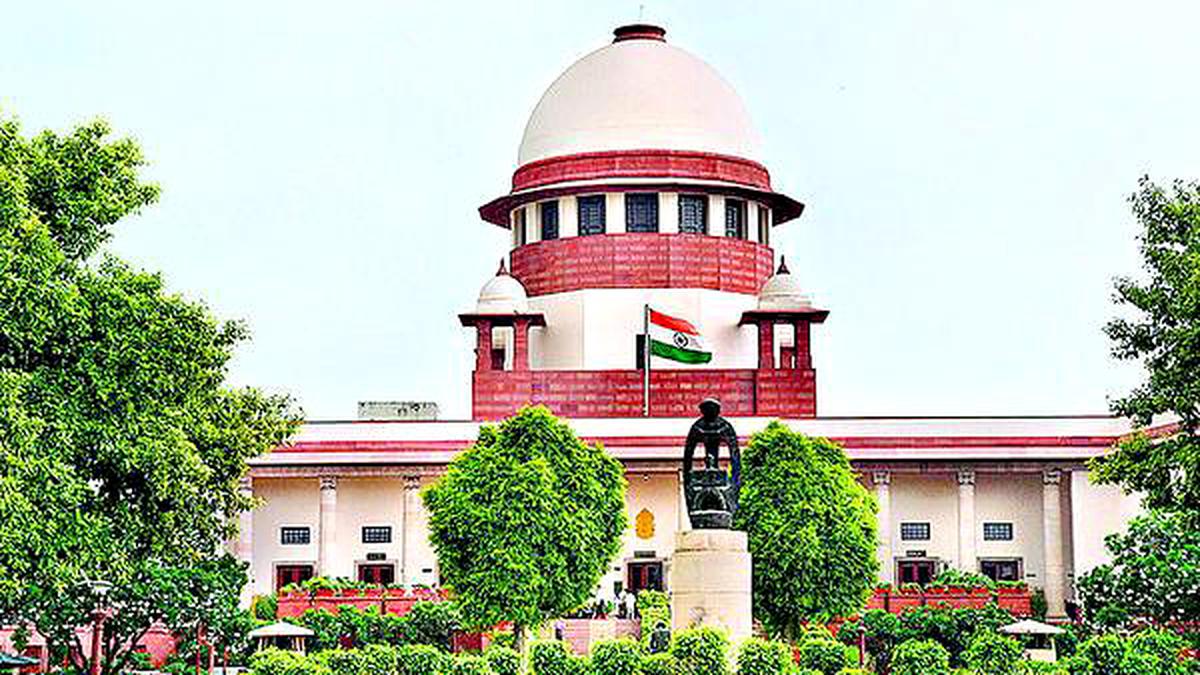
Supreme Court bench headed by Justice Ujjal Bhuyan heard the matter on IPS deputation in CAPFs
GK and monthly revision
Supreme Court seeks explanation from government on IPS deputation in CAPFs
The Supreme Court, led by Justice Ujjal Bhuyan, has sought an explanation from the Union Home Ministry regarding the continued deputation of IPS officers in Central Armed Police Forces (CAPFs), stating that cadre officers are "completely stifled". The Home Ministry responded that it has initiated cadre reviews across all CAPFs and is implementing the Court's earlier directions. This issue is significant for exams as it touches on Centre-state relations, police reforms, cadre management, and judicial oversight of executive appointments — topics frequently tested in polity and governance sections.
Revision structure
Monthly events and exam calendar context
Static GK and one-liner notes
Quiz and mock-test revision path
Key points
Exam-ready takeaways
Justice Bhuyan observed that CAPF cadre officers are "completely stifled" due to IPS deputation
Union Home Ministry informed SC it has initiated cadre reviews across all CAPFs
Home Ministry stated it is implementing Supreme Court's earlier directions on the issue
The case relates to long-standing demand for cadre parity and promotion avenues for CAPF officers
Detailed analysis
Full exam-oriented breakdown
The Supreme Court's recent intervention in the long-standing issue of IPS deputation in Central Armed Police Forces (CAPFs) marks a critical juncture in India's internal security governance. Justice Ujjal Bhuyan's sharp observation that CAPF cadre officers are "completely stifled" underscores a structural anomaly that has persisted for decades. To understand the gravity, we must trace the history: since the 1960s, key leadership positions in CAPFs — such as the Border Security Force (BSF), Central Reserve Police Force (CRPF), Indo-Tibetan Border Police (ITBP), and Sashastra Seema Bal (SSB) — have been predominantly filled by Indian Police Service (IPS) officers on deputation from state cadres. This practice, rooted in the colonial-era Indian Police (IP) legacy, was initially justified by the lack of a dedicated CAPF officer pool. However, over time, it created a dual-track system where direct-recruit CAPF officers (Group A, gazetted) found their promotion avenues blocked at the DIG/IG levels, leading to stagnation, low morale, and talent attrition. The key stakeholders are the Union Ministry of Home Affairs (MHA), which controls CAPFs under Article 355 (duty of the Union to protect states against external aggression and internal disturbance) and Entry 1 of the Union List (defence of India, including armed forces), the IPS cadre managed by the Department of Personnel and Training (DoPT), and the CAPF cadre officers themselves. The judiciary, particularly the Supreme Court, has emerged as a crucial arbiter — earlier in 2018, in the *Prakash Singh vs Union of India* follow-up and subsequent contempt petitions, the Court had directed the MHA to ensure cadre review and reduce IPS deputation. The current hearing suggests those directions remain unimplemented. Constitutionally, this touches on Article 309 (recruitment and conditions of service of persons serving the Union), Article 310 (tenure of office of persons serving the Union), and Article 311 (dismissal, removal or reduction in rank). The CAPF Acts (e.g., BSF Act, 1968; CRPF Act, 1949) provide for their own officer cadres, yet the MHA has consistently bypassed them by appointing IPS officers to top posts — DG, ADG, IG — violating the spirit of cadre autonomy. This also raises federalism concerns: IPS officers belong to state cadres (Article 312), and their prolonged central deputation weakens state policing, a State List subject (Entry 2, List II). The significance extends beyond administrative fairness. CAPFs are India's first line of internal security — guarding borders (BSF, ITBP, SSB), managing Naxal-affected areas (CRPF), and providing VIP security. Leadership continuity, institutional memory, and domain expertise are vital. Stifling cadre officers undermines operational effectiveness. Economically, the cost of maintaining a parallel deputation system is high; socially, it breeds resentment among 10 lakh+ CAPF personnel. Politically, it reflects the Centre's reluctance to cede control over paramilitary leadership. Broader themes include police reforms (Model Police Act, 2006; Supreme Court's 2006 *Prakash Singh* directives), cadre management in All India Services, and judicial enforcement of executive accountability. The MHA's claim of initiating "cadre reviews across all CAPFs" is a step forward, but without a time-bound roadmap to phase out IPS deputation — especially at DG/ADG levels — it risks being mere compliance theatre. Future implications: If the Court enforces a deadline, we may see the first CAPF-cadre Director Generals in history — a transformative shift. This could set a precedent for other central organisations (like CBI, IB, NIA) where IPS dominance persists. For aspirants, this case is a live example of judicial-executive tension, cadre politics, and the unfinished agenda of police reform — essential for GS-II (Governance, Polity), GS-III (Internal Security), and Essay papers.
How to study
Turn news into exam marks
Revise monthly events by exam family instead of reading random updates.
Pair one-liners with mock tests so mistakes become the next revision list.
Keep state job pages, calendar pages and GK packs connected in one path.