
India recorded the highest historical casualties from Glacial Lake Outburst Floods (GLOFs) in the Hindu Kush Himalaya region according to a global study
GK and monthly revision
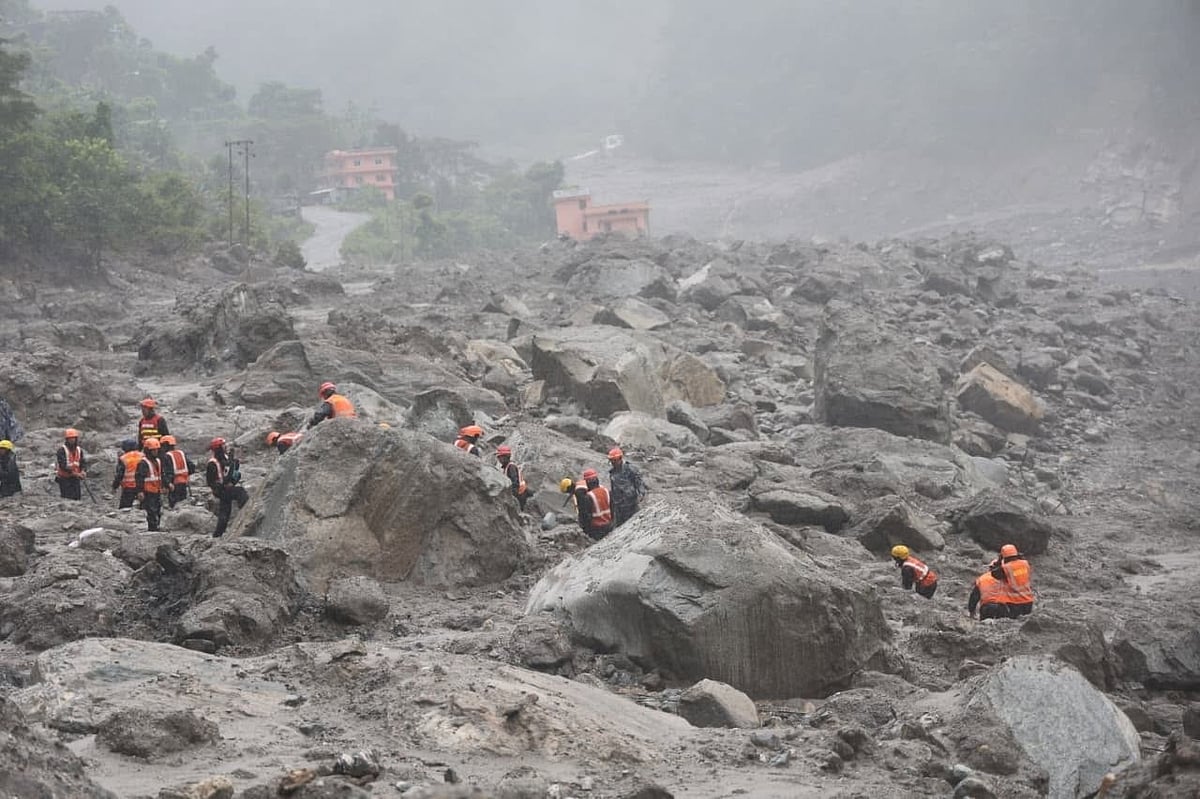
UN expert explores seismic linkage to Nepal disaster, warns of cascading effects and holds climate change responsible
A UN expert has linked seismic activity to Nepal's recent disaster while warning of cascading effects, attributing the crisis to climate change. A global study reveals India has historically suffered the maximum casualties from Glacial Lake Outburst Floods (GLOFs) in the Hindu Kush Himalaya region. This highlights the growing climate-induced disaster risks in the Himalayan ecosystem and underscores India's vulnerability to glacial hazards, making it critical for environment, disaster management, and geography sections in competitive exams.
Revision structure
Monthly events and exam calendar context
Static GK and one-liner notes
Quiz and mock-test revision path
Key points
Exam-ready takeaways
UN expert established linkage between seismic activity and Nepal's recent disaster, warning of cascading multi-hazard effects
Climate change identified as primary driver increasing frequency and intensity of glacial hazards in the Himalayas
Hindu Kush Himalaya region spans 8 countries including India, Nepal, Bhutan, China, Pakistan, Afghanistan, Bangladesh, Myanmar
GLOFs pose transboundary risks requiring regional cooperation under frameworks like ICIMOD and SAARC disaster management mechanisms
Detailed analysis
Full exam-oriented breakdown
The Hindu Kush Himalaya (HKH) region, often called the 'Third Pole' and 'Water Tower of Asia,' is facing an unprecedented convergence of geological and climatic threats. A recent global study has brought into sharp focus India's disproportionate vulnerability, revealing that the country has historically recorded the maximum casualties from Glacial Lake Outburst Floods (GLOFs) within this vast mountain system spanning eight nations — India, Nepal, Bhutan, China, Pakistan, Afghanistan, Bangladesh, and Myanmar. This finding, coupled with a UN expert's warning linking seismic activity to Nepal's recent disasters and predicting cascading multi-hazard effects, paints a grim picture of compounding risks driven primarily by anthropogenic climate change. The background to this crisis lies in the rapid warming of the HKH region, which is occurring at a rate significantly higher than the global average. According to the International Centre for Integrated Mountain Development (ICIMOD), the region could lose up to two-thirds of its glaciers by 2100 even if global warming is limited to 1.5°C. This accelerated glacial retreat leads to the formation and expansion of moraine-dammed glacial lakes. When these unstable natural dams breach — triggered by intense rainfall, seismic activity, or ice/rock avalanches — they unleash catastrophic GLOFs. The 2013 Kedarnath disaster in Uttarakhand, triggered by a GLOF from Chorabari Lake combined with extreme rainfall, claimed over 5,000 lives and remains a stark reminder of this hazard. Similarly, the 2021 Chamoli flash flood, likely caused by a rock-ice avalanche impacting a glacial lake, killed over 200 people and damaged two hydropower projects. Key stakeholders in managing this crisis are multi-layered. At the national level, the National Disaster Management Authority (NDMA), constituted under the Disaster Management Act, 2005, is the apex body. The Act, enacted under Entry 23 (Social security and social insurance) and Entry 29 (Prevention of the extension from one State to another of infectious or contagious diseases or pests affecting men, animals or plants) of the Concurrent List (List III), Schedule VII of the Constitution, provides the legal framework for disaster management. State Disaster Management Authorities (SDMAs) and District Disaster Management Authorities (DDMAs) operationalize this at sub-national levels. Scientific institutions like the Geological Survey of India (GSI), Wadia Institute of Himalayan Geology, and the National Centre for Polar and Ocean Research (NCPOR) play critical roles in monitoring and research. Internationally, ICIMOD serves as the key regional knowledge hub, while the SAARC Disaster Management Centre (SDMC) and the Sendai Framework for Disaster Risk Reduction (2015-2030) provide cooperation frameworks. For India, the significance is profound across economic, political, and social dimensions. Economically, the Himalayan states host critical hydropower infrastructure — India aims to add 30,000 MW of hydro capacity by 2030 — and tourism revenue. GLOFs threaten these assets and the water security of millions downstream dependent on the Indus, Ganga, and Brahmaputra basins. Politically, the transboundary nature of Himalayan rivers necessitates hydro-diplomacy with China, Nepal, and Bhutan; data sharing on glacial lakes and early warning systems becomes a strategic imperative. Socially, marginalized mountain communities, often Scheduled Tribes under Article 342, bear the brunt of displacement and livelihood loss. The Forest (Conservation) Act, 1980, and the Environment (Protection) Act, 1986, regulate developmental activities in these fragile ecosystems, while the recent Forest (Conservation) Amendment Act, 2023, has raised concerns about dilution of protections in border areas. Connecting to broader themes, this crisis epitomizes the climate adaptation-governance nexus. It demands integration of disaster risk reduction (DRR) into development planning — a core tenet of the Sendai Framework and India's National Disaster Management Plan (2019). It highlights the tension between infrastructure push (hydropower, roads, border infrastructure under the Vibrant Villages Programme) and ecological carrying capacity. Internationally, it underscores the need for a binding Himalayan River Basin Treaty and operationalizing the 'Loss and Damage' fund agreed at COP27. Future implications are stark. Without urgent mitigation and adaptation, GLOF frequency could increase 3-4 fold by 2100. India must accelerate the implementation of the NDMA's 2020 Guidelines on GLOF risk management, expand the Glacial Lake Monitoring Network (currently covering 477 lakes in Indian Himalaya), and invest in community-based early warning systems. The recently approved National Mission on Himalayan Studies (NMHS) Phase-II and the Himalayan Climate Change Adaptation Programme need scaling up. Ultimately, safeguarding the Himalayas is not just an environmental imperative but a national security and developmental necessity for India.
How to study
Turn news into exam marks
Revise monthly events by exam family instead of reading random updates.
Pair one-liners with mock tests so mistakes become the next revision list.
Keep state job pages, calendar pages and GK packs connected in one path.