
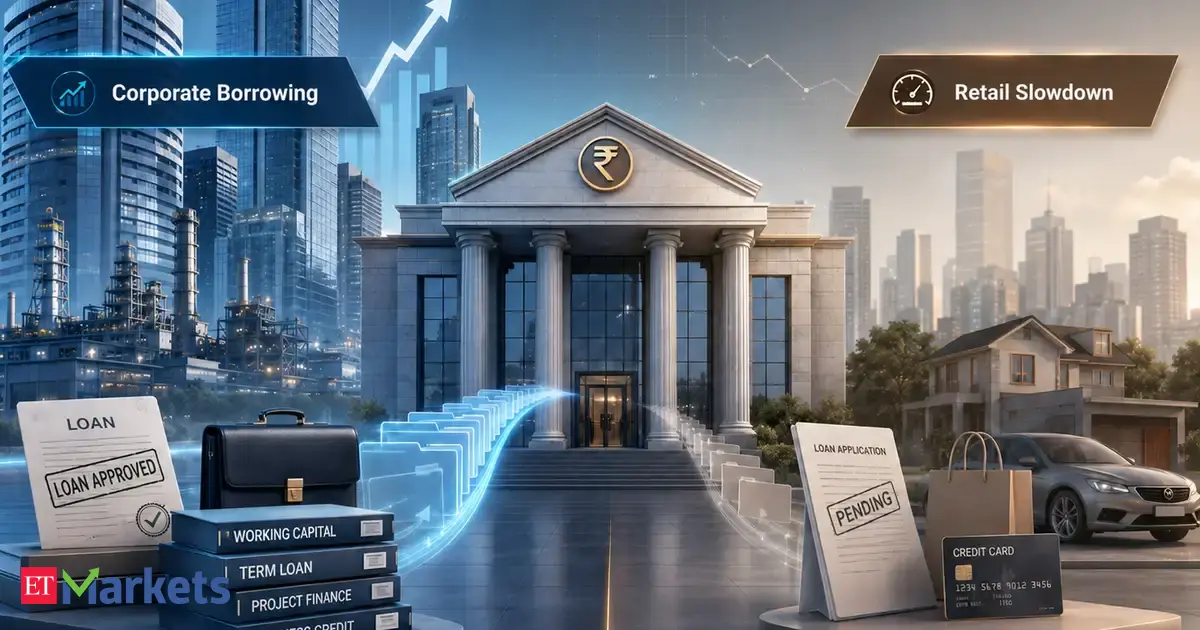
Corporate and SME lending is the primary driver of loan growth for India's largest private banks in current fiscal
GK and monthly revision
India Inc is returning to banks for money, but retail borrowers aren’t keeping pace
India's leading private banks report a structural shift in credit demand where corporate and SME lending is driving loan growth while retail borrowing remains sluggish. Stronger working capital needs, refinancing activities, and business banking expansion are boosting advances, but slower consumer credit growth and declining CASA ratios are pressuring banks' funding mix and net interest margins. This trend reflects improved corporate balance sheets and cautious consumer sentiment amid high interest rates. For competitive exams, this highlights evolving banking sector dynamics, credit deployment patterns, and monetary policy transmission challenges.
Revision structure
Monthly events and exam calendar context
Static GK and one-liner notes
Quiz and mock-test revision path
Key points
Exam-ready takeaways
Retail borrowing growth remains subdued due to high interest rates and cautious consumer sentiment
Stronger working capital demand and refinancing activities are boosting corporate credit offtake
Weaker CASA (Current Account Savings Account) ratios are pressuring banks' funding costs and net interest margins
Shift indicates improved corporate balance sheets but incomplete monetary policy transmission to retail segment
Detailed analysis
Full exam-oriented breakdown
India's banking sector is undergoing a fascinating structural transformation that every competitive exam aspirant must understand. The current shift — where corporate and SME lending drives credit growth while retail borrowing stagnates — marks a significant departure from the post-2014 trend where retail loans (home, auto, personal) were the primary growth engine for private banks like HDFC Bank, ICICI Bank, and Axis Bank. This reversal didn't happen overnight. After the 2008 global financial crisis, Indian banks aggressively expanded retail lending as corporate balance sheets remained stressed due to the "twin balance sheet problem" — overleveraged companies and bad-loan-burdened banks — identified in the Economic Survey 2017-18. The Insolvency and Bankruptcy Code (IBC), 2016, and subsequent RBI frameworks like the Prudential Framework for Resolution of Stressed Assets (2019) gradually cleaned up corporate books. By FY2023-24, gross NPAs of scheduled commercial banks fell to a decadal low of 2.8% (RBI Financial Stability Report, Dec 2024), restoring corporate creditworthiness. Now, with healthier balance sheets, companies are returning to banks for working capital and refinancing. The RBI's October 2024 Monetary Policy Report noted a 14.2% year-on-year growth in non-food bank credit to industry (as of September 2024), led by infrastructure, chemicals, and MSMEs. The Emergency Credit Line Guarantee Scheme (ECLGS), extended till March 2024, provided ₹3.6 lakh crore in guaranteed credit to MSMEs, further boosting SME lending. Meanwhile, retail credit growth has slowed to 16-17% from peak levels of 20%+, as the RBI's cumulative 250 basis points repo rate hike (May 2022–February 2023) raised EMIs and dampened consumer sentiment. High interest rates also triggered a shift from low-cost CASA deposits to term deposits — CASA ratio for major private banks dropped 200-300 bps YoY — squeezing net interest margins (NIMs). Key stakeholders include the RBI (monetary policy transmission), banks (asset-liability management), corporates (investment cycle revival), and households (consumption demand). The Finance Ministry's capital expenditure push (₹11.1 lakh crore in FY2025 Budget) complements private capex recovery. Constitutionally, Article 265 (taxation only by law) and Article 110 (Money Bills) underpin fiscal measures supporting credit flow, while the RBI Act, 1934 (Section 45JA) empowers the central bank to regulate credit. The Banking Regulation Act, 1949 governs bank operations. This shift has profound implications. A sustained corporate credit uptick signals private investment revival — critical for India's $5 trillion economy goal and Viksit Bharat@2047 vision. However, weak retail credit and CASA erosion reflect incomplete monetary transmission and household financial stress, potentially constraining consumption-led growth. For exams, track RBI's February 2025 policy stance, quarterly banking data, and the evolving deposit-insurance framework (DICGC Act amendments). Future implications include possible RBI rate cuts in 2025 if inflation aligns with the 4% target, which could rebalance credit flows. Aspirants should link this to topics like financial inclusion, monetary policy framework, and the role of NBFCs in credit intermediation.
How to study
Turn news into exam marks
Revise monthly events by exam family instead of reading random updates.
Pair one-liners with mock tests so mistakes become the next revision list.
Keep state job pages, calendar pages and GK packs connected in one path.