
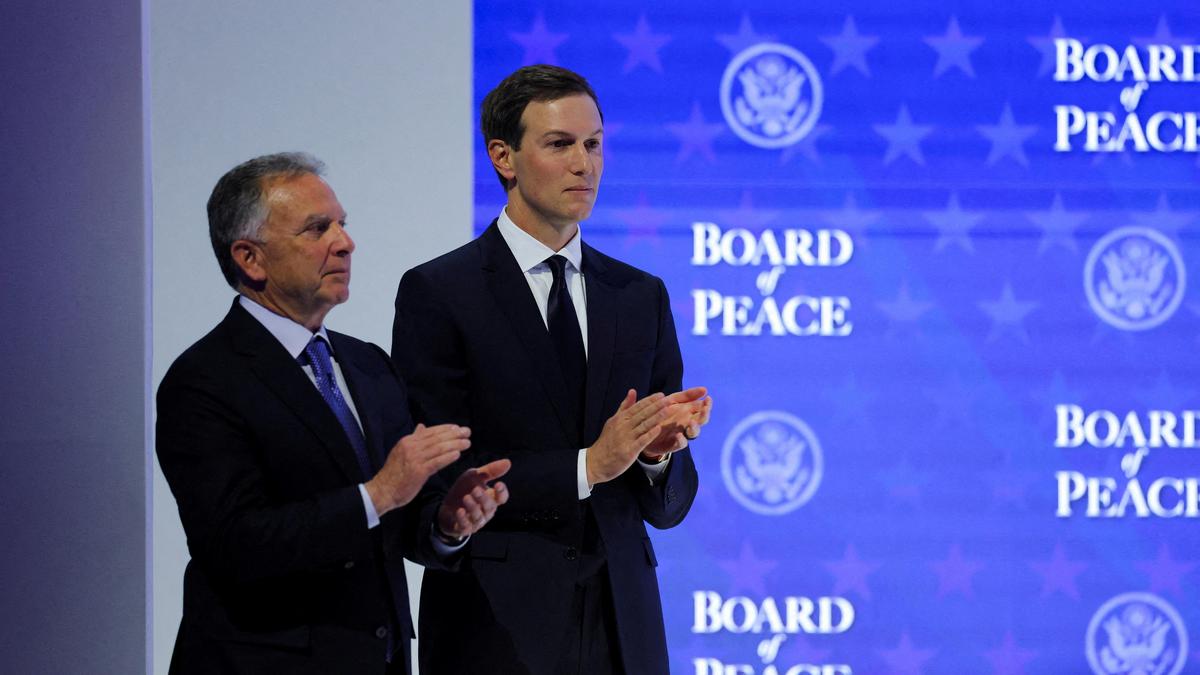
U.S. envoys Jared Kushner and Avi Witkoff were in Israel for talks.
GK and monthly revision
U.S. envoys Kushner, Witkoff in Israel for talks on Gaza: U.S. official
U.S. envoys Jared Kushner and Avi Witkoff visited Israel for crucial talks focused on the Gaza conflict. A significant aspect of these discussions involved addressing the return of the remains of the last Israeli hostage held in Gaza. This diplomatic engagement underscores ongoing international efforts to manage the complex Israel-Hamas conflict, making it a relevant topic for competitive exam preparation in international relations and current affairs.
Revision structure
Monthly events and exam calendar context
Static GK and one-liner notes
Quiz and mock-test revision path
Key points
Exam-ready takeaways
The primary focus of their discussions was the ongoing situation in Gaza.
A specific agenda item for the talks was the return of the remains of the last Israeli hostage held in Gaza.
The visit signifies ongoing U.S. diplomatic engagement in the Israel-Gaza conflict.
The news of the talks was reported by Israeli media, citing a U.S. official.
Detailed analysis
Full exam-oriented breakdown
The recent visit of U.S. envoys Jared Kushner and Avi Witkoff to Israel for discussions on the Gaza conflict, with a specific focus on the return of the remains of the last Israeli hostage, underscores the persistent international efforts to de-escalate the volatile situation in the Middle East. This diplomatic engagement highlights the complex interplay of humanitarian concerns, national security interests, and geopolitical dynamics that define the protracted Israel-Hamas conflict. **Background Context and What Happened:** The current intense phase of the Israel-Hamas conflict escalated dramatically following the unprecedented attacks by Hamas on Israeli territory on October 7, 2023. These attacks resulted in the deaths of approximately 1,200 Israelis and the abduction of over 250 hostages. In response, Israel launched a large-scale military operation in the Gaza Strip, aiming to dismantle Hamas's military capabilities and secure the release of all hostages. This operation has led to a severe humanitarian crisis in Gaza, with widespread displacement, destruction of infrastructure, and a catastrophic loss of Palestinian lives, estimated to be over 35,000 by Gaza health officials. International pressure has mounted on all parties to agree to a ceasefire and facilitate humanitarian aid. The U.S., a staunch ally of Israel, has been actively involved in diplomatic initiatives, often mediating between Israel and regional players like Egypt and Qatar, who have channels to Hamas. The visit by Kushner and Witkoff is part of these ongoing efforts, signaling a continued focus not just on a broader ceasefire but also on the specific, deeply sensitive issue of retrieving all hostages, alive or deceased. **Key Stakeholders Involved:** * **United States:** As Israel's primary strategic ally, the U.S. plays a critical role in mediating the conflict. Its interests include regional stability, prevention of a wider conflict, and ensuring Israel's security. The U.S. also faces domestic pressure to address the humanitarian crisis in Gaza. * **Israel:** Driven by national security imperatives and a profound societal trauma from the October 7th attacks, Israel's primary objectives are the elimination of Hamas as a military and governing force, and the return of all hostages. The issue of the 'last hostage' holds immense emotional and political significance. * **Hamas:** The de facto governing authority in Gaza, Hamas holds the remaining hostages (or their remains) as leverage in negotiations. Its stated goals include resistance against Israeli occupation and demanding concessions, such as the release of Palestinian prisoners. * **Palestinians in Gaza:** The civilian population of Gaza is the primary victim of the conflict, facing immense humanitarian challenges. Their stake is survival, access to aid, and a future free from conflict and blockade. * **Regional Mediators (e.g., Egypt, Qatar):** These countries often facilitate indirect talks between Israel and Hamas, leveraging their diplomatic channels and influence to broker deals, particularly concerning hostage releases and ceasefires. **Why This Matters for India:** The Israel-Gaza conflict has significant implications for India across several fronts. Economically, instability in the Middle East can disrupt global oil supplies and drive up prices, directly impacting India's energy security given its heavy reliance on oil imports. Disruption to trade routes, particularly the proposed India-Middle East-Europe Economic Corridor (IMEC), could also have adverse effects on India's economic ambitions. Geopolitically, India maintains a delicate balancing act, historically supporting the Palestinian cause while simultaneously fostering strong strategic and economic ties with Israel. This conflict tests India's non-aligned principles and its ability to navigate complex international relations. The safety and well-being of the Indian diaspora in the Gulf region, many of whom could be affected by regional instability, is also a concern. India has consistently called for a two-state solution and has provided humanitarian aid to Palestine, reflecting its commitment to international peace and humanitarian principles. **Historical Context and Broader Themes:** The Israel-Palestine conflict is one of the longest-running geopolitical disputes, rooted in historical claims to land, religious significance, and post-colonial nation-building. Key milestones include the 1948 Arab-Israeli War, the 1967 Six-Day War, and various peace attempts like the Oslo Accords (1993, 1995) which aimed for a two-state solution but ultimately failed to achieve lasting peace. The current conflict is a continuation of this cycle, marked by cycles of violence and failed negotiations. It highlights broader themes of self-determination, refugee rights, international law, and the challenges of achieving peace in deeply entrenched conflicts. **Future Implications:** The immediate future hinges on the prospects of a sustained ceasefire and a comprehensive agreement for hostage release and prisoner exchange. Beyond that, the conflict raises critical questions about the governance of Gaza post-Hamas, humanitarian reconstruction efforts, and the long-term viability of a two-state solution. The U.S. role will be crucial in shaping these outcomes. For India, the implications include adapting its foreign policy to a changing West Asia, securing its economic interests, and continuing to advocate for a peaceful resolution based on international law and humanitarian principles. **Related Constitutional Articles, Acts, or Policies:** While this is an international event, India's response is guided by its constitutional principles and foreign policy doctrines. **Article 51 of the Indian Constitution**, a Directive Principle of State Policy, mandates that the State shall endeavor to promote international peace and security, maintain just and honourable relations between nations, foster respect for international law and treaty obligations, and encourage settlement of international disputes by arbitration. This article underpins India's consistent call for a peaceful resolution to the Israel-Palestine conflict and its advocacy for international law. India's foreign policy also includes its 'Look West' or 'Connect West' strategy, emphasizing engagement with West Asian countries for economic, strategic, and diaspora-related reasons. India's humanitarian aid to Gaza aligns with its broader policy of extending assistance to nations in distress.
How to study
Turn news into exam marks
Revise monthly events by exam family instead of reading random updates.
Pair one-liners with mock tests so mistakes become the next revision list.
Keep state job pages, calendar pages and GK packs connected in one path.